Government responses to the Great Depression under President Hoover
One of the two major American political parties. Republicans tend to hold a more conservative viewpoint on politics and society. presidents had been in charge of the USA since 1921. Their policies of not interfering in business had helped the US economy to grow. However, these policies did not help Republican president Herbert Hoover, who had only become president at the beginning of 1929, to deal with the problems of the Great Depression.
Hoover’s actions
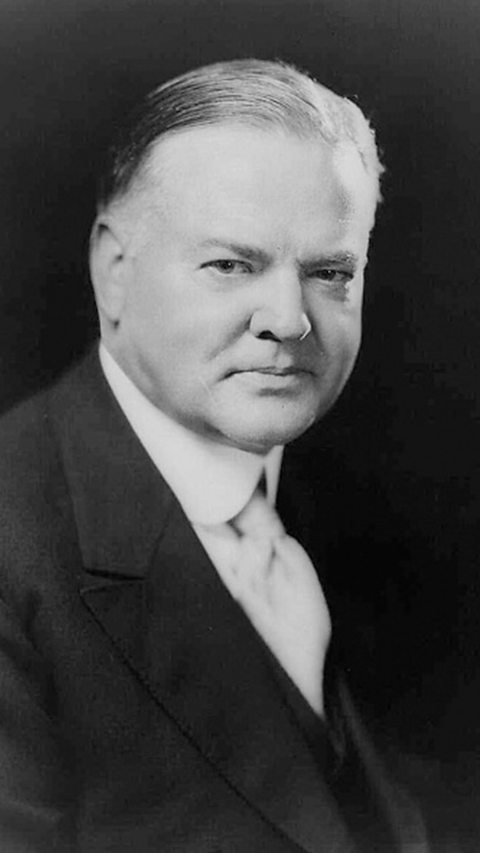
Herbert Hoover had become president in 1929 after promising to bring prosperity to everyone in America with the slogan “a chicken for every pot”. However, Hoover thought that it was the job of charities to look after the poor, not the job of the government. He also followed the policy of When a government doesn't believe in interfering in the lives of individuals and businesses. For the Republicans, liberty or freedom to live your life and run your business was one of the most important roles of government. which said that the government should not interfere in what businesses were doing. He also believed in Personal liberty and free competition, and the idea that people should be self-reliant. which was the idea that people should sort out their own problems. Hoover himself had become a millionaire by working as a mining engineer and business man before becoming president.
No US government ever before had to deal with an economic problem as big as the Great Depression. To begin with, Hoover’s policies were not very effective. Eventually, Hoover did try to take actions he thought would help people. However, very little of what he tried had any effect before the 1932 presidential election.
Tax cuts
In October 1929, Hoover asked The legislative body of the US government, made up of the Senate and the House of Representatives. for a $160 million cut in income taxes. He believed that lower taxes would help struggling businesses to make more money. However, this left the US government with less money to use to deal with the crisis. In December 1930, Hoover reversed this tax cut. The 1932 Revenue Act raised taxes for everyone, increasing the top level of income tax from 25 per cent to 63 per cent.
Tariffs
Hoover introduced the 1930 Hawley-Smoot Tariff Act, which increased A tax or charge placed on imported or exported goods and services. by 50 per cent on imported manufactured items. The act aimed to help industry sell more home-produced goods by making foreign goods more expensive. However, foreign countries retaliated by taxing American goods, so trade fell even further.
Banking
Hoover realised that he needed to give financial support to banks and other institutions so that people could access money and begin spending again.
The Reconstruction Finance Corporation Act was passed and signed into law on 22 January 1932, creating the Reconstruction Finance Corporation (RFC). The RFC allowed banks to provide $2 billion of government money in emergency loans to help struggling banks and Bought protection against unfortunate events that may cost money, eg car insurance is paid so that damage is paid for in the event of an accident. companies, as well as businesses and railroads that were in danger of going A legal status where a person or organisation is ruled to be unable to pay their debts. By the time of the 1932 presidential election, the RFC had started to make a difference. It was an idea that was continued by President Franklin D Roosevelt’s The name of the policies put in place from 1933 to 1945 under the Democratic Party President Franklin Roosevelt. His plan intended to solve the problems caused by the Great Depression. It provided money for public works programmes such as the construction of the Hoover Dam, between Arizona and Nevada, which was built between 1931 and 1936.
The Federal Home Loan Bank Act, passed in July 1932, set up 12 banks across the USA. These provided loans to enable construction companies to build houses and provided A mortgage is a type of loan. It is usually a large amount of money used to pay for a property. for people who wanted to buy houses.
Public works
Hoover set up the President’s Emergency Committee for Employment (PECE) in October 1930. This aimed to support state programmes to assist the unemployed and help businesses to employ more people. However, as Hoover was reluctant to raise taxes to fund this body, it lacked effectiveness. The PECE was replaced in 1931 with the President’s Organization on Unemployment Relief (POUR), which helped charities to raise more money to help the poor. However, this was nowhere near enough to meet the increasing demand for their services.
Laissez faire
Despite some actions to aid the victims of the Great Depression, Hoover strongly retained the Republican belief in laissez faire. He warned of the destruction of individual responsibility by providing too much relief. His beliefs were reflected in his decision to block the Garner-Wagner Relief A proposed new law. When a bill is approved by Congress and the president, it becomes an act and is now the law. in July 1932. This would have given Congress an additional $2.1 billion dollars to provide food for the unemployed and create new jobs.
