Further effects of the Great Depression
Homelessness
There was no national A state (or country) where the government provides welfare benefits, such as education, health care and unemployment payments, to its population free at the point of use, although they are paid for by general taxation. in the USA. Therefore, people who lost their jobs had to rely on limited help from their state government, local churches and charities. This support system was quickly overwhelmed, especially in places with high unemployment.
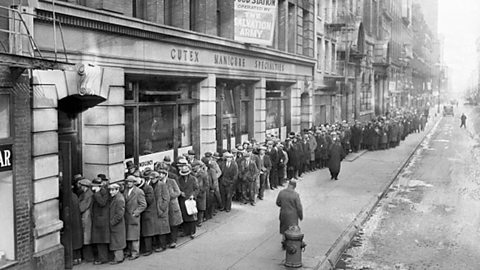
Every day, unemployed people queued outside businesses that were still operating, hoping to be given work. When people lost their jobs, they lost the ability to feed themselves and their families. Queues of people outside charity soup kitchens waiting to be fed were called A line in which people in extreme poverty, who did not have the money to buy food for themselves or their families, queued up for food handouts. People also lost their homes as they could no longer afford to pay their A mortgage is a type of loan. It is usually a large amount of money used to pay for a property. or their rent.
Emergence of Hoovervilles
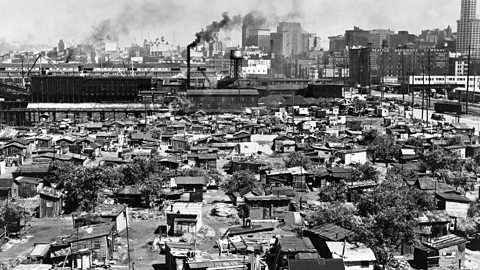
The national mood was extremely low as many homeless people wandered the country looking for work and slept in public places. They wrapped themselves in ‘Hoover blankets’, which were sheets of newspaper, to keep warm. They also transported their possessions in ‘Hoover wagons’, which were carts with wheels that contained a person’s goods. These names arose because the people blamed President Herbert Hoover for not doing enough to help them.
Some people dealt with losing their homes by building temporary places to live in public parks using tents, cardboard boxes or corrugated iron sheets. These temporary places had no Measures to help cleanliness and hygiene. and grew into unofficial villages and towns. However, the people who lived in them developed a sense of community and looked after each other. These communities became known as A name for shanty towns, which are large settlements consisting of very poor-quality housing, built during the Great Depression. They took their name from President Herbert Hoover.
