Think about what you really want help with" - Addy
AI tools could play a role in supporting your wellbeing, by giving you in-the-moment support to manage your emotions. They can break down a problem and suggest practical steps to follow in a tricky situation.
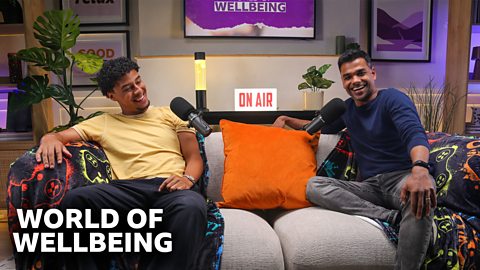
But can an app really understand how you’re feeling? Watch Addy and Solly test out an AI wellbeing chatbot.
This article was updated January 2026
Watch the film
GARETH: Can an app really understand how you're feeling?
Well, we're gonna test an AI wellbeing chatbot by asking for advice. Let's see how the prompts we use change the advice we get back.
Natural language processing helps the AI understand your prompt and generates responses that feel empathetic. Your initial prompt is important as it allows the AI to match helpful responses.
So, let's put it into practice with Solly and Addy. Shall we compare two different ways of asking for help, guys?
ADDY: 'What should I do if I've had an argument with a friend because we like the same person. I don't want to lose my friend.'
That's actually some good advice.
SOLLY: It's not bad, is it? It's good, yeah.
ADDY: It's really thought through.
SOLLY: How about, 'I argued with my best friend over someone we both liked romantically and now they're ignoring my messages. I don't want to lose my friend, so please give me a calm text I could send to start fixing things.'
It's laid out really nice and well.
ADDY: Yeah, it's good that there's multiple points. Yeah. It kind of explains the whole process.
SOLLY: It explains it well. It's even got here a transcription of what they might say back, which is interesting.
GARETH: And clear steps, isn't it?
SOLLY: Yeah, nice clear steps.
GARETH: The second gave you some options of text messages you can actually use and send to begin fixing things.
ADDY: We can make it even more useful if we ask what to do after we send the message or if the friend doesn't respond.
SOLLY: Yes, more detail is definitely better.
GARETH: But what if you want more options to support you?
SOLLY: How about, 'Can you give me a list of five top tips I can try to calm myself down, and five things I can do to fix things with my friend?'
ADDY: Hmm. I feel like this, it feels useful because it is really giving you that.
SOLLY: It's giving you exactly what you want, which is definitely perfect. I really do like the… what was it? Name it to tame it. I love 'Name it to tame it.' That's good, yeah.
ADDY: This feels better. We're being specific about the format we want: ‘Five Top Tips’ and asking it to build on the previous context.
SOLLY: And asking for tips to calm down first is actually really useful. It's making the AI give us a de-stress strategy alongside fixing things with our mates.
GARETH: AI isn't a therapist. It's using data to simulate empathy. By being specific, the AI can point you towards practical skills for managing emotions and situations.
But remember, it's a tool, not a therapist. It's not a substitute for a fully trained mental health worker who can understand your emotions, reactions and body language.
ADDY: The more you refine your requests with context and specific requests, the more useful the answers will be. Think about what you really want help with.
SOLLY: AI can help you find practical tips, but for a truly nuanced and empathetic response, it's still worth talking to a person you trust.
AI and wellbeing chatbot essentials
AI chatbots aren't therapists, they're tools built with large language models - computer programmes trained on millions of conversations and texts. The program spots patterns in the way people show empathy towards each other in these chats. An example is the Wysa chatbot.
Natural language processing helps the program interpret what you're telling it and predicts the most helpful response. That’s why you must be specific about what you need.
Sometimes, you just need to feel heard rather than fix a problem, and AI tools aren't a substitute for support from a true friend or trusted adult. As TommyInnit said at the BBC Bitesize and 5 Live Teen Summit when he tried using ChatGPT as a sounding board: “It was like therapy at 1am. Then I realised: hang on, am I really confiding in a robot more than my mum?”
Tips for using AI tools to support wellbeing
| Do | Don't |
|---|---|
| Remember that a fully trained mental health worker can understand your emotions, body language, physical health, or the nuances of a situation much better than any bot. | Become overly reliant on an AI chatbot - it's not your friend or a confidant. |
| Give AI chatbots a clear task by being specific with your prompts. "Give me five ways to approach my friend who isn’t replying to my texts. I know she’s been worried about her driving test?" is much better than "Help me fix things with my friend." | Input any personal data about yourself, your friends or family. Never share your name, address or school. |
| Use a professionally-recommended AI wellbeing chatbot with guardrails in place. | Use a general AI assistant that isn't clinically approved or doesn't have guardrails in place to discuss your health and wellbeing. |
Take the quiz
Teacher notes
Teacher notes. document
Download the BBC Bitesize Guide to AI teacher notes to use this film and article in the classroom.

If you need support
You should always tell someone about the things you’re worried about. You can tell a friend, parent, guardian, teacher, or another trusted adult. If you're struggling with your mental health, going to your GP can be a good place to start to find help. Your GP can let you know what support is available to you, suggest different types of treatment and offer regular check-ups to see how you’re doing.
If you’re in need of in-the-moment support you can contact Childline, where you can speak to a counsellor. Their lines are open 24 hours a day, 7 days a week.
There are more links to helpful organisations on the BBC Bitesize Action Line page for young people.
More from the BBC Bitesize Guide to AI
How to use AI to generate pictures
Generative AI tools can create almost anything you can imagine. Find out how you can you get what’s in your head onto a screen.
How to use AI to style an outfit
Can an AI tool really pick the perfect outfit for you? Ffion and Toky investigate.

How to use AI to create art
Can you tell the difference between human-made art and AI-generated images? And what about the legal and ethical questions everyone is talking about?