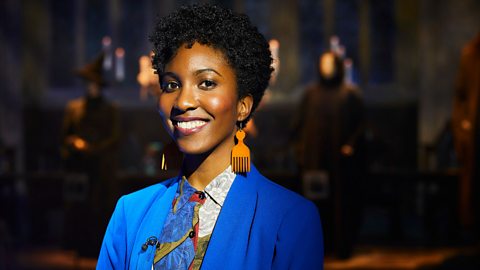
When we spot stereotypes, we can prompt AI to remove them." - Toky
London, Paris, New York, Milan - we've long looked to these fashion capitals for style advice. Now, we can get inspiration from AI! But can an AI tool really pick the perfect outfit for you? Ffion and Toky investigate.
This article was updated March 2026
Watch the film
GARETH: Too much? Yeah, thought so. You need an outfit that looks good and feels like you. Could generative AI help you design the perfect outfit?
I've got Ffion and Toky here to test generative AI's style. We're using an image generation model which creates images based on patterns in its training data. Ffion, you're up first. Think of an outfit that you'd like.
FFION: Okay, I'll start with a simple prompt and see what happens. An outfit that includes a blue sequin top that I can wear to a day festival this weekend.
It's okay, but it's the type of thing you'd see in any shop and it's automatically used a specific body type.
GARETH: That's a good point. An AI model is trained on a huge dataset of images and it reflects what it sees in that data. If the training data shows one body type, the AI learns that as the norm.
TOKY: I'm going to be really clear about what I want. Create a male gym outfit for the summer. A breathable, bright T-shirt and matching knee-length shorts. The fit should be good for a 5 foot 10 male, not baggy. Give me 10 possible options.
These are really simple, not my style and none of the people look anything like me. They're mostly middle-aged white men. Not very inspiring at all.
FFION: You need even more specific details in the prompt to get what you really need.
GARETH: So, what did we learn? The generative AI isn't a designer and it's not truly creative. What it creates is based on recognising to replicate existing styles and trends.
If the data a generative AI tool is trained on contains biases around body type, style or cultural representation, then it will repeat them. The less representative the training data, the more biases may be evident in the output.
Being more specific and inclusive in your prompt is one way to get a more accurate and inclusive image that reflects you and your style.
FFION: To get a custom look that reflects your vibe, using a detailed prompt can make a huge difference.
TOKY: Since we use and control generative AI, we need to guide it and make the final decision. And when we spot stereotypes, we can prompt AI to remove them.
AI and fashion stylist essentials
AI stylist tools use a generative text-to-image model that create pictures based on what you ask for.
AI tools aren't truly creative designers - they recognise and replicate styles and trends based on training data - a massive bank of fashion references.
Watch out for stereotypes and bias in generative AI model outputs. If lots of the images a generative AI model is trained on shows one body type or cultural representation, the AI learns that as the ‘norm’ and can reinforce stereotypes.
Tips for using AI stylist tools
| Do | Don't |
|---|---|
| Have fun writing different prompts and generating different styles! | Forget to be critical of the output. Remember AI tools can only replicate what it's been trained on, and it might not always make sense. |
| Practice being specific with your prompts to get images that reflect you and your individual style. | Forget to add important details like your eye colour, skin tone and the occasion. |
| Look out for biases or stereotypes in the images created. | Compare yourself unfavourably to AI-generated images. Never let a computer program make you feel bad about yourself. |
Some generative AI tools have age limits or require parental consent. Make sure you check these before you get started.
Take the quiz
Teacher notes
Teacher notes. document
Download the BBC Bitesize Guide to AI teacher notes to use this film and article in the classroom.

More from the BBC Bitesize Guide to AI
How to use AI to create art
Can you tell the difference between human-made art and AI-generated images? And what about the legal and ethical questions everyone is talking about?
How do I trust my social feed?
What do AI-generated social media influencers mean for our content feeds? Watch Caelyn and Devan create virtual influencers using a generative AI tool.
How to use AI for revision
Can AI really be a good study buddy? Learn how AI tools can support your revision.
Where next?
Vinted creator: How my idea became a billion-dollar online business
Vinted creator Milda Mitkutė tells us how her idea to sell unwanted clothes led to the development of the global online marketplace.