It’s not just about perfect lives being fake anymore. The actual person you’re watching might not even be real.” - Caelyn
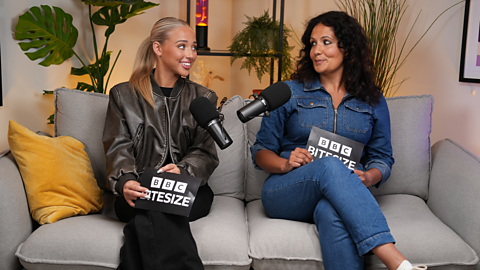
Emma-Louise Amanshia explores the rise of AI-generated social media influencers and what that means for our content feeds. Watch Caelyn and Devan create virtual influencers using a generative AI tool.
This article was updated March 2026
Watch the film
EMMA-LOUISE AMANSHIA: More and more content on our social feeds is being altered or created using generative AI.
It's no longer just filters. Entire videos and completely virtual people are being created and shared online. Some of these virtual people have millions of followers and have partnerships with brands.
Generative AI can also generate images, news headlines and videos with simple prompts, which can then be shared on social media. Devan and Caelyn are generating a clip of an influencer type character based on themselves, using generative AI.
CAELYN: I'm prompting it to create a female 17-year-old influencer from Burnley and I've given it a brief explanation of my height, what I look like and a few personal details about my life.
DEVAN: I'm doing similar. Male,16, from Kent. I'm going to mention some of my characteristics and I'm going to make mine animated.
RECORDED CAELYN: Hi guys! My name is Caelyn, I'm 17 and from Burnley. But as you can tell, I've got a bit of a London twang from my mum.
CAELYN: That's really weird!
[VIDEO REPLAYS]
RECORDED CAELYN: As you can tell, I've got a bit of a London twang from my mum…
RECORDED DEVAN: My name is Devan and I'm 16 years old and from Kent. My heritage is a unique mix of Asian, African and Inuit. I love acting.
DEVAN: It cut off.
CAELYN: That was it. That was the end.
DEVAN: [LAUGHING] It's not there.
EMMA-LOUISE: Can we watch it again?
DEVAN: No!
CAELYN: It looks real. If I was scrolling a feed, I would think it was a real person, and it's almost exactly what I put into the prompt.
DEVAN: The animated one does look a bit like me, and my character looks professionally designed, as if someone had spent a lot of time creating it.
EMMA-LOUISE: How does seeing that make you feel?
CAELYN: The tech is incredible, but it is a little weird that this character basically just didn't even exist until I typed in a few words.
DEVAN: Yeah, it makes me wonder how many other videos I've seen in my social feeds that's actually AI generated. I still really like it though, it's pretty cool.
CAELYN: It feels a bit hollow. It's not a real person, but these kind of characters could be used to sell or promote something.
EMMA-LOUISE: That brings up some big questions. Trust and transparency. Do you think content creators and social media companies are doing enough to label what's AI and what isn't?
Seeing how easy it is to create your own AI videos, you can begin to imagine how much of the content that you see may be AI generated.
And the technology is only getting better, making critical analysis of your personal feeds more and more important.
CAELYN: You really have to question what you see online. It's not just about perfect lives being fake anymore. The actual person you're watching might not even be real.
DEVAN: And we need to think about transparency. If a company or creator is using AI to make their content, we should know about it. It's about being able to make our own informed choices about who and what we follow.
Your AI and social media essentials
Looking at your feed with a critical eye matters now more than ever. Some influencers you see online aren’t even real - they’re virtual influencers (a computer-generated character). Whole teams of professionals might be designing their look, writing their captions, and deciding what they “say”. Should the makers of virtual influencers have to be clear they’re not real people?
According to research by Ofcom, 75% of 16–24-year-olds get their news from social media. Generative AI can make fake posts, news headlines, and even videos that look totally real. And not everyone tells you when something was made by AI. This can make it harder to spot misinformation (when someone accidentally shares something that isn’t true) and disinformation (when someone deliberately spreads false information to trick people).
Generative AI can change how you present yourself online. You could even generate an avatar that looks and sounds just like you. But once it’s out there, someone else could copy it or use it in a way you wouldn’t want. Is that worth the risk?
Tips to identify AI in your social feed
Generative AI tools are user friendly. It can be fun to create new content, and entertaining to consume that content.
| Do | Don't |
|---|---|
| Be your own detective. Check sources and look at a wide range of places online for your information and news. | Use just one source for your news and information. |
| Look out for AI labelling. As technology improves, transparency around the use of AI will become increasingly important. Some social media platforms require content to be marked as AI-generated but it’s not always obvious. | Assume that if something doesn't have a label, it's not AI generated. You can look for other clues too - AI sometimes finds features like hands difficult to replicate! |
| Remember, if you know that someone or something is AI-generated, you can make your own informed decision as to whether you choose to follow them or not. | Compare yourself to someone on a social feed who doesn’t exist in real life or aspire to unrealistic lifestyle ideals or beauty standards. |
Some generative AI tools have age limits or require parental consent. Make sure you check these before you get started.
Take the quiz
Teacher notes
Teacher notes. document
Download the BBC Bitesize Guide to AI teacher notes to use this film and article in the classroom.

If you need support
You should always tell someone about the things you’re worried about. You can tell a friend, parent, guardian, teacher, or another trusted adult. If you're struggling with your mental health, going to your GP can be a good place to start to find help. Your GP can let you know what support is available to you, suggest different types of treatment and offer regular check-ups to see how you’re doing.
If you’re in need of in-the-moment support you can contact Childline, where you can speak to a counsellor. Their lines are open 24 hours a day, 7 days a week.
There are more links to helpful organisations on the BBC Bitesize Action Line page for young people.
More from the BBC Bitesize Guide to AI
How to use AI for revision
Can AI really be a good study buddy? Learn how AI tools can support your revision.
Is AI bad for the environment?
Explore how much energy AI tools use compared to other everyday habits. Some results may surprise you!
How could AI support my wellbeing?
Can an app really understand how you’re feeling? Watch Addy and Solly test out an AI wellbeing chatbot.