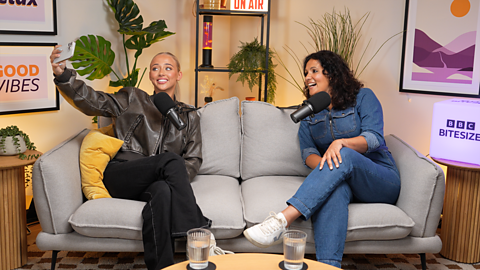
World of Wellbeing is a vodcast series featuring Ami Charlize and Dr Radha Modgil. In this episode, Ami and Radha talk affirmations, body confidence and bullying. Ami shares her experiences of growing up and talks about how her confidence increased as she got older.
Ami: When I was getting bullied at school, I definitely didn't feel like I was good enough. I felt like whatever I did was never going to be right.
Hey guys.
I'm Ami Charlize.
Dr Radha: And I'm Dr Radha.
Welcome to World of Wellbeing from BBC Bitesize, where we talk about how to look after yourself and your mind.
Ami: So today what are we chatting about?
Dr Radha: So we're talking all about self-esteem and confidence. Two really big topics.
So Ami, have you ever felt like you're not good enough?
Ami: I feel like when I was younger, especially when I was getting bullied at school, I definitely didn't feel like I was good enough. I felt like whatever I did was never going to be right, But yeah, I still feel like I get that now. You know, you have them days, but I also have days where like, I feel better about myself.
Dr Radha: Yeah, I can definitely relate about the bullying, because I was bullied at school, which was really hard. And also if I think back, like when past relationships have broken down, that's really affected how I feel about myself.
So there are lots of things that can knock our confidence. So for example, not getting the test result you want or not being chosen for your your school play, for example. Or maybe a friendship fallout. All of those things can make us feel bad in terms of who we are and affect our confidence. But there are things that we can do that can improve our self-esteem and our confidence.
Ami: Are self-confidence and self-esteem different in your eyes?
Dr Radha: Yeah, they are.
So self-confidence is about our belief in ourselves and our ability to do things. So for example, that can change in different scenarios. So you might feel really, really confident standing up and giving a speech, for example, in front of your class. But actually, you can feel really not confident when you're on the sports field.
Ami: Yeah.
Dr Radha: Whereas self-esteem is about how we feel, what we think and how we see ourselves. And our self-esteem can be affected by many things, either in a positive way or a negative way. So Ami, what do you do to help kind of boost your self-esteem?
Ami: One thing that I can just think of is like, I write down every single evening and morning three words of affirmation. So it could be like, I don’t know, I'm grateful for my health today. I'm grateful for my family and my friends. And maybe it could be like I'm grateful for the opportunities I'm getting given. And personally for me, I just love it because I feel like, number one, I'm kind of putting it out there to the atmosphere and to, you know, the universe, but also I think it's just nice to have that in the back of your head always.
Dr Radha: So I love the fact that affirmations is one that works for you.
There are lots of other ways as well. So taking positive action for example towards your goals, maybe tackling something difficult like homework, and also just putting yourself first and giving yourself some time to do some hobbies that you enjoy, or getting creative and doing things that actually make you happy can also really help your self-esteem as well.
Ami: So what if like, you're not very confident about how you look?
Dr Radha: Yeah, so it's easy to think that self-esteem is related to how we look, but actually it's about how we think we look and how we feel about how we look. So some days that will be really good and sometimes that may not be quite so good. So that's really helpful, because it means that actually it's about how we're thinking and the thoughts in our head that are directly impacting how we feel about how we look.
Ami: Yeah, definitely. How I feel depends on the day kind of thing.
Dr Radha: Yeah, which is great because that means that once we notice our thoughts and we kind of pick up on them and we sort of notice they are a little bit more negative, we can stop, take a breath, and we can re-frame those and think more positively. And that will then directly impact how we feel about ourselves.
Ami: Definitely.
Dr Radha: So the fact it’s about our thinking is really great news, because we can change our thinking.
Ami: Definitely.
Dr Radha: So Ami, how do you feel when you look in the mirror?
Ami: I don’t know, everyone has their insecurities and I think even the prettiest girl in the world probably has many, many insecurities. Before, I think I was definitely worse and I was very, very like hung on, like the fact of like, ‘oh, I have to look this slim.’ ‘I have to, you know, eat healthy.’ ‘I need to clear my skin up.’ I think definitely for me, you know, when I was younger, I wouldn't wear certain outfits. Like, now I literally wear what I want when I want, and I feel good with it.
Dr Radha: I love that, and I think that’s a really great point to make, is that we kind of learn how to kind of be kinder to ourselves, we learn how to build our self-esteem and we also learn that actually, every single person struggles with something, and that we're not alone and it's not just us.
Ami: Yeah.
Dr Radha: And I think a particularly tricky time is, you know, when our body's changing. So we're going through puberty and all our hormones are doing all kinds of things, and actually it can be a really tough time with our self-esteem and how we feel about how we look and our bodies, but actually there are lots of things we can do, and lots of things we can kind of learn, as to how we can feel good about ourselves and actually just not care so much as well.
Ami: So what can we do if we're not feeling as confident in how we look? Would you say?
Dr Radha: So, the really interesting thing about body confidence is actually it's kind of like a habit. So it's something we can practice and develop and get better at. So a couple of things you can do are to think about how unique you are and how special you are. There's only one of you in the entireworld, which is pretty extraordinary. But also to focus on what our bodies actually do for us, not just how they look. So, you know, how many steps do your feet take every single day? Which is incredible.
Ami: It’s mad, really.
Dr Radha: It really is mad.
And also just, I think learning to work with your body, you know, the things that you really love about yourself and accentuating those I think is also really helpful.
Ami: Yeah, like sometimes I look at myself and I think, ‘oh, I look really nice today.’
Dr Radha: And other days we don't.
Ami: But it's part of growing up, it's part of life really. You've just got to kind of take it on the chin, but definitely what you've said, I think is really useful.
Dr Radha: Yeah, and remembering that, you know, that kind of glamorous actor or that person you really love on social media, you know, they also have days.
Ami: Yeah.
Dr Radha: Like you have, like we all have.
So remembering that I think is really important.
Ami: And I mean, I'm a person that, you know, who's been brought up kind of being on social media and I think it's just important for the people watching or listening to know, you know, like not everything you see is real, because it's so hard to not get into this world of like, ‘oh, that's the norm,’ because it's not. It shouldn't be like that. But I think words of advice is like, if you see a pretty girl down the street and you've seen her in her real life, she's obviously beautiful. But now I wouldn't look at her and be like, ‘oh, I'm so jealous of her.’ I'd look at her and think, ‘she's beautiful. But I've also got things about me that I love.’
So, what can we do right now to build our self-esteem?
Dr Radha: So Ami, I've got a little exercise for you.
Ami: Ooh, yay.
Dr Radha: So I want you to take these sticky notes.
Ami: Okay.
Dr Radha And basically think of three words, positive words, about yourself and write them down. If you're struggling with that, then asking someone, your friend, your family member, you know, to write down three words for you can be really helpful as well.
Ami: I've wrote some.
Dr Radha: Amazing.
Ami: Let’s not judge the handwriting, please. But I thought I'd write a few down that I think could match with me. I've put down generous because I think I'm pretty generous. I’d say I’m quite optimistic, like I look at the good in things as much as I can. And then I've put down confident because I think I'm quite confident.
Dr Radha: Well, from having met you Ami, I completely agree with all those three things.
Ami: And I'm going to put that in my pocket as we speak. And if you're listening or watching, I think you should definitely do the same. So you can put them in your phone, you can set them as a reminder, or you can put them on sticky notes and pop them in places where you're going to see them every single day.
Thanks so much for being with us.
Head to Bitesize Study Support to watch more episodes or search World of Wellbeing on BBC Sounds to listen now.
Bye!
Dr Radha: If you're experiencing low self-esteem or confidence and it's affecting your day-to-day life, it's really important to talk to a trusted adult, that might be a teacher, a parent, a carer or someone you trust.
Confidence and self-esteem
Have you ever felt like you’re not good enough? Or felt like you don’t believe you could do something or be good at it? Well, you’re not alone in feeling that way – we all do from time to time.
These thoughts and emotions can bring on challenging feelings. But the good news is that we can notice those thoughts and feelings and challenge them, even change them, by learning skills and taking steps to help us feel better.
Confidence and self-esteem are two hugely important foundations of our mental health and wellbeing. You may have thought these to be the same kind of thing, but actually they are two very separate and different things.
What’s the difference between confidence and self-esteem?
Self-esteem is about how we feel, what we think and how we see ourselves – basically, our opinion of ourselves. Confidence on the other hand, is about our belief in ourselves and our ability to do things. So, for example, we might think to ourselves something like ‘I am not a nice person’, which might mean we have low self-esteem, or we might think ‘I am not good at public speaking’ which is about confidence.
Once we understand what each is, we can notice our thoughts and work out which ones are about our self-esteem and which are about our confidence, and then use strategies to improve both.
What can impact our confidence and self-esteem?
Lots of things! For example, not getting the test result you wanted, not being chosen for your school play, or maybe a fall-out with friends. Other things like being bullied or making a mistake in class, or having a lot of stressful things happen in a short space of time can also affect how we feel. When we are growing up and our bodies are changing a lot quite quickly it can be challenging to maintain good self-esteem and confidence. We’re learning more about who we are and we have the pressures of social media – it’s not easy! But we can change things up.
What can we do to improve our confidence and self-esteem?
1. Notice your thoughts and feelings
Noticing how you feel and what you’re thinking every now and again through the day is really helpful. It means we take a step back and realise that sometimes we can get into a habit of similar-themed thinking patterns. The more we notice certain themes that we think or feel, the easier it is to take specific action on those themes. For example, you might notice your thoughts around body confidence when you look in the mirror some days. That means that you can take action specifically to help with this, like positive statements and focusing on the things you love about your body instead, or asking a friend to help you do that.
2. Feel your Feelings
Sometimes we try and push challenging feelings down or pretend they’re not there, but the healthiest and most useful thing we can do, is to feel those feelings and look at them, and tell someone we trust about them. If you need to cry or talk about something that is making you feel sad, then do it. Processing our feelings in that way can help us start to take action to help us feel better.
3. Take Action
It’s great to tell an adult you trust about how you feel and ask for their support. You can also try reframing and turning your thoughts around. So, if you have a lot of thoughts and feelings around not being a nice person, you can start to write down every day three things that you show you are nice, for example, that you helped your younger sister, or you held open a door for someone. These facts and evidence can help you see things differently. You can also try affirmations – statements or words that help you believe something – for example ‘I am a lovely and kind person’.
Taking action towards your goals and tackling difficult things like homework can help, as well as taking time to do some nice hobbies that you enjoy and getting creative. You might want to write down three things per day that you are grateful for or that you love about yourself and keep repeating that and make that a habit. Accepting compliments from others can also help boost our self-esteem and confidence, as well as asking someone else to write down some things they love about us.
If you need some support then talk to someone you trust, that might be a parent, a teacher, or a carer, or even another friend.
More World of Wellbeing
What is friendship? video
Ami Charlize and Radio 1’s Dr Radha talk friendship fall-outs and growing apart.
How much sleep do you need? video
Ami Charlize and Radio 1’s Dr Radha give some guidance on how exercise and being active can help boost your mood.

Self care ideas from Dr Radha. video
Ami Charlize and Radio 1’s Dr Radha chat about the benefits of practising self care.

World of Wellbeing on BBC Sounds
The World of Wellbeing Podcast. audio
Listen to The World of Wellbeing Podcast on BBC Sounds.

If you need support
You should always tell someone about the things you’re worried about. You can tell a friend, parent, guardian, teacher or another trusted adult. If you're struggling with your mental health, going to your GP can be a good place to start to find help. Your GP can let you know what support is available to you, suggest different types of treatment and offer regular check-ups to see how you’re doing.
If you’re in need of in-the-moment support you can contact Childline, where you can speak to a counsellor. Their lines are open 24 hours a day, 7 days a week.
There are more links to helpful organisations on BBC Action Line.
