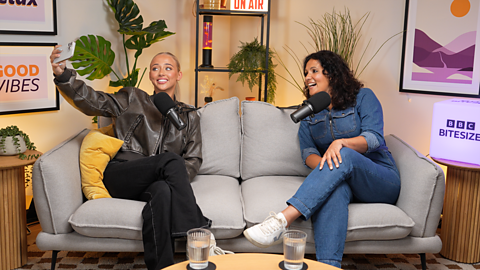
World of Wellbeing is a vodcast series featuring Ami Charlize and and Radio 1’s Dr Radha. In this episode, they discuss being active, exercise and sleep. Ami talks about how boxing and pilates help improve her mood and Radha spills the secrets about the “feel-good” chemicals your body releases when you exercise.
Ami: I was addicted to it and not to boast, but I think I was pretty good at it, out of everything.
Hey guys.
I'm Ami Charlize.
Dr Radha And I'm Dr Radha.
Welcome to World of Wellbeing from BBC Bitesize, where we talk about how to look after yourself and your mind.
Ami: So today what are we chatting about?
Dr Radha: We are chatting about getting active and moving your body.
So Ami, I know you're a big fan of getting active and sport, but do you know why it's so great for your mind?
Ami: I just feel like for me, I love exercising because I feel better about myself.
I've been absolutely loving reformer pilates, like anyone that knows me, knows I'm addicted to it right now. So I think things like that, it's just really, really good and it's really helping me having like a routine setevery single day, which I really enjoy.
Dr Radha: I love that. I've been trying to get into pilates as well.
Ami: I love it.
Dr Radha: Similar to you, I really love exercise. It makes me feel so much better and whenever I do it, I think I always feel really energised, I feel really good about myself.
Ami: It is amazing.
Dr Radha: I absolutely love it.
Ami: So how come we feel like this when it comes to, you know, getting active and sports and things like that?
Dr Radha: Yeah, so there's a lot of science behind it.
So basically, when we get active and we move our bodies, our bodies release chemicals so kind of feel-good chemicals, that boost our mood and our self-confidence.
So we get things like serotonin and dopamine and endorphins, they do loads of great things in our bodies, but they mainly help us feel better about ourselves and lift our mood.
Ami: Wow, that's actually really interesting.
Recently, weighted hula hoops is like my best friend.
Amazing. I can just do it in my room, do it for ten minutes and feel good.
Dr Radha: So really important to find something you enjoy, because that means you’ll keep it going. You can do it by yourself or with friends. But also the fact you enjoy it actually gives an extra lift to your mood as well, which is great.
And it has been shown that when we do exercise with our friends, actually we're more likely to keep it up and keep it going, than if we do it on our own, and I think you know, those days sometimes when we’re not always feeling our best, and we’re like, ‘oh, shall I leave it? Shall I not go?’ But if you've got your friend on text going, ‘hello, where are you?’Then we're more likely to keep it going.
Ami: And I think that's why I probably loved P.E. so much at school, that was like my favourite subject. I was addicted to it and not to boast, but I think I was pretty good at it, out of everything.
So I'd say, yeah, that was definitely my like favourite thing to do every single day with friends. And also with like my reformer and boxing, I do one-to-one. I think it's great because obviously I've got someone there telling me what to do. It keeps me very, very concentrated and that's why I probably love it so, so much.
Dr Radha: Yeah, and motivated, which is great. And I think the other really nice thing about exercise is you've got different types of exercise for different moods. So it's a bit like pick and mix, so if you're feeling a bit angry or stressed out, you can go running and you can pound your feet on the pavement. If you want to relax and you kind of just be a bit calmer, then you can go swimming, which is brilliant. And not everyone likes P.E. or sport, so again, it's about making it your own. So it might be going for a walk or it might be kind of dancing or learning the next, like the new TikTok dance for example, whatever you like.
Ami: I absolutely love that. I think that’s super important.
Dr Radha: And you can combine getting active with getting outdoors as well. So if the weather's nice then putting on some suncream, getting out there and absorbing all that Vitamin D, which is great for your bones, but if it’s not so nice, then actually grabbing a waterproof and getting out there as well, is still great because nature alongside exercise is even more beneficial for us. And it's also free, so why wouldn't we want to use it? Do you know what I mean?
Ami: Exactly.
And you can literally just run around in a park and everything. And I also think it's really important to know that food is fuel. So when it comes to working out, you should make sure that you are you know, eating to make sure that you've got enough energy to be able to work out because there is nothing worse than trying to work out on an empty stomach.
Dr Radha: Oh yeah, one hundred percent. So you think about your mobile phone, you need to charge it up and it’s the same if you're getting active, you’re exercising for your health and you need to kind of make sure you're eating enough, you're eating things which give you that energy and that fuel to actually help your body move, because it needs some fuel.
Ami: Definitely.
Dr Radha: There are also some other really big wins when it comes to exercise, so it can boost our confidence if we set ourselves a goal and we achieve that, we can feel really good about ourselves. But also it helps us sleep better, because we’re using up energy, we're feeling tired physically, so we sleep much better and almost sometimes for longer as well when we exercise. Both those things, sleep and exercise, can really help us with our brains. So when we're kind of at school doing exams and actually both of those things can make us kind of focus better, concentrate better, so we might end up doing better at school as well.
Ami: Definitely, and I feel like for me, if I don't get my seven to eight hours of sleep every single night, I'm so grouchy. So what do you kind of recommend for someone that is struggling with kind of sleeping and things like that?
Dr Radha: Yeah, so a couple of tips are trying to go to bed at the same time and wake up at the same time every single day, so your body gets into a routine and a rhythm and it knows what to expect. Another really good thing to do is to try and get rid of any stresses or worries before you go to sleep. So whether or not that's writing it down in a journal, talking to someone is really great and having a bit of a bedtime routine. So you know, whether or not that’s a bath or kind of like just relaxing with some music, some breathing exercises. You need to help your body almost expect and kind of know what's coming, so you have a little bit of an unwind, because then your brain is going to kind of almost relax better and you’ll basically sleep better as well.
Ami: I love that.
So for me, I have this thing on my phone, like a sleep reminder where I just shuts my phone down at a certain time to remind me that it's basically time to go to sleep, that's something that’s really helped me to be honest,because it's like, ‘oh, my phone knows I should be sleeping, so maybe I should be sleeping now.’
Dr Radha: Exercise and sleep go hand in hand, so if we're kind of helping one, the other one will get better too.
Ami: What do you think we could do right now to kind of get the people who are listening moving, and me? I want to get moving.
Dr Radha: So really important thing to do is to put that in your diary.
So to schedule something in and organise something, so that might be a club, it might be like a hobby or an activity, or it might just be kind of going for a walk with one of your friends. So getting out your phone, texting somebody.
Ami: I might text my sister.
Dr Radha: I love that.
Ami: Ask her if she wants to walk my dog, Hugo, when I get home.
Dr Radha: I love that and again, it’s also helpful because when we have something to look forward to, that's really great for our mental health as well. So scheduling it in, prioritising it, making it part of what's important to you is really important.
Ami: I just said, ‘hi, can we go on a dog walk?’
Dr Radha: I love that.
Ami: Thank you.
And guys, if you're listening, you should do the same.
Dr Radha: Definitely.
Ami: But I think that's a really, really important tip there, and I love that.
Thanks so much for being with us.
Head to Bitesize Study Support to watch more episodes or search World of Wellbeing on BBC Sounds to listen now.
Bye!
Dr Radha: If you're worried about anything to do with your health when it comes to exercise, then talk to someone you trust. That might be your parent, your teacher, your carer or another friend.
And if you're struggling, then your GP is always a great place to get help.
What’s the point of getting active?
Getting active and moving our bodies is great for our physical health, but did you know how amazing it is for our mental health and our minds too?
Our bodies and minds are very closely connected and whatever we do with one affects the other. Science shows us that lots of things happen in our brains when we exercise. Our bodies release ‘feel-good’ chemicals that boost our mood and self-confidence. We release chemicals like serotonin and dopamine and endorphins which help us feel better and lift our mood.
These chemicals are the reason why you feel better after you get active and why you feel less anxious or tense or stressed, and why you feel more energised and motivated.
What’s the best way to exercise?
The amazing thing about exercise is that there are so many different ways you can move your body depending on what you like, how you feel on that day or in that moment, and what you need for a specific feeling. Think of ways to get active as a ‘selection-box’ of all kinds of activities that you can choose from to help you feel better – from pilates to boxing, to running to dancing round your room, to walking to riding your bike. If you’re feeling frustrated, you can box. If you need something to calm you down, then go swimming, or if you want to get stress out, you can go running and pound your feet on the pavement.
The most important thing to consider when picking what exercise you want to do is to make sure you enjoy it. If you like something then you are more likely to keep it going, to do it regularly, and to be your best in it. Another thing that can help us get into the habit of moving our bodies is to do it with a friend or in a group. Research has shown when we start something in groups or to change a habit then we are more likely to keep it up. Socialising whilst exercising has also been shown to benefit our mood. Make sure it’s fun too – like a fun dance or something that allows you to express who you are and what you’re about because that is great for your self-esteem.
How can I get a good night’s sleep?
Exercise has loads of other benefits for our mental health too. It improves our concentration when we’re studying or working and it can help us sleep better and longer too.
Just like exercise helps our mood, so does good sleep. Making sure you’re getting enough hours and good quality sleep can really help us in so many ways, from focusing at school to being more resilient to difficult days and managing our emotions. The NHS recommends that people age 13-18 should get an average of 8-10 hours sleep a night. To get a good night’s sleep, try:
- going to bed and wake up at the same time every single day
- journaling any worries before you go to sleep
- having a bath, listening to relaxing music or doing some breathing exercises.
Your body needs to know that it’s expected to sleep by having a good pre-sleep routine and habit. That includes putting away your mobile or devices and turning them off so you can have a good night’s sleep.
Getting active and sleeping well really are two of the most amazing and effective ways to look after your mood and how you feel.
If you need some support to get into getting active or exercising or with your sleep, then talk to someone you trust, that might be a parent, a teacher, or a carer, or even another friend.
Watch more World of Wellbeing
What is friendship? video
Ami Charlize and Radio 1’s Dr Radha talk friendship fall-outs and growing apart.
How to stop worrying? video
Ami Charlize and Radio 1’s Dr Radha chat through what you can do if you're feeling worried or anxious.
How to be more confident
Ami Charlize and Radio 1’s Dr Radha talk affirmations, body confidence and bullying.
World of Wellbeing on BBC Sounds
The World of Wellbeing Podcast. audio
Listen to The World of Wellbeing Podcast on BBC Sounds.

If you need support
You should always tell someone about the things you’re worried about. You can tell a friend, parent, guardian, teacher or another trusted adult. If you're struggling with your mental health, going to your GP can be a good place to start to find help. Your GP can let you know what support is available to you, suggest different types of treatment and offer regular check-ups to see how you’re doing.
If you’re in need of in-the-moment support you can contact Childline, where you can speak to a counsellor. Their lines are open 24 hours a day, 7 days a week.
There are more links to helpful organisations on BBC Action Line.
