Look for the bus stop on the left. Buses that stop here will take you back to Reading Station. But the buses from Sonning to Reading are quite infrequent. Times (as of Summer 2004) are as follows... Mon-Fri | Time | Number | | 0705 | 127 | | 0729 | 127 | | 1616 | 129 | | 1621 | 129 | | 1706 | 129 | | 1811 | 127 | | 1831 | 129 |
Sats | Time | Number | | 0739 | 127 | | 0828 | 127 | | 0936 | 127 | | 1146 | 127 | | 1344 | 127 | | 1546 | 127 | | 1804 | 127 |
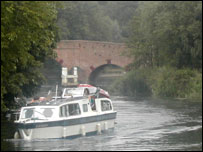
Sonning Some quick facts about Sonning... if you don't take the footpath to the church, but continue on the towpath, you will leave the river at Sonning Bridge, initially built in 1790 by John Treacher and modified by Admiral Rich in 1772. If you cross the bridge and pass the Mill, you will be on an island complex within the river which leads to Sonning Eye (actually and eyot or ait – a small island within the river). We don't advise you walk down to Sonning Eye as there is no footpath. But for your information, in the 1960’s Ulster Petroleum sank a borehole at Sonning Eye to search for oil. Click here to see a log of what was found. The rocks recorded down the borehole become progressively older with increasing depth. Below a thin veneer of river gravel the borehole entered the Chalk, which is over 100m thick. Strange to think that if coccoliths had not evolved, the chalk would not exist, but instead there might be just a few metres of clay. Large tracts of Europe underpinned by Chalk (London and the Thames Valley, Paris Basin) would today be under the sea. The topmost Chalk sediments here are about 70 million years old. Below the Chalk the Cretaceous beds continue in the Upper Greensand (which occurs at outcrop south of Kingsclere), the Gault and Lower Greensand (seen today around the margins of the Weald and at Abingdon. These Lower Cretaceous rocks are about 130 million years old The Cretaceous rocks rest unconformably upon Jurassic rocks below, meaning that there was a phase of earth movements (folding and erosion) after the Jurassic rocks were laid down and before the Cretaceous sediments accumulated. The Jurassic rocks comprise the Corallian (limestones with corals and other shelly fossils), the Oxford Clay (a fossiliferous marine clay) and the Great Oolite (limestones and claystones). These rocks are seen successively as you drive north from Abingdon, through Oxford and into the Cotswolds (e.g. Witney). The oldest Jurassic rocks here are about 170 million years old, their base is approaching 400 m below ground surface. The Mid-Jurassic Great Oolite lies unconformably upon very much older rocks, Upper Carboniferous Coal Measures, sandstones, claystones and coal beds around 300 million years in age. Ulster Petroleum found no oil but they found uneconomic coal – part of the Witney Coal basin which extends in the subsurface into Oxfordshire. Coal Measures like these occur at outcrop in South Wales, the East Midlands and North of England. At around 630m the drill encountered an igneous rock (a dolerite sill) intruded into the rock sequence during the Late Carboniferous. Below this was a thick succession of red coloured sandstones and claystones, the Upper Old Red Sandstone (approaching 370 million years old) and seen today at outcrop in South Wales and the Welsh Borderlands. So to look down under Sonning we are doing the equivalent, in rock outcrop terms, of journeying northwards and westwards, as well as travelling backwards in time by nearly 400 million years, beyond the age of the dinosaurs and to a time when animals were first leaving the seas and taking their first breaths of air on the land. MANYTHANKS TO PROFESSOR BRUCE SELLWOOD OF READING UNIVERSITY FOR ALL OF HIS HELP WITH THIS WALK | 



 PREVIOUS

![Email your comments to [sitename_email]@bbc.co.uk](/staticarchive/5ec3db937412b12fbb10f1ebb3b864f002f93812.gif)