Chalk  | | Chalk |
The Chalk on this walk is visible at outcrop just behind the Reading Blue Coat School Boathouse, beyond the iron fence, and in the undergrowth high in the “cliff” above. This is within the private grounds of Reading Blue Coat School. Chalk is a limestone, virtually pure calcium carbonate, comprising the ultra-small fragments of calcareous plants (algae) called coccoliths, which lived in the near surface waters of a warm Cretaceous seaway that stretched across nearly all of Europe. 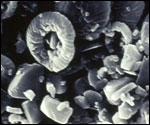 | Scanning electron microscope image of the Chalk from Sonning showing coccolith ringlets. Scale bar line is 5 micro-metres in length.
©Reading University |
Under the scanning electron microscope you can see that the rock is nearly entirely composed of tiny ringlets of calcite. These tiny fossils fell, within crustacean droppings (copepods swim in near surface seawater and eat coccoliths), onto the seafloor, in waters that were many tens of metres deep. Sea level at this time ( 70 million years ago) was perhaps 500 metres higher than now. Reading’s climate was more like that of the Canaries. Clams and sea urchins lived on the sea floor, along with sponges and crustaceans. Ammonites, fish and large reptiles swam in the sea and pterosaurs flew in the skies above. These organisms, as fossils, are to be found in the Chalk. On the nearest landmasses (Central France, Scandinavia, Greenland) dinosaurs lived. The sponges, made of silica, provided the chemical source of the silica which comprises flints.  | Reconstruction of the floor of the chalk sea around 70 million years ago with shrimps, sea urchins (echinoderms) and clams (pelecypods).
©The Cretaceous World by P. Skelton (Editor) 200.3. |
These hard black bands in the chalk were generated during burial as sponge skeletons dissolved, and silica diffused towards localised irregularities within the sediment (shrimp burrows) and then re-precipitated. These flints would be sought out by our ancestors for tools and, much later, as building materials. A large time-break (an unconformity) separates the Chalk from the Reading Beds. During this break, which marks the beginning of the growth of the Alps, the dinosaurs (and many other animal groups) became extinct, probably because a large meteorite struck Mexico triggering poisoning of the atmosphere. The Reading Beds consist of sands and clays that formed 55 million years ago. The land had been uplifted above sea level, but a new seaway flooded in, this time from the east and the base of the Reading Beds (which can be seen in a number of places around Reading, such as Pincent’s Kiln in West Reading, and at Bradfield, is a fossilised seafloor with shrimp borings and burrows and encrusting oysters. The Reading Beds here are around 20 metres thick and are overlain by London Clay, which occurs towards the top of the hill. The London Clay (3 m thick here) beyond the iron fence, from which bricks were made locally until 30 or so years ago (e.g. at Arborfield) formed in a warm tropical sea around 50 million years ago, when Reading had the climate of Malaysia, with deep tropical weathering and marine muds (now the London Clay) formed in a shallow near-shore environment, the land being over towards Newbury. MANYTHANKS TO PROFESSOR BRUCE SELLWOOD OF READING UNIVERSITY FOR ALL OF HIS HELP WITH THIS WALK | 




 PREVIOUS

![Email your comments to [sitename_email]@bbc.co.uk](/staticarchive/5ec3db937412b12fbb10f1ebb3b864f002f93812.gif)