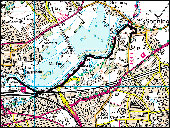
Terraces rising away from the River Thames | | Caversham Park in the distance |
Look across the river to the north, and see the hills above Caversham (“Caves Ham”), deriving its name from the medieval, and possibly older, mines which were sunk there. Old Reading was a town largely built of flint, which was extracted from the Chalk bedrock, which forms the hills. The mansion of Caversham Park - home to BBC Monitoring and BBC Radio Berkshire - has, to its right, a large white scar in the hillside. This is a quarry in the chalk. The hills are blanketed with river gravels much older than those on the present flood plain. They sit on a series of terraces which rise like a set of steps up from the present river. The older steps are the higher steps. The terrace at 60–80 feet (approx. 20–25m) above the present river, famously yielded hundreds of Palaeolithic hand axes, together with the bones of mammoth, horse, deer and many other animals.  | Palaeolithic hand axes
© British Regional Geology, London and the Thames Valley by M.G. Sumbler 1996. |
These occur in sediments that formed between about 300,000 and 450,000 years ago, and the implements were probably made by Neanderthal pre-cursors Homo heidelbergensis. There is a large gravel pit on the opposite side of the river. Gravel extraction in the Thames Valley provides an important resource for the construction industry. And the lakes generated can provide a range of amenities, like boating, sailing, and wildlife areas. MANYTHANKS TO PROFESSOR BRUCE SELLWOOD OF READING UNIVERSITY FOR ALL OF HIS HELP WITH THIS WALK | 




 PREVIOUS

![Email your comments to [sitename_email]@bbc.co.uk](/staticarchive/5ec3db937412b12fbb10f1ebb3b864f002f93812.gif)