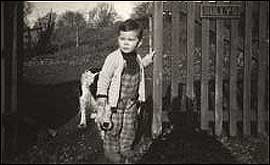
| Jim Lewis |  |  | | Jim was evacuated from bomb-wrecked Westminster aged two. After an unsettled childhood moving round the country with his foster mother, he eventually settled in St Albans, where he has lived for over 40 years, and become a foster parent himself. |
I was born in the Westminster area of London in August 1938, in the infamous Peabody Buildings. My mother was already 40-years-old, and I was an only child. I have been told that when the war broke out we were both evacuated to the Brighton area whilst my father stayed in London. He became an Air Raid Warden, as he had been badly gassed in the First World War. But my mother didnt want to leave him alone and so after a few months she returned home with me.
Sometime during 1940 the factory next to the buildings was bombed, and I was apparently lost for 24 hours when the floors fell through, but I was found by a neighbour who knew who I was.
In December, 1940, when I was just two-years- old, I was evacuated alone to a childrens home in the Dulverton area of Somerset where apparently I never stopped crying. Fuss
After about two weeks a lady came to the home and chose me to go and live with her. She had quite a wonderlust, and we lived in various places around Devon Dulverton, Oakhampton, and Exmoor, where I can remember my first day at kindergarten and kicking up a tremendous fuss because I didnt want to be there!
At the end of the war we were living in Widmouth Bay, Devon. I had a great time there because milk and papers were delivered on a pony and trap, and I used to help and ride in the trap. I also used to ride on the gravel lorries, as there was a quarry nearby. When the war ended, there was a big bonfire party in the middle of one of the roads, and the atmosphere there was full of celebration and happiness.
I remember going to my parents home in London at about the time the war ended and seeing the bomb damage. There were large holes in the roads and wrecked buildings all around. I also remember riding on the trams because they were very jerky and rocked about, and were also very noisy. The buses also had stairs on the outside to get to the top deck. I also remember that to have a bath we had to go to the Public Baths that were nearby.
Bond
I didnt go back to live with my parents after the war, neither of them were any good with small children, and as I had formed such a close bond with my foster-mother, she wanted to keep me with her. She was a woman of "independent means" so I lacked for nothing all through the war years. Her American relatives (her brother was a well-known Hollywood film actor) used to send her food parcels, so I was much luckier than most children during the war. I went home occassionally but there were things going on that I wasn't happy with and many unfulfilled promises so I always returned to my foster mother.
We then moved again, right across England to the South East, where we stayed for about two years, a period that was not very eventful although I do remember the Winter of 1947/48 which was very long with thick snow and very long icicles were hanging from roofs. In May 1948 we moved back to the Richmond area of London where I went to Primary School and then to Secondary school. Independent
Sport was important to me at that time and I spent a lot of time rowing. During that time I was in the youngest crew to have taken part in the 4¼ miles Head of the River race. During that time I also used to go and watch Fulham at Craven Cottage. The were in the old Division One at the time and used to play teams like Blackpool and Preston (when they were good!) I will always remember seeing the great Stanley Matthews play. When I finished school we moved, again, back to Hythe in Kent where I started work as an Apprentice Draughtsman which included going to college in Dover for a day and two evenings a week. I stayed there until I finished my apprenticeship, and then I applied for a job at the de Havilland Aircraft Company in Hatfield in1960. That was the time I left what I had called home and became independent. Unusual
It was a very unusual childhood travelling around but I don't think that being fostered made me decide to become a foster parent although I have met many foster carers where this had been the case. This is partly because my wife Wendy and I kind of fell into fostering and didn't actually sit down, decide we were going to do it and then go out and look for it. Fostering found us. But having said that, I suppose that subconsciously being fostered has helped me to understand the kids that are placed with us, having had a somewhat unsettled childhood myself. Since becoming independent I have lived the complete antithesis of my own childhood, being settled and having a stable family. And not having had a steady male role model as a child, I feel that I have been able to provide what I missed to many who were in the same situation. Read more about Jim and Wendy as foster parents >> You can find more stories like this and add your own on the People's War Website. 
| Peter English, Worthing | Wednesday, 10-Nov-2004 21:00:56 GMT | | | My mother was sent to somewhere near Dulverton during the war. There was an American base nearby and she had relations with a GI. The consequences were that I have a half sister who, again coincidentally, lives in the US. I have a name and a photo of this "guy" and am trying to trace him or his family, if he survived. What a wonderful story it would make if we could trace some family and tell my all American niece she has relatives over there. The problem I'm having is who to contact, are there are US military records available, or local records, newspaper, museum - would you know. Any help or information would be greatly appreciated. Kind regards Peter English |
|