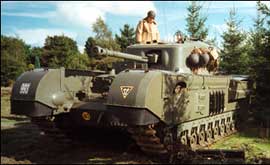
But 15 years ago, Garden Centre owner David Russell rescued the hull of a Churchill tank from a scrapyard. See photos of the tank before and after >> Although it was in terrible shape, he's painstakingly restored it back to its former glory and now stands proudly at Russells Nurseries and Garden Centre in Warwickshire. As well as the main cannon and a machine gun, the MK VII Crocodile version had a flame thrower, which ejected a stream of jellied gasoline (napalm) from the tank by pressurized nitrogen gas. If needed, the five man crew could quickly remove the flame projector from its mount and install the normal hull machine gun, although usually there wasn't enough space inside the tank to carry the spare gun as well. 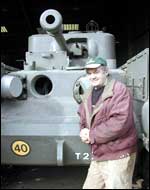 | | David Russell with the tank |
Powered by 12-cylinder Vauxhall Bedford Twin-Six 350hp engine, it could travel at around 12mph on the road, and 8mph cross country. Although most of the hull of the tank was intact when David got the machine, just about everything that could rust or dissolve had done so. Most of the vehicle's wiring had to be completely replaced in case it shorted out the electrical equipment and the entire engine had to be rebuilt. But after countless hours of love and labour, the tank can now be driven, and David claims it's easier to steer than a modern car. In August 1942, the allies carried out a raid on the French Port of Dieppe. They wanted to find out what it would take to mount an invasion. There were 27 Churchill tanks that made it to French soil, but the attack was repelled by the Germans. Many soldiers were killed and many taken prisoner. But the attack gave the allies valuable experience about landing on French beaches and forced the Germans to waste time building up defences in areas well away from where the eventual invasion would be mounted. Admiral Lord Mountbatten said that 'for every soldier who died at Dieppe, 10 were saved on D-Day'. In September, David is planning to take his tank over to France to remember the role the tanks played at Dieppe and in the final invasion on D-Day. He'll be leading a convoy into Le Havre, which was heavily defended by the Germans and was finally liberated by Crocodile tanks in September 1944. See photos of the tank before and after >>
You can find more stories like this and add your own on the People's War Website. 
|