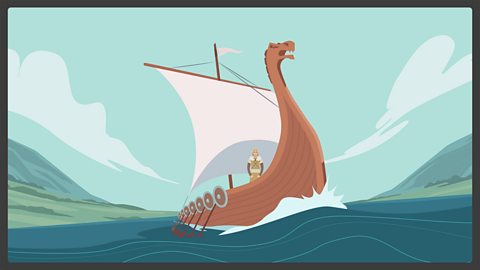
Unit 3 focuses on the history topic 'The Anglo-Saxons' - specifically the life of Alfred the Great. Dance expert Claire Pring works with a mixed group of Year 3 / 4 pupils and their teacher, to create a dance exploring some key factors of Alfred's reign: his escape from the Vikings across the marshlands of Wessex and his building of fortresses known as 'burhs'.
Unit 3 is also concerned with the final dance phase of assessing and reflecting.
Go to the Teachers' Notes for full details of how to use the CPD film (for teachers) and the Dance Challenge and Final Performance films below (for teachers and pupils).

Alfred the Great - CPD film for teachers
Claire Pring joins a group of Year 3 / 4 and their teacher, to work on their dance about some key events from the reign of Alfred the Great.
Adam (Teacher):Right what I want you to do guys is…
Claire Pring:Here at Ashgate Primary School in Derby I’ve been working with Adam Brooks and his Year 3 and 4 class to use the theme of Anglo Saxons in dance! The learning is both topic focused and dance specific. I’m here to see how they’re getting on.
Caption: Warm Up ~ Control
Adam:Good morning, Claire.
Claire:Well good morning everybody, it’s lovely to see you. And those were just the most brilliant strong shapes you were making. They were lovely.
Adam:They’re doing really well at the moment with their strong shapes. Guys, would you like to show Claire, how we switched into our low shape, and hold that position there.
Caption: Warm Up ~ Travel
Adam:What should I be looking for with travelling in dance?
Claire:If you just ask them to travel, typically most people will either walk or just run, so sometimes you need to prompt some ideas.
Adam:Okay.
Claire:Maybe get them some suggestions from them.
Adam:Yep.
Claire:So, how else could you travel?
Pupil:Tip-toe.
Claire:Tip-toe, brilliant. Or you could?
Pupil:Be sneaky.
Claire:Sneaking, so creeping around. Or you could?
Pupil:You could, like, crawl.
Claire:Crawl. Lots of different ways.
Claire:Here we go, holding one, two, three, four, five, six, seven, travelling, one, two, three, four, five, six, seven, hold your strong shape, three four five, six, seven, travelling one, two, three, four.
Caption: Context ~ Application
Adam:You said that Alfred the Great – who was it who he fought?
Pupil:King of the Vikings.
Adam:King of the Vikings, so what we’re going to do is we’re going to split into two groups. We’re gonna have King Alfred the Great, okay, and the King of the Vikings, over this side, okay, and we’re gonna split into two groups.
Caption: Creative Exploration ~ Timing
Claire:How about if we did a cannon, from that end, all the way along to show your battle shapes?
Adam:And what is a canon?
Claire:It’s where you do an action but you do it one at a time so it ripples along, often in a line, like a Mexican Wave.
Adam:Right okay.
Adam:And advance!
Caption: Creative Exploration ~ Timing
Claire:Where did Alfred go? Through…
Pupils:Marshes, marshland.
Claire:The marshes. So what’s it like travelling through marshland, would you think?
Pupil:Muddy and sticky.
Claire:Muddy and sticky. So we’re gonna try now travelling, as if you are travelling through the mud. The sticky, difficult mud. So your steps are not going to be regular, they will be irregular.
Adam:You’re Alfred, trying hard to get his legs out, okay? He’s gonna be really forcing it. Go on, put some facial expression into it. Well done, I can see some good balancing from some children as well.
Caption: Composition ~ Collaboration
Adam:Alfred the Great, he fought the Vikings, he escaped through the marshland. What’s something else? What else did he do?
Pupil:He built burgs.
Adam:He built burgs, they’re forts aren’t they? Around – to protect his people. So he wanted to protect his people. So I’d like you to do guys, we’re gonna work together, in small groups, to create our own burgs.
Claire:Where’s everybody looking? So your focus was going to go up was it? Nice. Strong arms guys, that are round at the sides. Nice wide base. Good team work everybody.
Claire:How easy do you think that’ll be for the audience to see?
Pupil:Hard.
Claire:Hard. So how can we make it easier?
Pupil:Make it higher.
Claire:Make it even higher.
Claire:Tablets have been introduced to support the children in recording their own work and feeding back to improve.
Adam:Is it gonna be a strong shape? Ooh, it’s pretty strong. It’s pretty good. What we can do is, Chris do you want to come over? Cos I can see this, you can’t see it, let’s have a look at what you guys think.
Adam:Compared to your first one where you were quite high, this one’s low.
Pupil:I think low’s like better because most other people are like doing it high and we want something different.
Adam:Okay yeah, so you’re doing yours different compared to everyone else, that’s a good idea.
Caption: Performance ~ Sequencing
Claire:Everything we’ve done so far today, we’re going to put it together. Do you remember we started out earlier where we had one team down here, and another team down here in the lines? And we did the canon?
Pupils:Yes.
Claire:…Of our battle shapes? And then advanced. And then this group did a canon, and advanced. Then after that we’re going to use our marsh walking to use that to help us travel, to make our?
Pupil:Forts.
Claire:Our forts, our burg shapes, right at the end and we’ll use those as a finishing position.
Claire:The use of canon is one of the key learning objectives so look for the children's spatial awareness and group relationships - they should be clear when it's their turn to move, in time with the music, to make the canon effective.
Claire:These dances show different levels of compositional, physical and performance skills. There are different dynamics in each section. Then there are transitions and finishing positions that need to be controlled.
Adam:So when it comes to the final performance, what is it I should be looking for?
Claire:Once they’ve got their choreography sorted, we’re looking to make sure they’ve got their performance skills in there. So really we’re looking – making sure we’ve got projection in there; it’s that idea of communicating their dance idea to their audience effectively, but also things like extension, musicality, that they’re working with the music, and also that sense of being a team, working together.
Caption: Performance ~ Analysis
Adam:What do you think of these starting positions?
Pupil:Amazing.
Adam:Amazing? What makes them amazing?
Pupil:If you like –
Adam:One second.
Pupil:They’re really strong positions.
Adam:So really strong positions. What else can they be?
Pupil:Can I show you something? I noticed that some people, there was this group together and they didn’t do the canon properly, they were, like, probably three people standing up not…
Adam:Okay so…
Pupil:…like going down and up, alternating.
Adam:So next time you’d say they need to focus on whether they’re up…
Pupil:People next to them.
Claire:You’ve got different levels, did that work, do you think? Using the different levels on the strong shapes? What could you do to have made that even better do you think?
Pupil:Don’t, like, always go for the same position.
Claire:Oh nice, don’t always go for the same positions, we want some variety in there. Good point. Are they showing how difficult it’s looking?
Pupil:No.
Pupil:They need face expressions.
Claire:They need facial expressions, that’s such an important part of communicating to your audience.
Adam:So, what should we be looking for, what should the children be looking for?
Claire:Well it’s a great opportunity to reflect on what they’ve done, and it will help us to get them to expand their vocabulary. So this group have really been looking about how they’re transitioning from one section to the next, and also that their finishing shapes need to show both balance and strength.
Adam:Okay.
Claire:It makes for a nice clear finish.
Caption: Cool Down ~ Dynamics
Adam:So one of the stories about King Alfred, a particularly funny story, what did he do?
Pupil:He baked a cake.
Adam:He baked a cake, didn’t he? Now the story goes that he burnt that cake. Imagine you are the smoke, the smoke spiralling up, slowly coming up, till you’re stood beautifully.
Claire:At the end of the lesson it’s important to cool down. They need to adjust both physically and psychologically, to return to their next lesson
Adam:Quietly and sensibly, can we walk to where our shoes are and put our shoes and socks on, quietly. Put shoes and socks on please.
Alfred the Great - Dance Challenge
Year 3 / 4 pupils working in two groups compete with each other to create their own dances about the reign of Alfred the Great. Experts Laura Nicholson and Claire Pring will decide at the end who are the star performers.
Presenter:In today’s Dance Challenge, pupils from Ashgate Primary School in Derby battle it out on the dance floor to see who will be our start performers. They have been studying The Anglo-Saxons and have chosen to perform a dance based on perhaps the greatest Anglo-Saxon of them all - King Alfred. Judging the challenge are dance experts Laura Nicholson and Claire Pring.
Claire Pring:Well hello everybody and welcome to your Dance Challenge.
Laura Nicholson:We really want to see that you’re using musicality so that means really listening to the music and responding to the changes in mood and the changes in tempo in that music.
Claire:You’re going to have five minutes to make your dance. Are you ready?
Pupils:Yes.
Claire:Start the clock!
Claire:So what’s your dance group called?
Pupils:The Great Dancers.
Claire:Great Dancers, great name.
Pupil:This is the ending.
Claire:So you’re working from the ending first? That’s nice.
Pupil:We’re working on the burg that’s at the ending and then we’ll carry on…
Claire:Work out how you’re going to get there. Very nice.
Laura:What’s the name of your group?
Pupils:The Movers and Shapers.
Laura:That’s a great name, The Movers and Shapers.
Claire:Is it easy to walk through the marshlands or difficult?
Pupil:Difficult.
Claire:So what dynamics are you using then?
Pupil:Our facial expressions.
Claire:So you’re going slow and putting a lot of effort in. Well done.
Laura:You have got one minute left.
Presenter:So which dance group will win our Dance Challenge? On the dance floor first it’s The Movers and Shapers.
(Dance)
Presenter:Brilliant teamwork. But will it be good enough to beat The Great Dancers, up next.
(Dance)
Presenter:Well done to both dance groups. But only one can go through. It’s over to our judges to find out who will be our star performers.
Claire:These two groups are very evenly matched.
Laura:Both absolutely wonderful ideas and your two dances were very, very different weren’t they. And that’s the beauty of dance, that you can have an idea but whatever you do is right because how you respond to that idea is going to be different to the next person and that was really, really wonderful.
Pupil:I liked how, when they did the smoke, they started off with the smoke, but then they did their canon with the boys and the girls but then after that they went back to do a little smoke part.
Claire:That use of repetition really works, doesn’t it? Just because you’ve seen an idea once in dance doesn’t mean you can’t do it again.
Pupil:I think you should work on, erm, after the canon instead of just walking to the back and…
Pupil:We ran.
Pupil:Yeah, like running…
Pupil:We wanted to use the beats of the song so we weren’t out of time with the song. That’s why we ran.
Pupil:Okay.
Claire:But we do have to choose one group to go through and I think it’s going to be…The Great Dancers.
(Applause)
Presenter:So The Great Dancers it is. And their final Dance Performance is coming next!
Alfred the Great - Final Performance
Year 3 / 4 pupils perform their final dance inspired by the reign of Alfred the Great.
Resources
Teachers' Notes for Step-by-Step: Dance in Schools
The Notes offer a comprehensive guide to using the content in the series (pdf).
Download audio
Download the audio session for the 'Alfred the Great' unit (mp3).

Unit 3: Alfred the Great - Slideshow. image
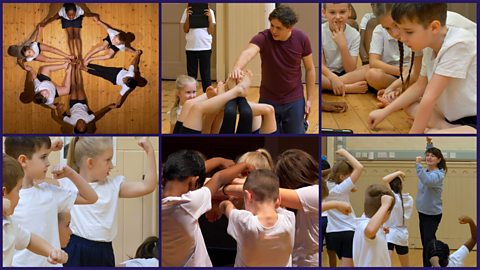
Still images from the 'Alfred the Great' session showing planning, creating, performing and assessing.
Dance frameworks for Unit 3: 'Alfred the Great'
Use the frameworks to extend the dance experience beyond Alfred the Great to a more comprehensive study of the Anglo-Saxon era as a whole.
Framework: Why did the Anglo-Saxons come to Britain?
Click to print / download the framework (pdf)

Framework: Who were the Anglo-Saxons?
Click to print / download the framework (pdf)
Framework: What were Anglo-Saxon beliefs?
Click to print / download the framework (pdf)
Framework: Who was Alfred the Great?
Click to print / download the framework (pdf)
Framework: Why did the Anglo-Saxon dynasty end?
Click to print / download the framework (pdf)
Blank framework template
A blank framework for planning your own dance sessions (pdf).
Click here for the completed Framework template - a guide to creating your own.
Related resources from BBC Teach
History - The Anglo-Saxons. collection
KS2. Songs about Anglo-Saxon monarchs, society, culture and the story of 'Beowulf'.
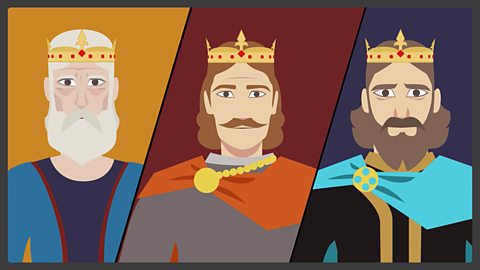
KS2 Music: The Anglo-Saxons. collection
Age 9 - 11. Six songs to learn and dramas covering Alfred the Great, Athelstan, the story of Beowulf and the year 1066.
Beowulf. collection
The Anglo-Saxon story of Beowulf is told in 3 short animated episodes