Unit 2 explores an Aboriginal 'dreamtime' story called The Firebird. Dance expert Claire Pring works with a mixed group of Year 5 / 6 pupils and their teacher in Derbyshire, on a dance that depicts the swooping Firebird, called Wirritt-wirritt, taking fire from the secretive creature, Koimul.
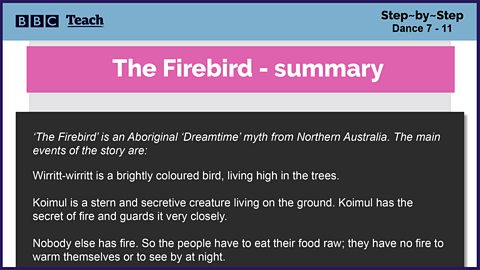
You can listen to Eric Maddern's popular retelling of the story here - the main characters are renamed Bird Lady and Crocodile Man. It's ideal preparation for this dance session. You can also print a summary of the main events of the story.
Unit 2 is concerned with the intermediate dance phase of delivering and performing.
Go to the Teachers' Notes for full details of how to use the CPD film (for teachers) and the Dance Challenge and Final Performance films below (for teachers and pupils).

'The Firebird' - CPD film for teachers
Claire Pring is joins a Year 5 / 6 class and their teacher to work on their dance exploring the Aboriginal fire myth The Firebird.
Claire Pring:I’m here at Castle View Primary School in Matlock where I’ve been working with a wonderful Year 5 class and their teacher Amie.
Amie:Can you find a different way that you can twist for me on the spot?
Claire:Today I’ve come to see how they’re getting on with delivering and performing their dance based on an Aboriginal story.
Amie:Some lovely twisting there - nice big movements.
Caption: Warm Up ~ Mobility
Amie:Good morning, Claire.
Claire:Good morning, morning everybody.
Children:Morning!
Claire:Lovely to see you warming up already, are you twisting?
Children:Yeah!
Claire:Can you twist different parts of your body at the same time? Have a try. Got two arms going that way, I can see someone with legs twisting, very nice, twisting out to the sides.
Amie:Would you like to find yourself a partner and stand next to your partner but not so that you are touching.
Claire:So this time, you’re going to do your twisting actions near to your partner, but like we said, not touching them. So now you’re going to have to be very careful to twist maybe over them, under them, next to them, beneath them, around them. Let’s see what you come up with though.
Claire:We don’t think of a warm up as separate to the lesson – here we are preparing the children for the composition element of dance both physically and creatively.*
Claire:Brilliant. What about if you two tried doing it back to back. Ready for a challenge? You’re going to have to really be aware of each other now. Try it. Think about those different levels you can use, don’t always have to be high.
Amie:Are you going to twist round him? So make your movements work together, ooh you’re going to twist your body, lovely.
Amie:So what sort of timings would we want between the warm up and transitioning into the main part of the lesson?
Claire:As long as they’ve had enough time to really mobilise their joints, get their heart rates up a little bit, and got some ideas going, after that we’re ready to go.
Claire:You twist that leg, yes, yes, yes, well done.
Claire:The learning in this lesson is that structuring a dance is similar to structuring a story.
Caption: Context ~ Application
Amie:I want you to have a think back to the aboriginal legend that we’ve been thinking of about the firebird. And at the beginning of the story we saw Koimul who was protecting, he was guarding the fire wasn’t he the secret of the fire.
Claire:What words can you think of that connect with fire? What about things like the sound that fire makes
Pupil:Crackling.
Claire:Crackling.
Pupil:A spark.
Claire:Spark, that’s a beautiful word. Love that one. It has a real suddenness to it doesn’t it? A spark
Pupil:Like, a twisting sound.
Claire:A twisting sound that’s brilliant because that will go in with our twisting action.
Pupil:A flash from the spark.
Claire:Flash, again another sudden move. So what I want you to do know with your duets, with your lovely twisty movements, is think about some of those other fire words. The spark, the flash, a popping, yeah? Some sparking actions. Things that maybe give us a different speed, because twisting and stuff can often be quite slow and steady, but a sudden spark, will change it.
Claire:That was nice, I like the way your fingers exploded, and then, a bit like a firework, it dissolved. Nice.
Claire:That’s got a flickering quality to it, with your fingers going like that.
Claire:Ooh, love that little darting action with your hands there.
Caption: Creative Exploration ~ Complementary Actions
Amie:So we’re going to think now about the next part of our story. Why was it they couldn’t get the fire sticks off Koimul? Who thinks they can tell me?
Pupil:He was strong.
Amie:He was very strong wasn’t he that’s right. So one pair, you’re going to do your fire actions from before those lovely popping, sparking actions that we all saw added in there. The other pair you’re going to be the ones creeping up on the fire, sneaky, stealthy.
Claire:In these creative explorations get the children to change over so they experience both roles.
Caption: Creative Exploration ~ Dynamic Balances & Stretches
Claire:The Firebird. What does a firebird do?
Pupil:Soars through the sky
Claire:Soars, that’s a beautiful word, soars through the sky. So please could you stand on one foot, make sure you’ve got enough room around you, and now imagine you’re going to use your arms like your wings to help you as you want to soar. Would you take the next minute to show me some beautiful flying balances.
Claire:It’s a good idea to set the task, then introduce the music quietly so it simply informs rather than leads the lesson – it sets a mood or atmosphere.
Claire:So if we use ‘find a way of’ it will be open to the children to find their own way of solving it, which will be more inclusive, it stretches their imaginations more and it just is more inventive.
Amie:So now we’ve thought about our Wirrit-wirrit bird year five, we’re going to think about how we can have that action of the Wirrit-wirrit bird scooping down, okay, to collect those fire sticks.
Claire:You’re also able to just travel a bit so you might, every time you change foot, go in a different direction.
Claire:These are contrasting dynamics – it’s how you do the movements that matters – we’re encouraging the children to be light and free when they are flying but strong and fast when they swoop down to snatch the fire sticks.
Amie:Occasionally you’re swooping.
Caption: Composition ~ Structure
Claire:The sections of the story we’ve covered include – the fire, guarding the fire, is that what you were going to say? Sorry. What else?
Pupil:The Wirrit-wirrit bird.
Claire:The Wirrit-wirrit bird, and also the…?
Pupil:Is it swooping?
Claire:Swooping, it is. So we’ve got four different sections. And we’ve done them in the order they come in the story. Do you have to do them in that order? If we were going to do them in a dance? Don’t have to do you? A bit like a poem really, you’re allowed to put things in a random order sometimes, and juggle up the order we’re going to put them in. And that’s what you’re about to do.
Amie:So how would we differentiate this part for those children that are finding it more challenging?
Claire:We’ve got four ideas, so of course you can always drop down to three ideas, they can select their favourite three and just use those, so you might want to take some of the harder, more challenging bits out. And for more able students you could say ‘okay, one of the ideas you’ve got to have in there more than once, you’ve got to repeat an idea’, so they can build it up.
Caption: Performance ~ Analysis
Claire:It is key to give the observers something to look for instead of inviting general feedback. Overall they should focus on what is eye catching and makes the dance more interesting for the audience.
Amie:You’ve got some lovely arm movements there, I like the way you’re twisting them in lots of different ways, higher and lower. So have you got all of those sections that you need? So now you’re going to go back into your Wirrit-wirrit bird?
Pupil:All of us would go in there at the exact same time in a big line like that.
Pupil:Yeah.
Amie:So you felt like you were in time?
Pupil:Like a line.
Claire:Okay so, we have a really nice start there with you doing a beautiful turn, but actually, just at the moment it looks a bit busy, doesn’t it? There’s a lot going on, and the audience kind of don’t know what to watch. We just need to just use your -
Pupil:Slow down.
Claire:You can slow down a bit, yep. You need to stay in the same spot, yep. And you need to keep that lovely beginning bit that you’ve got.
Caption: Cool Down ~ Air Patterns
Amie:We’re going to move on to cooling down now. And I want you to think about the end of the story, and at the end of the story, when they’ve got the fire, and Koimul decides that he’s going to become a crocodile and he goes off into the river. You can choose to be either the water ripples or the smoke.
Claire:So how do you feel that went?
Amie:Really well, there was some really lovely feedback from each of them to their peers about how they felt things had gone, and ways they could improve their movements. Tablets were really useful for them to give that feedback to each other, and for them to use that assessment going forward in the next lesson.
Amie:Now I’m going to ask quietly, a few at a time for you to go and put your shoes and socks on. So when I point to you, you can go and put your shoes on.
'The Firebird' - Dance Challenge
Year 5 / 6 pupils working in two groups compete with each other to create their own dances exploring the events of The Firebird. Experts Laura Nicholson and Claire Pring will decide at the end who are the star performers.
Presenter:In today’s Dance Challenge, pupils from Castle View Primary School in Matlock go head to head to see who will be the most creative dance group.
Claire Pring:Well hello everyone and welcome to your Dance Challenge.
Presenter:They have been studying the theme of Myths and Legends and have chosen to base their dance on an Aboriginal Myth from Australia – The Firebird. Judging the Challenge are dance experts Claire Pring and Laura Nicholson.
Laura Nicholson:We are looking for dances that have really clear characters from the story. We’re looking for how clearly you’re showing us those characters, different aspects of the story and how creatively you’ve put those things together to make an excellent composition.
Claire:You can have just 5 minutes to make your dances. Your going to get some help, some support, but it’s all about your ideas. And the time starts now!
Laura:So what’s your group name?
Pupils:The Outback Dancers.
Laura:The Outback Dancers, I like it.
Claire:How’s your dance coming on so far?
Pupil:We do the flying bird first.
Laura:Will we know as the judges that your dance has finished? How will we know?
Pupil:At the end I turn into a crocodile, you’re the water and you’re the smoke.
Claire:We’re looking forward to it.
Laura:Can we just pause you for a second? Right we’re getting ready for our Dance Challenge, so have you got a group name yet?
Pupils:The Didgeridoos.
Claire:The Didgeridoos.
Pupil:Yeah.
Claire:That’s a great name.
Laura:Fantastic. What are the main ideas and the main movements that you’ve used in your dance?
Pupil:We turn into birds altogether.
Claire:You’re like a flock, a flock of birds?
Laura:Yeah.
Pupil:We go like that and then we go…
Claire:You’ve got just about another minute to work on it, so we’d better leave you to get on with it.
Laura:Good luck.
Pupils:Thank you.
Claire:Ladies and gentlemen, time’s up.
Presenter:So which dance group will wow the judges with their Firebird composition? First up it’s dance group, The Didgeridoos.
(Dance)
Presenter:Great characters from The Didgeridoos. Taking the floor next, it’s The Outback Dancers.
(Dance)
Presenter:So well done to both our dance groups, and their mentors. Now who will go on to be the winners of the Dance Challenge and be our star choreographers?
Laura:It’s going to be a very, very difficult job. They were both absolutely brilliant pieces of work and what I really enjoyed is how each group had done something different from the same starting point. I especially enjoyed watching the mentors watching their groups and really encouraging them and guiding them through it. I could see that you were really supporting them so that’s absolutely fantastic and it’s going to be a very difficult job.
Claire:Any thoughts?
Pupil:On their group, I didn’t really like when they were crawling across the floor.
Laura:What would you have done differently if you could change that piece of choreography, that composition?
Pupil:Instead of crawling, maybe like, just like, walking and lowering down or something.
Laura:So using low levels but in a different way without actually being down on the floor? Great. Yeah?
Pupil:When the other group came up from their small position, when they started doing the bird, they kept on doing that and I think you could add something else in there instead of keep doing the bird.
Claire:A bit more variety?
Pupil:Yeah.
Claire:We need to make a decision.
Laura:The group that I’m thinking of really used an interesting variety of levels in their dance.
Claire:The one I liked had some lovely little moments of different dynamics, some lovely light flying contrasted with some flickering moments from the fire. I’m wondering if we’re thinking of the same one?
Laura:I wonder if we are. My star choreographers today were The Outback Dancers.
(Applause)
Presenter:Well done to all the Castle View Primary School dancers. And the final Firebird dance performance from The Outback Dancers is coming next!
'The Firebird' - Final Performance
Year 5 / 6 pupils perform their final dance exploring the story of The Firebird.
Resources
Teachers' Notes for Step-by-Step: Dance in Schools
The Notes offer a comprehensive guide to using the content in the series (pdf).
Download audio
Download the audio session for 'The Firebird' unit (mp3).

The Firebird - Slideshow. image
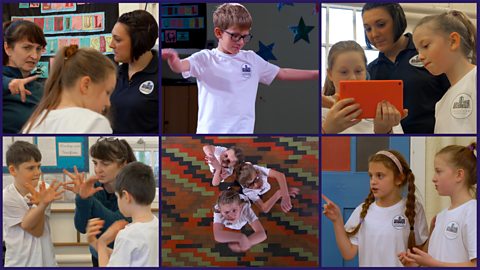
Still images from 'The Firebird' session, showing planning, creating, performing and assessing.
Story: 'Rainbow Bird' by Eric Maddern
Eric Maddern reads his own version of the Aboriginal story explored in this dance unit.

'The Firebird' - Summary. document
Download / print a summary of the main events of 'The Firebird' story.
Dance frameworks for Unit 2: 'The Firebird'
Use the frameworks to explore a range of traditional stories from around the world through dance.
Framework: 'The Firebird'
Click to print / download the framework for this Aboriginal story from Australia (pdf)

Framework: 'The Midas Touch'
Click to print / download the framework for this traditional story from Ancient Greece (pdf)
Framework: 'Romulus and Remus'
Click to print / download the framework for this traditional Roman story (pdf)
Framework: 'Why Warthog is on his knees'
Click to print / download the framework for this traditional story from Africa (pdf)
Framework: 'Creation story'
Click to print / download the framework for this traditional story from China (pdf)
Blank framework template
A blank framework for planning your own dance sessions (pdf).
Click here for the completed Framework template - a guide to creating your own.
Related resources from BBC Teach
Story: 'Rainbow Bird' by Eric Maddern
Eric Maddern reads his own version of the Aboriginal story explored in this dance unit.
4. King Midas and the golden touch
King Midas is granted his wish for everything he touches to be turned to gold.
Music: Traditional tales
Three famous traditional stories explored through music and songs.