Unit 1 explores the theme 'Shape Shifters'. Dance expert Claire Pring works with a Year 7 class and their teacher to develop dances based on geometrical shapes.
Go to the Teachers' Notes for full details of how to use the CPD film (for teachers) and both the Dance Challenge and Dance Performance films below (for teachers and students).

Shape Shifters - CPD film for teachers
Claire Pring joins a Year 7 class to develop their dances based on geometrical shapes.
Claire Pring: In this secondary school, I’ve been working with a fantastic Year 7 class and their PE teacher, Jess.
Jess (teacher): (To the students) Let’s try a different one, Circle…10, 9, 8, 7, 6…
Claire: They’ve been using geometry to develop their choreographic skills.
Claire: (To the students) Good morning Year 7.
Students: Good morning!
Claire: These shapes you make are lovely. Let’s see if we can make these a little more complicated. Can you do a right-angled triangle? How could you do that? Yeah, you can do it sitting down, you can do it lying down, you can do it standing up, you can do it balancing. Brilliant!
Jess: Let’s try an even harder shape. Think to yourself, how many sides does a pentagon have? Show me on your fingers, how many sides does a pentagon have? Good, five. OK I’d like you to try and make a pentagon. Ten seconds… 9, 8…
Claire: The task is to find ways to create and manipulate geometric shapes - revisiting shapes they explored in previous lessons. Here they’re working independently to ensure they are fully warmed up and mentally prepared.
The students progress into working in small groups.
Claire: (To the students) You’re going to have a go at making a square. Try and use, each person in the group, a different part of their body and make it really precise as a square. Think about all the sides, same length – that’s the challenge.
Very nice, what are you going to do with your arms. Maybe your arms almost need to reach your knees. Yeah, that’s looking more like a square to me now, can you see the difference?
Fantastic, amazing. You’re holding, can you hold it? Great strength there.
Well done and I love the way you came out of that safely, that you thought that because I’ve got the legs, I need to come down first.
Each group is going to make a shape. I’m going to choose one group, and it’s going to be you this time. Once they’ve all made their shapes, you’re going to be our Shape Shifters. Maybe you are going to add on to it, distort it in some way, change it, alter it, you are going to literally shift those shapes.
Nice, you’ve added onto it. You’ve changed it from a 2-D shape, a triangle to a 3-D one. You’ve gone now into a pyramid. Beautifully done, well done! Go on to your next one off you go. Well done you two, beautiful shape.
Going through. Cutting it in half. Brilliant, fantastic. Out you come and go onto your next one.
Jess: (To Claire) So, if a teacher doesn’t have as much of a dance background, how can they make sure these lessons are still successful?
Claire: (To Jess) It’s the difference between dance education and dance training. A lot of people think that dance is about teaching sequences, teaching moves. But actually, it’s largely about asking questions and setting tasks. So, we’re not just looking at their performance skills, but we’re also looking at them being able to their compositional, their creative development and also their ability to analyse. So, if you can ask a good question, you can teach a very successful dance lesson.
Jess: Makes sense.
Claire: (To students) You’re about to become your own Shape Shifters. You’re going to make a shape and then you’re going to be the ones that are shifting it. So, make a square. Go, make a square.
Claire: Students are working now in different groups, so they are exposed to new ideas and challenges.
Claire: (To students) Here’s a challenge for you. Can you find a way to fold it? If you had a square and you were going to fold it, how would you do it, how can you show it?
Student: It’d be like a little rectangle. When the square’s folded.
Claire: So, you use that line of symmetry and it kind of goes up and over? Like that.
Claire: The students are establishing a menu of elements to pick from and build their choreographic understanding - using space and relationships creatively.
Claire: (To students) Brilliant. So, you’re going to go back to a square shape again, reform a square. But this time, you’re not going to fold it, you’re going to flatten it.
Jess: We’ve got our 3-D square. To bring it flatter and down, what do we need to do with our different body parts? What could we do with our legs first?
Good. Oh, there you go, all got the same idea. What could we do with our arms?
Good OK. How could we bring it condensed, closer together, so still keeping this square shape? Ah, lovely so using your arms and your shoulders to make those points. Lovely, make sure we’re keeping it looking like a square, nice.
So, this time, you can choose what you want to do to change the shape – dissolve, melt, flatten, rotate, anything you like, but it’s got to be a triangle this time. Are we ready? Let’s go.
Claire: Nice shape. Beautifully stable. I like that.
Student: With this there’s a triangle, and like grows like a plant.
Claire: Yeah, so you’ve increased the size?
Students: Yeah.
Claire: Brilliant!
Claire: If including lifts, ensure the students plan their ideas and allocate roles whilst applying safe lifting techniques.
Claire: (To students) Well done, stabiliser. Don’t feel you have to take your arms off, you look better with them on and it makes a nice clear triangular shape anyway. You’ve got a triangle with your arms and with your legs. And when you’re ready, get one foot out and then the other.
Student: If I take it out.
Claire: So, you’re in control of that. You can just step out of that at any time, alright. That was very nice teamwork, well done.
Jess: You’re going to pick three shapes from these to use in your routine.
Claire: But then like we did before, you are either going to twist it or melt it or dissolve it. You’re going to choose, how you’re going to do them and then how do you move from one to the next. Ready, over to you.
Jess: Let’s go.
Great, so you’ve melted the shape and turned into another one.
Claire: Instrumental music provides a steady tempo, clear rhythmic pattern and structure to support composing the work and performing with accuracy.
Jess: OK so am I right in guessing that you were doing the pentagon, then then the square, then you went into the circle.
Students: Yeah.
Jess: Brilliant, very clear, well done. You did those three so quickly, let’s challenge ourselves - try and add one more.
Claire: Allow the students the chance to try their ideas out, they might solve it in an unusual way, or they might learn that something doesn’t work well and that’s just as important.
Jess: So, from your shape that you have at the end of your routine, how can you transition that into that smoothly? I like that, that looks great.
Claire: (To students) OK. Oh, what was that, that you just did? Beautiful stretch there. Was that what you did when you came up?
Student: Yeah.
Claire: Put it in, put it in, absolutely. Keep the turn as well. But that can take you into the turn really nicely I think, yeah.
Ready…Oh yeah…up and into a turn and start travelling, turn…Yes, yes, yes! Beautiful. Are you going to do a turn? Don’t worry about that, that’s something you kind of go oh that’s what I need to learn for next time, yeah.
Claire: To give the students the opportunity to view and review their work, recording on tablets can be a useful tool. This can be done by the students or the teacher. Watching the work allows the opportunity to share feedback…
Claire: (To students) So, you need to make it sort of cleaner?
Students: Yeah.
Claire: Commenting on the skills being developed, identifying the content covered or omitted and reflecting upon whether the choreographic intention is being effectively communicated.
Claire: (To students) That really worked, that spread apart and then next coming in tight. I think that jump can be bigger as well. Maybe hold it a moment more…
Students: Yes.
Claire: …and then…yeah, yeah, exactly that. OK Happy with that?
Students: Yes.
Claire: OK, brilliant!
(The cool down)
I’d like you to make a line, a vertical line. Wonderful, fantastic.
Can you find a way of bending that vertical line or folding it in some way?
Brilliant. A triangle, how can you make a triangle with your body? How can you flatten it? Maybe make it melt. Or maybe stretching it out to flatten it…and relax.
Shape Shifters - Dance Challenge
Year 7 pupils create and perform their dances on the theme of 'Shape Shifters'. Experts Laura Nicholson and Claire Pring will decide at the end which group will take part in the Dance Performance.
Narrator: In today’s Dance Challenge, the theme chosen by our students is 'Shape Shifters'. Deciding which group is the most creative are dance experts Laura Nicholson and Claire Pring.
Claire: Hello everybody.
Students: Hi.
Laura: So, the dance theme that we’re going to be working on today is geometry and this is a really great starting point for dance because it means you can explore some really great shapes and use of space such as things like formations.
Claire: You’re only going to have 10 minutes to work on these pieces, and the time starts now.
Claire: (With group 1) Oh, may I just pause you a minute? Can you tell me, what is the name of your group?
Students: (Group 1) ‘Dance Triangle’.
Claire: Is that because you use those triangles as one of your shapes?
Students: Yes.
Laura: Great, what kind of shapes have you included?
Student: Like a trapezium, and a circle.
Laura: Amazing, that sounds fantastic.
Claire: Thanks you so much, keep rehearsing.
Laura: (With group 2) Hi everybody, sorry to interrupt you, that was fantastic. Have you chosen a group name?
Students: (Group 2) ‘Shapify.’
Laura: ‘Shapify’? Brilliant, I love it.
Claire: And you’re quite a big group, are you finding that is helping you, or is that difficult?
Student: It’s a bit hard.
Claire: You’ve got a lot of ideas to include, haven’t you. It’s looking fantastic. Keep rehearsing - over to you. (To everyone) Just to let you know, you’ve got two more minutes.
Claire: (With group 3) Can we pause you a moment, have you got a group name yet?
Students: ‘Vectors’.
Claire: ‘Vectors’, very nice.
Laura: Fantastic, and can you tell me a little bit about your dance?
Student: So, we have loose canon, canon, unison and many other things that we need to make our dance.
Laura: Fantastic, so lots of different relationships, brilliant. Can you tell me about some of the shapes that you’ve included in your dance?
Student: Circle, star, square.
Claire: Ah, well done, going to look forward to seeing that piece, keep rehearsing. (To everyone) And stop everybody. Time’s up!
Narrator: So, now’s the time to see their ‘shape shifting’ dances - who will impress the most? First up it’s ‘Shapify’.
Narrator: (After dance snippet) Now that’s going to be hard to beat. Next, it’s the ‘Vectors’.
Narrator: (After dance snippet) Truly fantastic. Time for our final group, it’s the ‘Dance Triangle’.
Narrator: (After dance snippet) Wow, really incredible dances. Now our judges have to decide.
Claire: (To the students) Have any of you got any comments you’d like to make on it?
Student: I like how the ‘Dance Triangles’ like used canon and loose canon which made like, it was a really good concept.
Claire: Kept your interest because they used different relationships, fantastic, thank you.
Student: For the ‘Vectors’, I liked how their dance matched the music.
Claire: Brilliant so they’d got that music dance relationship going on. They’d obviously worked hard on that. Thank you very much.
Student: I liked about ‘Shapify’ er, when, they actually showed a lot of expression.
Claire: And they worked really well as a team didn’t they.
Laura: Thank you very much. So, we have come to a decision. We can only choose one group even though they were all fantastic. So the group that we would like to see again is…‘Dance Triangle’!
Narrator: So, the ‘Dance Triangle’ group it is! Their final Dance Performances is coming next.
Shape Shifters - Dance Performance
The successful Year 7 group performs their full shape-shifting dance.
Resources
Teachers' Notes for Step-by-Step: Dance in Schools
The Notes offer a comprehensive guide to using the series content (pdf)
Download audio
Download the audio session for the 'Shape Shifters' unit (mp3)

Unit 1: Shape Shifters - Slideshow. image
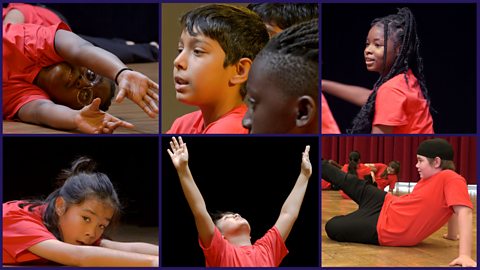
Still images from the 'Shape Shifters' session showing planning, creating, performing and assessing
Dance frameworks for Unit 1: 'Shape Shifters'
Use the frameworks in sequence to deliver an extended dance scheme on the theme of geometrical shapes.
Framework 1: Shapes in space and time
Print / download the dance framework (pdf)

Framework 2: Shapes and formations
Print / download the dance framework (pdf)
Framework 3: Manipulating geometric shapes
Download / print the dance framework (pdf)
