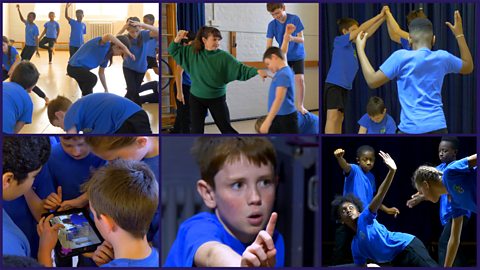
Unit 1 focuses on the WW2 history topic 'The Blitz'. Dance expert Claire Pring works with a Year 6 class and their teacher in London, to create a dance exploring lightning shapes (from 'Blitzkrieg' or 'Lightning war') and the effect of falling bombs on nearby buildings.
Unit 1 is concerned with the initial dance phase of planning and creating.
Go to the Teachers' Notes for full details of how to use the CPD film (for teachers) and the Dance Challenge and Final Performance films below (for teachers and pupils).

The Blitz - CPD film for teachers
Claire Pring joins a Year 6 class and their teacher in London to work on their dance about 'The Blitz'.
Claire:
I’m here at Heathbrook Primary School in Lambeth, South London, where I’ve been working with a fantastic Year 6 class and their teacher Bekki.
Bekki (teacher) to pupils:
The first thing I’d like you to do as our warm up is to use just one of your arms to make the shape of lightning.
Claire:
They’re just beginning to explore some dance movement ideas that are inspired by their work on the Blitz.
…
Claire:
Morning everyone! Love your lightning shapes. You’re doing brilliantly. Is there a way you could do these brilliant angles and jagged lines with two different body parts at the same time?
The plan here is to address the physical skills of dance and see whether the children can perform a wide range of actions and use dynamics to convey the idea of lightning. We’re looking for balance, control, co-ordination, flexibility and placement in their movements. The lesson is about improvisation here - exploring movement ideas.
That was a lovely stretch then. Like it - keeping it big.
Child:
Quick and sudden movement and then I went (demonstrates) with my elbow…
Bekki:
When I’m going round talking to the children and asking them to describe what they have been doing, what sort of things do I need them to be saying or listening out for?
Claire:
You’re going to hope that they’re going to describe the action, the jump, the turn, the travel, whatever it is, but also how they do the action. The dynamics in this case is really important. We’re looking for words like sharp, sudden, quick, brisk, all those kinds of words. We’re looking for words that describe the action, the space the dynamic, and sometimes even the relationship between them.
Bekki (to pupil):
Strong movements, fast movements! How else would you describe that kind of movement that you were making?
Pupil:
Edgy.
Bekki:
Edgy, that’s good. And then what about in relation to like how you are using the space?
Pupil:
We’re trying to make it like as big actions as possible.
Claire:
Allowing time for them to explore actions ensures they are each able to work at their own level. This will probably look ‘messy’ but it’s no different to every child writing a different opening line to a story.
…
Bekki:
Can anyone remember the German word for 'lightning'?
Pupil:
Er, blitz.
Bekki:
Good, so remember blitz is the German word for lightning. Basically this was describing how heavily bombed the cities were during World War 2.
Claire:
Around the 1930’s and 40’s, what sort of building do you think would have been around here?
Pupil:
Like churches?
Claire:
Churches.
Pupil:
Shops and schools?
Claire:
Shops and schools. One more.
Pupil:
Ammunition factories?
Claire:
I wasn’t expecting that idea but you’re absolutely right well done. OK, so you’re going to pick a building in that group and see if you can find a way of making that building with your bodies.
…
This is the next part of the lesson plan and like the lightning where the children were asked ‘What does it do?’ here the children are simply asked ‘What shape does it make?’ Both come directly from the work they have been doing on the Blitz.
Bekki:
When you get children to choose their groups, how do you do that so that someone’s not always left out?
Claire:
By having groups of different sizes it will mean that you don’t have that awkward situation of one child being left alone, but also choreographically, it will make it more interesting.
…
Claire:
So, the reason I stopped you at the moment is we need to think about how we are doing these safely. So who’s moving first, where are they going to, how are they getting down, to make sure we’ve got people moving to the floor without the risk of injury. Does that sound sensible?
Class:
Yeah.
Claire:
So you need to have a conversation first before you get on and do it so you know who’s moving where.
…
Bekki:
Now you need to think which one’s the best, so where’s the first one?
Pupil:
That one looks weird because…
Pupil:
It’s really unstable because the tower.
Claire:
So is there something you want to change, that will make it more stable, make it easier for you to hold?
Pupil:
Maybe make it like wider…
Claire:
That would make a big difference.
Claire:
Hopefully by giving some real clear parameters on what they’re going to feed back on it will really help them improve either the shape that they’re making with their bodies, or how they’re working together.
Bekki:
Yeah, they were able to give that feedback that it led to an improvement.
…
Claire:
So, you’ve now got the shape of a building. You’re going to use that now as your starting position. I want you now to imagine that some distance away, a couple of streets away, a bomb has dropped – a blitz has happened. What impact does that have on your building? Does your building just tremor? Does your building have some minimal damage? Or is it really impacted upon by it? Over to you please.
The lesson creates some great opportunities to develop the children’s physical skills. A Year 6 class, like this, should be using the whole body and they should also have a sense of the aesthetics of their shapes and balances.
Is it really going to cause that much damage?
Pupil:
No.
Claire:
Maybe less?
Pupil:
Maybe one side.
Pupil:
Like this side rocks.
Claire:
Yeah, you think?
Pupil:
3, 2, 1, Bomb drop!
Bekki:
In terms of moving this on, I guess is next…
Claire:
So we’re going to get them now to respond to the idea of different levels of impact happening, so as if the bomb’s getting closer. So they should then be able to manipulate and manage these shapes in different ways and we’ll get different responses from them.
…
Bekki:
I’ve seen some really nice shuddering and trembling and just thinking about more gentle movements, this time, there’s been a direct hit, not on your building but on a building next door. Now how will you change your movements but still remember the safety aspect of not just getting out of your position but getting into it. Okay?
Claire:
Hopefully the groups will respond with a significant change in shape suggesting that the building had been ruined. More capable groups may decide to show more than impact responses.
…
Bekki:
Think back to the beginning of the lesson, think about all the shapes you were making with your body to show all the lightning. So one group is doing the shapes of the lightning and then the other group thinks how that will impact on your building.
**Claire:
This is the next part of Bekki’s plan and the key learning outcome of the dance lesson: the use of question and answer, or call and response, as a choreographic relationship. **
…
Claire:
We’ve put the buildings together with that blitz, but what we really need to see now is the different effect that the lightning has from how close or far away it is.
Claire:
So this dynamic that they’re doing for the lightning…
Bekki:
Yep…
Claire:
…because they haven’t done it since the beginning of the lesson, the warm up, they’re losing the quality of it now, and the ‘how’ they do an action communicates so much about what it is they’re trying to show. So bring that dynamics back in, the speed, the force, the actions.
Bekki:
Yep…
Claire:
And that really communicates well.
Claire:
So spread yourselves out, Blitz people. Come round here. You’re going to do me your sharpest, quickest, lightning move. You can use two different body parts. Go!
And stop! Hold still. Building react. Lightning, blitz go! And stop! Building react. That was so much better, well done. Cause and effect. Showed it really well there.
…
Claire:
Every time I clap my hands like this (Claps hands) I’d like to see your building crumble just a little. (Claps hands) And with every tremor (Claps hands) another bit (Claps hands) carefully (Claps hands) collapses (Claps hands) to (Claps hands) the floor.
The Blitz - Dance Challenge
Year 6 pupils working in two groups compete with each other to create their own dances about 'The Blitz'. Experts Laura Nicholson and Claire Pring will decide at the end who are the star performers.
Presenter:In today’s Dance Challenge the theme chosen by pupils from Heathbrook Primary School in Lambeth, South London, is The Blitz. Judging which group is the most creative are dance experts Laura Nicholson and Claire Pring.
Claire Pring:Well hello everybody.
Pupils:Hello.
Laura Nicholson:This isn’t necessarily an easy topic to work on, but it’s a topic that people have made pieces of art about for lots and lots of years so your challenge today is to create a piece of dance that reflects those ideas.
Claire:You can have 5 minutes to get your dance together. Are you ready?
Pupils:Yeah.
Claire:Over to you.
Claire:So how’s your dance going?
Pupils:Good.
Claire:Have you got a group name yet?
Pupils:Yeah. Keep Calm and Carry On.
Claire:Very good. Have you managed to include lots of ideas into your dance?
Pupils:Yeah.
Claire:What have you put in?
Pupil:We added a bit of canon.
Claire:Very good so where you do things one at a time?
Pupils:Yeah
Claire:Excellent fingers crossed for you, hope it goes well.
Pupils:Thank you
Laura:How’s your dance going?
Pupils:Good.
Laura:And what’s your group name?
Pupils:The Sirens.
Laura:And which ideas have you used in your dance so far?
Pupil:Every time a piece of building gets knocked off, they join the bombs.
Laura:So the building then becomes part of the lightning strike and the bombs.
Pupils:Yes.
Laura:Fantastic. Looking forward to performing it?
Pupils:Yes
Laura:Great, well we’d better let you get on and rehearse.
Claire:You have literally got one more minute.
Presenter:So which dance group will impress the judges the most with their creative choreography? First up it’s The Sirens.
(Dance)
Presenter:Pretty scary stuff from The Sirens. Now it’s Keep Calm and Carry On.
(Dance)
Presenter:Amazing, and well done to both groups! The judges now have their work cut out to decide whose Blitz dance was the most effective.
Laura:Absolutely amazing work Year 6. Absolutely brilliant from both groups. It’s really hard to believe that you’ve put those dances together in such a short space of time and what I loved was that all the ideas were entirely yours. Does anyone have any feedback about the other group’s performance? Yes…
Pupil:I really liked how Dexter like fell to the ground then he got straight back up. He was stiff then he just like tipped over like a statue would do.
Laura:Great, any other feedback?
Pupil:They all knew exactly what they were doing and they did it at exactly the same time and when they did it they could just flow into it.
Laura:Do you know what it’s called when we do the same thing at the same time in dance?
Pupil:Unison?
Laura:Unison, exactly yes.
Claire:I’m afraid we’ve now go quite a hard job.
Claire:We need to select one dance that we think has got the most original and creative ideas in it. What are you thinking?
Laura:It’s a really, really tough decision. The group I’ve got in mind I especially liked the way they had two different things happening at the same time that was really, really clear. And then those groups swopped and when they swopped they thought about using a really smooth transition, a smooth linking movement to change over. So, the group that are going to be our star choreographers today are Keep Calm and Carry On.
(Applause)
Presenter:So Keep Calm and Carry On it is. Their final Dance Performance is coming next!
The Blitz - Final Performance
Year 6 pupils perform their final dance inspired by the topic 'The Blitz'.
Resources
Teachers' Notes for Step-by-Step: Dance in Schools
The Notes offer a comprehensive guide to using the content in the series (pdf).
Download audio
Download the audio session for 'The Blitz' unit (mp3).

Unit 1: The Blitz - Slideshow. image
Still images from 'The Blitz' session showing planning, creating, performing and assessing.
Dance frameworks for Unit 1: 'The Blitz'
Use the frameworks to extend the dance experience beyond 'The Blitz' into a range of other cross-curricular WW2 themes.
Framework: The Blitz
Click to print / download the framework (pdf)

Framework: The Shelters
Click to download / print the framework (pdf).
Framework: Evacuees
Click to download / print the framework (pdf).
Framework: War artists
Click to download / print the framework (pdf).
Framework: Slogans
Click to download / print the framework (pdf).
Blank framework template
A blank framework for planning your own dance sessions (pdf).
Click here for the completed Framework template - a guide to creating your own.
Related resources from BBC Teach
The Blitz. collection
News reports on the Blitz and descriptions from adults and children of being bombed.
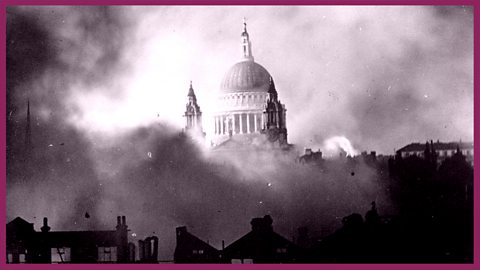
Class Clips - The Blitz. video
A brief guide to the Blitz, including how the British people responded.
Friend or Foe. collection
Age 9 - 11. Michael Morpurgo's story about evacuation and friendship during WW2.