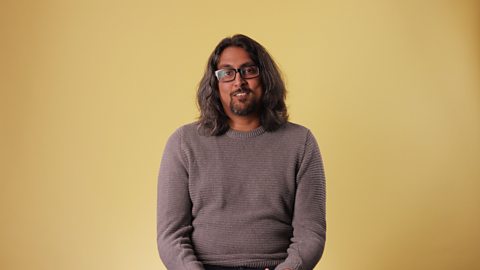
Tom Foolery:
There have been so many poemsthat took me much longer than they neededto because I spent a long timetrying to get each line perfect.And that doesn'talways have to be the way.
Hi, my name's Tomfoolery,and I'm a poet from London.Over lockdown I started making poetry videoswith my little brother and sister,Kai and Sora.And one of them called"The Great Realisation",went viral on the internetand got shared around a lot.And since then,that's been able to be my job.
I read a lot.I try and talk to people.The main thing really is,which I think a lot of artists do, is I tryand figure out what's interestingin the moment.That could be anything,that could be Englandgetting to the finals of the Euros.It could be something happeningwithin my personal life,you know, that maybethe whole country doesn't know about.
My little granny's gotdementia at the moment.Maybe I'm thinking a lot about that.And so I try and focus on what mattersto me in the moment because the workis always going to be most interestingif it matters to you.
I'm guessing the stimulusthen is the colour.What does that make me think about?"The color purple" is the name of a book.It's associated with strengthand ferocity, but also, I think royalty.I think it's quite a regal colour.You always have a choice to try and writesomethingabout what lots of peoplemight associate with that stimulus.Or you can go down a personal routeabout what you specifically associatewith that stimulus.And I really like doing that.I told you guys beforeabout my little granny.She was a piano teacher in her piano roomall of the furniture was purple,and I remember being really, really littleand sitting on itand listening to her play the piano.
Maybe for this, it would be nice for meto write something about that.In this section is where I liketo figure out where I'm goingbefore I start trying to go there.We're often told in school thatyour story should have a beginning, middleand an end.
A really good teacher once told meit's not beginning, middle and an endbecause that's not helpfulbecause it doesn't tell youwhat goes in each of those sections.So I like to think of it:things are stable,then they're unstableand then they're resolved.When things are stable,it means could be better, could be worse,then things are unstable.The problem emerges. In the final sectionthey're resolved.
So for this poem,I guess I want to tell you the storyabout my grandmother's life,but I want to do that basing myselfin that roomthat I used to sit in watching herplay the piano and watching her handsdancing around the keys.Yeah, I think I'll start there.
You should never expect your first draftto be the perfect poem.Sometimeswhat's most useful is just tryingto get the ideas out of your headand into words.By doing that, then you can organise them.After that, you can kind of start to thinkabout the fanciful parts of poetry.You know, putting it into stanzasand rhyming couplets and rhyming it.Stanzas are like your little poemparagraphs.
I had a teacher once that told me,if you can get rid of any lineand the poem still makes sense,you should get rid of that line.Now, that is brutal advicebecause it's hard to get rid of thingsthat you've writtenand that you care about.It's often more difficult to say somethingin a few words than a lot of words.So what I do is when I get to the end,I interrogateeach line almost as if I'm asking them,'Do you deserve to be here?'
And if they don't make a good enoughcase to me, then they got to go.I think I've got something now,so maybe we should give it a read.
I want to show you my grandmother's hands.Show you them when they were newand young and curiouswhen their fingers learned to addand when that palms began to sweatbefore the school tests.I want to show you them when theyimpatiently studied the scales and arpeggiosand when they danced across the keyswithout thinking. I want to show you themwhen they first held my grandfather's handand when he, knowing their importance,lassoed one finger with the Welsh gold.I want to show you themwhen they had children,when they first held my mother and thenwhen they held me and wiped my runny nose.I want to show you themwhen they come together in church,when they wipe away tears as they letgrandpa go.How they embraced my small cousinson Christmas Day lunch and movethe old boot when we play monopoly.I want to show youthem now after a lifetime of thingsthat you compare them to yoursto see what lies aheadas each line that runs through themtells a tale of its own.And how even now they play a mean piano.
I never thoughtI would be able to be a poetbecause I didn't knowanyone who was a poet,but there are certain things in your lifethat you will do,even if nobody's asking you tobecause you love that thing.And if you find that thing, you should dothat as much as you possibly can,because the more you do it,the more experienced you'll get.And these days, you can share thatwith a click of a buttonwith so many people.Perhaps one day that would be the thingthat you do with all of your time.I wish that for everybody. So good luck.
Video summary
Perfomance poet Tomfoolery reveals how he first got into poetry and talks through his creative process.
He talks about focusing on subjects that matter to you in the moment, whether they're personal or universal, as the work will always be more interesting if it matters to you.
Tom also describes the way he structures a poem – based on advice from a former teacher – instead of thinking in terms of a beginning, middle and an end, he tries to think of it as; things are stable, then they're unstable and then they're resolved.
This short film is from the BBC Teach series Inside the Writer's Mind.
Teacher Notes
Before viewing
Remind students about poems they have studied. What makes a good poem?
During viewing
Clarify how a stimulus can be interpreted in multiple imaginative ways.
Make links to structuring a narrative.
After viewing
Give students an unusual stimulus: a colour, a piece of music, a month or day, etc. mind map ideas based on this stimulus.
Revisit poetic techniques and devices.
Discuss what Tom’s attitude towards his grandmother is? How is she portrayed through his words?
This short film will be relevant for teaching English language at KS3 and KS4 in England, Wales and Northern Ireland and National 4 and 5 in Scotland.
Topics covered include character and plot development in narrative writing; making links to word meaning, effective punctuation and narrative structure; understanding characterisation, narrative planning, story structure, editing, proofreading and redrafting.
Derek Owusu – Writer. video
Derek Owusu, who works across a number of genres but is perhaps best known for his fiction writing, talks about the importance of finding your voice with your creative writing.
Hannah Khalil – Playwright. video
Hannah Khalil, a Palestinian-Irish playwright, talks about the creative process she goes through when writing for the stage.
Javid Rezai – Screenwriter. video
Javid Rezai, a British-Iranian-Italian screenwriter, offers insight into his creative process and how a collaborative writer's room works.
Vicky Foster – Poet. video
Vicky Foster, who works across a number of genres but is perhaps best known for her poetry, talks through her creative process when writing and editing a poem.
Maisie Chan – Children’s Author. video
Children's author Maisie Chan talks about how a lack of British East Asian and Southeast Asian representation in books spurred her on to become a writer, and gives insight into her creative process.
Priya Hall – Comedian. video
Stand-up comedian and comedy writer Priya Hall talks through her creative process and gives advice on comedy writing and performance.
Ram V – Graphic Novelist. video
Graphic novelist Ram V talks about how his background influences his writing, and the collaborative and creative process of creating a graphic novel.