Hannah Khalil:
Be very, very, verycareful if anyone tells youthey have the secret recipeon how to write the perfect play,a formula. There is no such thing.
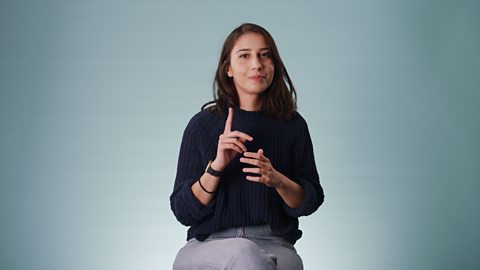
Hi, I'm Hannah Khalil.I am primarily a playwright,I also write for TV and radio as well.I think I started writingbecause I'm not very good at conflictand I'm not very goodat coming up with responses in the moment,if someone says something that bothers me.
So I go away and stew a bitand then think, Oh,I should have said thatand then scribble it down on the page.My background is dual heritage.My dad is from Palestineand my mum is from Ireland.And I think that dual heritageand the fact that I grew upin the Middle East and then came to the UKalso sort of spurred me to write storiesabout the places my family are from and to try and representcharacters on stage that I don't thinkwe normally see enough of,or certainly we don't see themin a non-stereotypical way.
There are lots of different thingsthat inspire me to write,mainly injustice,I get frustrated if there are thingsthat I feel are wrong in the worldand I want to shout about themand writing is a really empowering wayof being able to do that.
As Spider-Man said: 'With great powercomes great responsibility.'So make sure you knowwhat you're writing about,You understand it, you think carefullyabout what you're sayingand why you're saying it.
But writing is areally important political act,and it's a way to put the kind of worldthat you want to see on stageand bring it to life.
And it is a photograph of a lady with a baby.So with this picture, I'd be asking myselflots of different questionsabout this woman.How long did it take her to have thisbaby?Did she want it in the first place?Is this her only baby?
Possibly most interesting for me:Is she back at work?Now the reason I think'is she back at work?' is a really interestingquestion is because this personis probably having to suddenly undergoa new identity, step into new shoes,and we're all doing that all the time,navigating all these different identities.
So even if you're not a parent,you can understand thatthe difficulty of thatof being in different spacesand having to present yourselfdifferently.And I'd also be asking,what can I do with this story to makeit really properly theatrical?You could do a story abouta working mum on TV.Of course you could.
But if it's going to be a play,why is it at play?What is it about the wayI'm going to tell this story?That means that it being live and havinga live audience is really important.You can start with the title of the play.I wouldn't get too hung up on that.It will come as you're writing.Stage directions are really key.So these are sort of explanationsfor anyone who's reading the play aboutwhere you are, what's happening on stage,what we can see.
And then you're writing dialogue,which is the bit I love,which is differentcharacters talking to each otherand trying to capture their voice.That's pretty much it with a play,
You don't need any specialist software.In fact, I really like using just likeyour basic word processing software.Always think about the factthat even thoughplays are never meantto be read at a desksomeone will do that, so make it as easyfor people to read as possible.
First drafts normally for me come outvery easily and then redrafting is harder.You need a community of people around youwho you trust.And then comes the thornytask of redrafting, going back overand making sure that the play iswhat I really wanted it to be.
That I'm sayingwhat I wanted to say.So having looked at that stimulus,the thing I'm thinking most about is aboutreturning to work, and I'm thinkingabout how I would dramatise that on stage.And so I'm going to write a little bit.The beginning of a scene let's say,On my phone, and let's see howit goes.
The main thing I'm doing hereis doing stage directions.In my brainI'm thinking about the stage space.I'm just imagining a scenelike how it will look,how the actor will look in space,and I'm going to try and put that downlike what the audience see.
We watch a womanget ready for work in her bedroom,putting on amazing professional clothing.Blazer, trousers, blouse, make-up, hair.She does it slowly with intent,and it should be perfectas if she's getting ready for battle.Now she's ready.She looks at herself in the mirrorand nods.She's happy. She looks great.Then another person enters the room.This could be a partner or a parent.It doesn't matter.But when they open that door,we hear a baby crying.The person who comes in look surprisedthat this woman is dressed for work.The baby's cries get louder,and in that moment, we see milkblossoming on the woman's blouse.She's lactating in responseto her child's cries.The partner shakes their head and pointsto the clothes, seemingly asking'why?' with their expression.Our woman closes her eyes for a secondand then very slowlytakes off her clothes.She puts on a dressing gown,she takes out her hairand then she goes out of the room.
Get people to readyour play out loud. Plays are not meantto be sat and read at a desk,they're meant to be brought to life,air is supposed to be breathedinto them by actors or friends.So just get a group of mates aroundand get them to read it.You'll hear things in therethat you didn't know were there,and it will be really,really inspiring for you.
Video summary
Hannah Khalil, a Palestinian-Irish playwright, talks about the creative process she goes through when writing for the stage.
She talks about her dual heritage background, growing up the Middle East then moving to the UK, and how it spurred her on to write stories about the places her family were from.
Hannah also stresses the need to read your play out loud, as you'll hear things that you didn't know were there, and this will inspire you.
This short film is from the BBC Teach series Inside the Writer's Mind, and is supported by a free classroom resource from First Story.
Teacher Notes
Before viewing
Hannah’s final piece references motherhood. Although your students are very unlikely to be parents, they should be prepared to imagine and read about situations outside of their own experience.
The protagonist in Hannah’s piece is also juggling her identity, something students will be familiar with. For example, they probably speak and behave differently with school friends compared with grandparents – and differently again with teachers.
Students could also look at how Hannah creates empathy for her character.
Remind students of the saying ‘The pen is mightier than the sword’ and discuss possible meanings. How can writing be powerful? How can writing be empowering?
Recap on plays studied in class or theatre visits.
What makes something theatrical? How are stage directions used?
After viewing
Hannah Khalil has written a play without dialogue – How effective is this? Why is it effective?
Discuss how stage directions alone can communicate a range of feelings and emotions.
Give students individual situations to portray through stage directions alone (for example, a family on Christmas morning) – can their peers guess the situation through brief stage directions?
Using Hannah’s stage directions, write the first few lines of dialogue between the mother and the second character.
Consider the texts studied in class, write a conversation between two characters.
This short film will be relevant for teaching English language at KS3 and KS4 in England, Wales and Northern Ireland and National 4 and 5 in Scotland.
Topics covered include character and plot development in narrative writing; making links to word meaning, effective punctuation and narrative structure; understanding characterisation, narrative planning, story structure, editing, proofreading and redrafting.
Derek Owusu – Writer. video
Derek Owusu, who works across a number of genres but is perhaps best known for his fiction writing, talks about the importance of finding your voice with your creative writing.
Javid Rezai – Screenwriter. video
Javid Rezai, a British-Iranian-Italian screenwriter, offers insight into his creative process and how a collaborative writer's room works.
Vicky Foster – Poet. video
Vicky Foster, who works across a number of genres but is perhaps best known for her poetry, talks through her creative process when writing and editing a poem.
Tomfoolery – Performance Poet. video
Perfomance poet Tomfoolery reveals how he first got into poetry and talks through his creative process.

Maisie Chan – Children’s Author. video
Children's author Maisie Chan talks about how a lack of British East Asian and Southeast Asian representation in books spurred her on to become a writer, and gives insight into her creative process.
Priya Hall – Comedian. video
Stand-up comedian and comedy writer Priya Hall talks through her creative process and gives advice on comedy writing and performance.
Ram V – Graphic Novelist. video
Graphic novelist Ram V talks about how his background influences his writing, and the collaborative and creative process of creating a graphic novel.