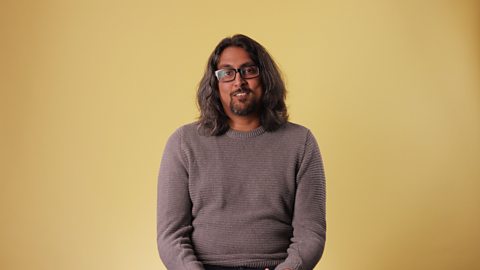
Priya Hall:
It's very much a process of sitting down and being like, is there anything in this? I think it's funny. Will anyone else? Sometimes - no, but oh well.
I'm Priya Hall. I'm a stand-up comedian and a comedy writer. I really like comedy writing because I find it's a really useful way to process what's happening in the world and try and get some laughs out of it and some joy out of it. And I really enjoy performing comedy as well for the same reason. It's nice to have that feeling of unity with an audience.
When I'm writing, I like to start with a topic. For example, I write a lot about my family. I write about my cat a lot. You can write about pretty much anything if you start with like a core topic that you yourself find funny. And then just write around that. I make notes of things that I see just out and about the place in the Notes app on my phone, send voice notes to friends being like, Is this funny? And then sort of just try and collate all of that information and write as many jokes as I can about that topic so that I can then go and try those jokes in front of an audience.
So this is my writing stimulus. It is a can opener, not something I would usually write about. It's a fairly mundane piece of technology that's in your house, but as I said, you can pretty much find comedy in literally anything. So the questions I might ask is, like, who invented the can opener? When was it invented? What's this can opener opened? What's it interacted with? Then what I'd do is I'd find an angle that I find particularly interesting, so I do find it a bit interesting that someone invented this, someone sat down and worked on this. That's weird. I might sit down and write around that topic and maybe use it as an avenue to explore other topics that aren't exclusively related to a can opener.
When I'm writing, for example, like I will be doing with the can opener, I sort of have to take into account my onstage persona. A lot of people go deadpan, which is just very monotonous and can be very funny because you juxtapose it with the things that you're saying. A lot of people go very loud. And that's, like, shocks the audience. So they quite like that. My onstage persona, if you will, is just an exaggerated version of myself. I sort of play a character that is constantly bemused by what's happening in the world and sort of mildly stressed by it. I'll maybe use writing about this particular topic to segue into other topics that sort of suit that persona as well.
Not everything I write is true, but it's often the case that comedians will sort of exaggerate what is happening to them or in the world in order to get a laugh. So when I'm writing, I will take into account punctuation. That's like a huge part of it. Obviously, the way you structure sentence changes the way you say it on stage. So I will make sure to emphasise certain parts of it. The use of rhetorical questions are quite funny.
For setup to a joke. What you're trying to do is create tension with the audience, so you ask them a question or you tell them a story that has quite a lot of tension in it. And then the punchline - what you're aiming to do with that is to pierce that tension and let it all go. And that's what usually gets a laugh. Usually with a punchline, you're doing that with subverting their expectations. So you are confusing them at the last minute and that gets a bit of a laugh. There's very much a difference between the jokes you have written down in the first draft and what you actually end up saying on stage, so what I tend to do is practise saying them aloud at home, because quite often you'll find that you've accidentally written tongue twisters for yourself. So my cats heard a lot, a lot of bad stand-up routines.
In order to keep editing my set and my jokes, I'll do a bunch of gigs and I record all of my sets and listen back to them because then I'll be able to pick up if I do anything different. If I riff, if I use emphasis on a different part of the setup or punchline I'll be able to figure out easier what works. And you also capture the audience's reaction, which is useful to have. When writing a set you generally start with your second best joke and you end with your best joke because you want to leave them on a good impression. Let's give these a go out loud.
I think can openers are the pinnacle of human achievement, like, we had a problem:Can.And we have a solution:Can openerIf we can apply this single-minded focus to something like, say, the climate crisis? Maybe we'll be able to turn this thing around. But no, we care more about access to beans than we do clean air. And I have another one. Why do soup makers need to exist when can openers have the same result without being such drama queens about it?
Advice that I would give to anyone looking to start stand-up or start comedy writing is to just give it a go. There is nothing better than being on stage and getting a good reaction from the audience. If you are trying to write and you are struggling to find humour in things, that's completely fine as well. Comedy is such a subjective thing, and it's difficult sometimes if you're not in the mood to try and, like, force it.
And also don't worry if you try it and it doesn't go particularly well. So much of a part of stand-up is trying and failing and having deaths on stage or like bombing is completely normal and completely fine. And if it's something that's worrying you to the point where you're not doing stand-up, do not worry about it because it happens to literally everyone.
Video summary
Stand-up comedian and comedy writer Priya Hall talks through her creative process and gives advice on comedy writing and performance.
She talks about finding a core topic that you find funny and writing as many jokes as you can around that subject.
Priya also advises anyone starting out in stand-up or comedy writing to give it a go and not to get discouraged when a performance doesn't go well.
This short film is from the BBC Teach series Inside the Writer's Mind, and is supported by a free classroom resource from First Story.
Teacher Notes
Before viewing
Students could discuss what makes them laugh (for example, wordplay, puns, irony, witticisms, sarcasm, etc.)
Discuss how humour can be found in everyday situations and share possible examples.
During viewing
The approach for writing comedy is the same as preparing for any written work – begin with a stimulus and mind map ideas.
Clarify the importance of punctuation for effect.
Understand that a joke is a miniature narrative.
Comedy is written, planned and crafted in order to appear natural.
The best comedy is always about something that people can relate to.
After viewing
Students to create mind maps around everyday relatable situations:
- running out of milk
- no hot water
- can’t find PE kit
- batteries run out in TV remote
Allow students the chance to tell their stories about these incidents and experiences.
This short film will be relevant for teaching English language at KS3 and KS4 in England, Wales and Northern Ireland and National 4 and 5 in Scotland.
Topics covered include character and plot development in narrative writing; making links to word meaning, effective punctuation and narrative structure; understanding characterisation, narrative planning, story structure, editing, proofreading and redrafting.
Derek Owusu – Writer. video
Derek Owusu, who works across a number of genres but is perhaps best known for his fiction writing, talks about the importance of finding your voice with your creative writing.
Hannah Khalil – Playwright. video
Hannah Khalil, a Palestinian-Irish playwright, talks about the creative process she goes through when writing for the stage.
Javid Rezai – Screenwriter. video
Javid Rezai, a British-Iranian-Italian screenwriter, offers insight into his creative process and how a collaborative writer's room works.

Vicky Foster – Poet. video
Vicky Foster, who works across a number of genres but is perhaps best known for her poetry, talks through her creative process when writing and editing a poem.
Tomfoolery – Performance Poet. video
Perfomance poet Tomfoolery reveals how he first got into poetry and talks through his creative process.
Maisie Chan – Children’s Author. video
Children's author Maisie Chan talks about how a lack of British East Asian and Southeast Asian representation in books spurred her on to become a writer, and gives insight into her creative process.
Ram V – Graphic Novelist. video
Graphic novelist Ram V talks about how his background influences his writing, and the collaborative and creative process of creating a graphic novel.