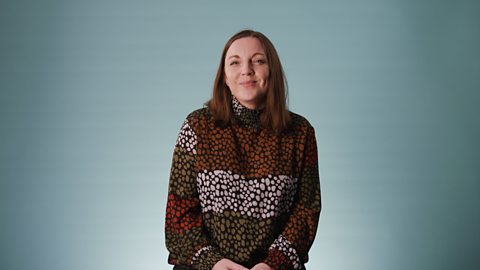
Ram V:
You alwaysget told to write what you know.That's not to limit what you write.That's to expand what you know.
Hi, I'm Ram V.I'm a writer,I write comics and graphic novels,including original content and for Marveland DC, and the great joy of writing,some of these charactersthat have been around for decadesis that you thinkpeople get tired of them, but they don't.We can put them through adventuresin space and all kinds of explosionsand drama, and people will still laughwith them, cry with them,take joy in their victories and failures.
I think the reason these stories lastfor so long is because storiesare fundamentally about being human.I grew up in India.I read a lot of comics and books as a kid,but then I studiedto become a chemical engineer.That let me travel a lot for my work.So I think a lot of my storiescome from meeting peoplefrom various places and culturesduring my travels,I think that informs my work a lot.
Stories are essentiallyabout having empathy, about being ableto put yourself in other people's shoes.Let's see what my stimulus is.It reminds methat music reminds me of the old schoolsort of big band jazz.It's really busy, has a lot of energy.For some reason, it conjures upimages of people performing in a theatre.I think that's where we'll set our story.
The next question, probably I would answeris whose story is this?I think I want it to be about the theatre.I want it to be about that era of jazz,about that performance.Because I predominantly write storiesfor comics and graphic novels,they tend to be very visual mediums.Writing and drawing to me are thingsthat are adjacent to each other,and when I'm writing a story,it helps me to draw while I'mthinking about it, not necessarily drawwhat's in the story, but just doodle ideasas they come into my head.
When I start telling a story,I think about structure a lot, storiestend and have shape, and good writers tendto be adept at recognizing that shape.I'll start off by structuring a storywith a beginning, middle and an end andrealisethat characters will go through tensionand they'll arrive at the end after goingthrough some sort of catharsis.It helps to have your story be toldby a character who is driving the plotthrough their choicesand actions, rather than having themgo to a predestined story, if you will.
The other thing to considerwhen you're writing is also sometimesthe story you planned and the storyyou end up writing can be very different.Characters or plots or ideas will crop upwhen you're writing the storyand it's OK to pivot, it'sOK to change your plans.In fact, the best stories happenwhen they have some element of spontaneityA lot of goodwriting is about redrafting,rewriting and editing your own work.It's importantto get everything down on paperbecause you can edit bad writing,but you can edit a blank page.This is being written for a comicor a graphic novel,and so the script will go to an artistwho will interpret what's in the scriptand decide what to draw on the page.
When it goes to the artist,they're likely to ignore everythingyou've doodled and just interpretwhat's on the script,and that'spart of the joy of making comics.It's like working with someone in a band.Eventually, when the reader's reading this,they're going to experiencea single story,not four people working together.So this is where a script and artworkturn into an actual comic.I think I'm ready to read it out.
Page one, panel one.We open on a frontal establishingshot of the Royal Majestic Theatre,the kind of place that's been aroundsince the forties, rebuilt, renovated.In the foreground, an old man in a coatleaning onhis cane is looking at the theatre.Narration reads:'For as long as I can remember,The Royal Majestic has always beenhaunted.'The old man opens a doorwith a set of keys and walks in,but as he walks in, it's not the old man,it's him as a kidback in the late forties,peering with a look of fascinationand awe on his face.
It's important to tell storiesthat only you can tell,that are about you as a person,where you come from, your references,your background.That's not to sayyou only write about who you are,but you write about things that you knowon a deeper level.
So I write a lotabout growing up in India.I write about characterswho are set in Indiaand whether they are fantastic vampiresor kids growing up in Mumbai.Those stories are stories that I feelonly I could tell in my voice.
Video summary
Graphic novelist Ram V talks about how his background influences his writing, and the collaborative and creative process of creating a graphic novel.
He talks about how closely linked he finds the processes of writing and drawing and, when writing a story, finds it helpful to doodle ideas that come into his head.
Ram also talks about the joy of working with an artist, and seeing the finished product as the script and artwork are turned into an actual comic.
This short film is from the BBC Teach series Inside the Writer's Mind, and is supported by a free classroom resource from First Story.
Teacher Notes
Before viewing
Students should be introduced to comics and graphic novels, and understand the difference between the two:
- Graphic novels are complete narratives and may be part of a longer series (e.g. Manga)
- Comics/comic books are usually part of a series building a longer narrative (e.g. Anime)
It might be possible to hook students' interest through discussion of Marvel or DC; students may be aware of the films rather than the comics/graphic novels.
Who writes and draws these types of genres? Discuss collaborations between producing the narratives and the images.
During viewing
The approach for writing comic books and graphic novels is the same as preparing for a written narrative. The story arc must have a clearly defined structure; beginning, middle and end with a crisis to be dealt with. Key advice includes:
Have a basic plan for your story. Who, where, what?
Write down all of your ideas and understand that it is ok to make changes to your story.
Think about your own experiences; you have a unique story to tell.
After viewing
Students could use the performance as an opening to their own story and continue.
Students could work in pairs with each student producing a short script based on teacher selected stimulus. They can exchange scripts and produce artwork. Discuss how they have different interpretations.
Students could select a piece of their own narrative writing and create a short comic book extract.
Students could be given a comic book with blank speech bubbles and complete their own narrative.
This short film will be relevant for teaching English language at KS3 and KS4 in England, Wales and Northern Ireland and National 4 and 5 in Scotland.
Topics covered include character and plot development in narrative writing; making links to word meaning, effective punctuation and narrative structure; understanding characterisation, narrative planning, story structure, editing, proofreading and redrafting.
Derek Owusu – Writer. video
Derek Owusu, who works across a number of genres but is perhaps best known for his fiction writing, talks about the importance of finding your voice with your creative writing.
Hannah Khalil – Playwright. video
Hannah Khalil, a Palestinian-Irish playwright, talks about the creative process she goes through when writing for the stage.
Javid Rezai – Screenwriter. video
Javid Rezai, a British-Iranian-Italian screenwriter, offers insight into his creative process and how a collaborative writer's room works.

Maisie Chan – Children’s Author. video
Children's author Maisie Chan talks about how a lack of British East Asian and Southeast Asian representation in books spurred her on to become a writer, and gives insight into her creative process.
Priya Hall – Comedian. video
Stand-up comedian and comedy writer Priya Hall talks through her creative process and gives advice on comedy writing and performance.

Tomfoolery – Performance Poet. video
Perfomance poet Tomfoolery reveals how he first got into poetry and talks through his creative process.
Vicky Foster – Poet. video
Vicky Foster, who works across a number of genres but is perhaps best known for her poetry, talks through her creative process when writing and editing a poem.