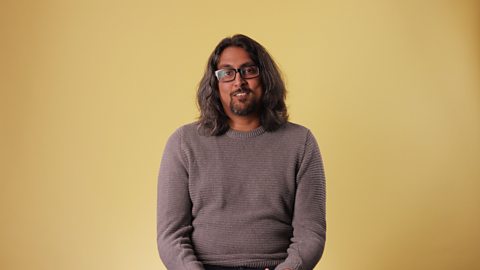
Maisie Chan:
Never give up.Oh that was rubbish,forget that.
Hi, I'm Maisie Chan.I'm a children's author bornin Birmingham, but I now live in Glasgow.I didn't know I wanted to be a children'sauthor when I was a child.I went to go and live in California.While I was there, I saw thatthere were quite a few Asian Americanauthors such as Amy Tanand Maxine Hong Kingston.And when I got back to Britain,I realized that there were noBritish Chinese authorsthat looked like meand very few booksthat had British Chinese characters,and that really spurred me onto become an author myself.
For my first novel,I got my inspirationfrom my friend's Chinese grandmotherwho arrived in Birmingham, aged 92.I wondered what shecould do to make friends and that becamethe seed of my first children's novel.And for the boy character,I was inspired by my own son.And I thought if he had a Chinesegrandmother in his bedroomon the top bunk, he would not be happy.And so often I listen to what he says,what his concerns areand how his relationships are at school.And I try and use those in my stories tomake them relevant for today's children.
So you too can listen to different peoplethat you know, listen to how they speak,how they act, what they're concerned aboutand put those into your stories as well.I also go on the internetand look at fairy tales,and I often like to rewrite storiessuch as Little Red Riding Hood or Mulan.That's a great way of having amodern twist on a fairy tale.
Right, so I cansee Edinburgh and I've been to Edinburghquite a few times.I know its gothic architecture.In the video,I can see spires, townhouses,tenements; in the distance, lots of hills.The video reminds me of flying as I cansee clouds and movement.And so I think for my character,for this story,I would create a vampire characterbecause often they fly.And so what about if I had a vampirewho was afraid to fly?Perhaps they're on the precipiceof flying, but they're too afraid.If I wanted to write a storyabout a vampire in Edinburgh,maybe I would create a characterwho's Scottish.I would write a list of Scottish namesand then choose one because charactersare really important.They're the vehicle that helpsthe reader go from the beginning,the middle and the end of the story.So, for example,I'm going to choose Mairi.It's a strong Scottish name.Mairi is going to be the personand the character that I followthrough the whole story.And we usually want an inciting incident,something that happens to Mairiearly on in the story.And then we create obstaclesbecause you want your character,have desires and want something,but something is stopping them from getting it.
We want to plan out our beginning,a middle and an end.Sometimes it's easier to have a beginningand an end,and the middle gets calledthe soggy middle.There are two types of writersa plotter and a pantser;a plotter is a writerwho likes to plot out every single detailbefore they beginwriting their story or novel.A pantser is the opposite; a pantser writesby the seat of their pants.That means thatthey just have a vague idea,and they get on their laptopsand they start to write.
So I usually write a one page synopsis,which is a story outline.Then I'll begin writing on my laptop.So during the editing processI like to look at structural edits first.That means I look at the overallpacing of the book.Is it too fast in the middle,is it too slow at the beginning?And then I work outwhat is not working in the structure.After the structural editsI like to look at line edits - that'sspecifically looking at sentence level.Am I using the right words?The right vocab? Is my dialogue realisticor is it just cliches?And don't be afraid to kill your darlingsand get rid of sections that perhapsyou really love,but just aren't working for the story.
Mairi stood on the edge of the balconyrail of the castle,high up on the hilloverlooking the city.Her toes began to tingle.'This is it!' - she thought. 'I'm going to flylike the vampires before me.'Her father had told her thatit comes naturally, that your first flightis the most exciting.Mairi looked down, her stomach lurched.If she'd been human, perhaps this is whereshe would have started to sweat.But the undead are coldand dry to the touch.If she had a beating heart,perhaps it would have boomed in her chest.Just then she heard a coffinlid creak open.It was her fatherwaking from his daytime slumber.He would be disappointed.She turned to see her father sit upright.Panic pumped through her body.She had to jump, to let go.'Vampires aren'tafraid of flying, are they?''Or is it only just me?'
Really observe people around you.Give your charactersquirks, ways of being, likes and dislikes,and that will make them feel likereal people.So don't forget your notebookwhenever you're aroundor you can use your notes on your phone.And that's what I do when I'm aroundlots of people that are interesting.You can also enter competitions,short story competitions,novel competitions,but don't be bogged down by rejection.You've got to have a tough skinas a writer.Don't give up.And good luck on your writing journey.
Video summary
Children's author Maisie Chan talks about how a lack of British East Asian and Southeast Asian representation in books spurred her on to become a writer, and gives insight into her creative process.
She talks about the importance of listening to different people that you know (how they speak, how they act, what they're concerned about), and to put these ideas into your stories.
Maisie also advises young writers to enter writing competitions, but not to be put off by rejection.
This short film is from the BBC Teach series Inside the Writer's Mind.
Teacher Notes
Before viewing
Students could think about novels they have read previously, either at home or in school.
Discuss what makes a story interesting. How is the plot developed? What happens to the characters? How are they realistic?
Remember that characters can change depending on their experiences within the story.
During viewing
Clarify the importance of planning, however briefly.
After viewing
Give students a selection of opening lines or paragraphs for them to complete as a story.
Lead a 'what's in my pocket' activity, in which students create a character based on five random items on a person's possession.
Revisit some well known nursery rhymes and fairy tales. Retell the story from the perspective of another character.
This short film will be relevant for teaching English language at KS3 and KS4 in England, Wales and Northern Ireland and National 4 and 5 in Scotland.
Topics covered include character and plot development in narrative writing; making links to word meaning, effective punctuation and narrative structure; understanding characterisation, narrative planning, story structure, editing, proofreading and redrafting.
Derek Owusu – Writer. video
Derek Owusu, who works across a number of genres but is perhaps best known for his fiction writing, talks about the importance of finding your voice with your creative writing.
Hannah Khalil – Playwright. video
Hannah Khalil, a Palestinian-Irish playwright, talks about the creative process she goes through when writing for the stage.
Javid Rezai – Screenwriter. video
Javid Rezai, a British-Iranian-Italian screenwriter, offers insight into his creative process and how a collaborative writer's room works.
Vicky Foster – Poet. video
Vicky Foster, who works across a number of genres but is perhaps best known for her poetry, talks through her creative process when writing and editing a poem.
Tomfoolery – Performance Poet. video
Perfomance poet Tomfoolery reveals how he first got into poetry and talks through his creative process.
Priya Hall – Comedian. video
Stand-up comedian and comedy writer Priya Hall talks through her creative process and gives advice on comedy writing and performance.
Ram V – Graphic Novelist. video
Graphic novelist Ram V talks about how his background influences his writing, and the collaborative and creative process of creating a graphic novel.