TOM PINFOLD:
The Middle Ages are notorious for their wars and brutality.With bloody crusades and vicious dynastic struggles, both military tactics and the defensive features of castle were consequently evolving.As quickly as attackers found new ways to bring down castle walls, the castle builders themselves found new and ingenious ways to make their castles stronger. And this is part of what makes this period a golden age in castle building.
NARRATOR:
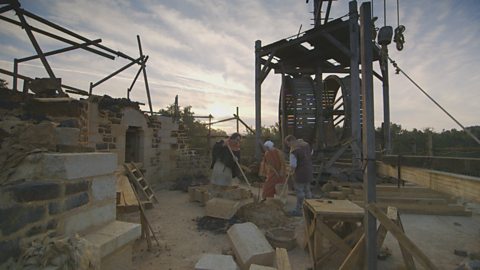
Castles were immense, defensive structures.Guédelon's walls are up to 10 metres high and 4 metres thick.As castle design advanced they became larger and more sophisticated, adding ditches, moats and drawbridges.They built round towers to better withstand the missiles hurled by increasingly powerful siege engines.
This prompted a medieval arms race.From basic stone throwers to mangonels, couillards and trebuchets, a range of deadly medieval war machines evolved.They were used in siege warfare to bombard defending troops and collapse castle walls.By the 13th century, the development of counterweight technology had improved their range and power.
A long throwing arm was lowered using a winch, raising a counterweight at the other end.
TOM PINFOLD:
It's amazing how only four people can manoeuvre such a heavy counterweight.
PETER GINN:
Yeah, I mean, what, that's about 500 kilograms.
TOM PINFOLD:
The energy you're putting into that to raise it up is gonna be stored as potential energy.
NARRATOR:
When released, the counterweight would fall, propelling the arm at high speed.
PETER GINN:
This, which is about 10 kilograms, this ball is gonna be swung out and flung into the distance.They reckon it'll go about a hundred metres.Tension's on the pin.Here we go.
The ball, the projectile, into the sling and it's ready to go.
RUTH GOODMAN:
I think we'll leave.
PETER GINN:
So standing back. Standing back.
TOM PINFOLD:
[laughs]
PETER GINN:
Right, we're gonna count down.
MAN:
Cinq, quatre, trois, deux, un, tiree
TOM PINFOLD:
And it's still, look how much energy…
RUTH GOODMAN:
Look at, yeah.
TOM PINFOLD:
…is still in there. It's…
RUTH GOODMAN:
And you have to get the mathematics absolutely right. The difference between the length of that arm and the length of the rope and the…Because if you don't get that spot on it can fly backwards instead of flying forward.
PETER GINN:
Right.
RUTH GOODMAN:
Shall we go and have a look.
NARRATOR:
Projectiles ranged from carved stone or mortar balls like these, to rotting animal carcasses intended to spread disease, and even the heads of defeated soldiers to really lower morale.
PETER GINN:
With, with one blow.
RUTH GOODMAN:
It's not a great explosion, it's…
PETER GINN:
The persistent drip, drip, drip until you crack.
NARRATOR:
But not all battles were conducted at long range.If the attackers attempted to storm the castle there would be fierce hand-to-hand combat.At Harlech Castle in Wales, Peter and Tom have come to meet medieval combat expert, Dave Rawlings, to find out about one of the most commonly used weapons of the era - the spear.
PETER GINN:
With a metal tip and a wooden shaft, the spear is a relatively simple weapon.
DAVE RAWLINGS:
Absolutely, and therefore it's probably gonna be quite cheap and easy to produce, which means you can arm more people with it.
And just generally something you could have from anyone really, from someone in a farmyard through to someone in a castle.
Obviously the advantage it has is it has a lot of reach. So even though it's cheap, it's still got potential to beat someone with something very posh, like a sword. It doesn't matter how fast it is if I can keep you out of reach.
You can use the butt, you can use the entirety of the shaft, you can use, obviously not just the point but these things have got edges on them as well and if it has an edge you can cut with it.
One, flick.
TOM PINFOLD:
So from the point of view of something like a siege……the thick castle walls, if you're on one side thrusting over, it's actually an ideal weapon.
DAVE RAWLINGS:
You have the potential with a spear of having lots and lots of points facing the enemy. If you, there's, there's a sort of rank of you at a doorway or something you can have five, six, seven of you all with your points forwards, all able to assault the enemy.
NARRATOR:
Along with the spear, a wide array of weaponry was used in the Middle Ages.Illuminations from the time show clubs, axes, swords and bows.One of the most infamous was the crossbow.First seen in 4th century BC China, crossbows were increasingly used in Europe by the 13th century.
RUTH GOODMAN:
Crossbows were probably introduced into Britain around the time of the Norman Conquest. In some ways they were less effective than the longbows, they took an awful lot longer to load, so the rate of fire was much, much slower. Out in the battlefield, in the heat of the moment, they were pretty useless, but in a siege it was a completely different thing.
Behind some nice safe walls you had time.And it was the sort of weapon that anybody could use with no training and no skill at all.Richard the Lionheart eventually met his end when a crossbow bolt, fired by a boy in 1199, pierced him in the shoulder; the resulting infection did for him.
NARRATOR:
As a weapon that knights more vulnerable to lowly foot soldiers some despised it for breaking the conventions of chivalry.Despite this it's use became widespread.
RUTH GOODMAN:
Bows are still really woven into our modern life.I mean, think of the surnames - Bowyer, Fletcher, Stringer, Archer. And then all the number of phrases that come from one form of archery or another; things like, 'to pick a quarrel' or a, 'a bolt from the blue' or 'he's got lots of strings to his bow'.
They're all archery terms.
NARRATOR:
The arrow loops built into castle walls allowed crossbow men to fire on their enemy.There'll be around 40 here at Guédelon.Their funnel-shaped design, tapering to a mere 3 inch gap, gave attackers outside only a tiny slit to aim at, while the defenders could look out without being seen.The arrow loops sloped down so archers could see invaders even at the foot of the tower.Peter and Tom are putting them to the test.
PETER GINN:
Yeah, go for it.
TOM PINFOLD:
[laughs]
PETER GINN:
Are you aiming for anything out there or are you just…
TOM PINFOLD:
Just aiming for the gap my friend.
PETER GINN:
Aiming for the gap. Right, bolt's in, touching string.
TOM PINFOLD:
Okay.I guess from a defensive point of view then, something like that shooting out the, the loop, you know, it was a bit of a fear factor straightaway, isn't it?
NARRATOR:
Satisfied with the defensive capacity of Guédelon's arrow loops on the inside, Tom and Peter set about seeing how resistant they are to attack on the outside.
TOM PINFOLD:
Do you think we can get a, a bolt through that gap? Luckily we're not under fire.
PETER GINN:
Um.
TOM PINFOLD:
And not er, having rocks thrown at us.
PETER GINN:
I reckon could definitely do it in six.
TOM PINFOLD:
Shall we give it a go then?
PETER GINN:
Yeah, let's give it a go. [laughs]
TOM PINFOLD:
Okay.So, you gonna load for me?
PETER GINN:
Load, load, arrow in the groove.
NARRATOR:
After many attempts, a shot finally finds its target.
PETER GINN:
Yes!
NARRATOR:
A feat which would have been somewhat harder to achieve in the heat of battle.
PETER GINN:
That, no that was lucky. [laughs]
TOM PINFOLD:
Well still, and that was a good height on there as well, that would have gone inabout head height inside.
PETER GINN:
Yeah.Architecturally, these arrow loops they work for this castle, don't they? You can be in there you can fire out but if you're outside here, trying to fire in, it's not impossible but it's, it's, it's lucky if you do.
NARRATOR:
While some sieges were won by overpowering the castle, it was often something far more basic which finally forced the defenders to surrender.
RUTH GOODMAN:
In truth, when castles fell it was rarely to actual siege enginesand far more frequently to starvation. Indeed, in 1215 at Rochester, besieged inside the castle, the people were holding out. King John on the outside had amassed five trebuchets that were battering the walls for two months.
Inside, food was running short and they looked round them and began to ear their expensive warhorses. And it was only when they had finished eating every horse that they surrendered.
Video summary
Historian Ruth Goodman and archaeologists Tom Pinfold and Peter Ginn help demonstrate different methods of attacking and defending a medieval castle.
They assess the strengths and weaknesses of the trebuchet, spears, crossbows and arrow loops.
This clip is from the BBC Two series, Secrets of the Castle.
Teacher Notes
Ask your pupils to try and identify military features from this video before recognising them in contemporary medieval sources.
Then they may devise in pairs, plans of castle attack and defence.
If possible, a visit to a local castle might be a useful follow up to explore primary evidence and local history.
This series is suitable for teaching history at Key Stage 3 in England, Wales and Northern Ireland and at 3rd Level in Scotland.
Building a medieval castle. video
Historian Ruth Goodman and archaeologists Tom Pinfold and Peter Ginn rediscover medieval castle-building techniques.
Inside a medieval castle. video
Those cold stone walls need some cheering up! Ruth Goodman, Tom Pinfold and Peter Ginn discover that medieval castles were lavishly decorated inside.
Medieval daily life. video
Not everyone in the 13th century lived in castles. Ruth Goodman, Tom Pinfold and Peter Ginn visit a much humbler home to see how medieval peasants lived.
Medieval trades and skills. video
A medieval castle needed many skilled personnel to function. Ruth Goodman, Tom Pinfold and Peter Ginn meet some of the most important including the blacksmith and carpenter.
The medieval world. video
Medieval life was not completely static. Ruth Goodman, Tom Pinfold and Peter Ginn discover the effects trade, travel and pilgrimage had on daily life in the 13th century.