PETER GINN:
Castles dominated the landscape of the medieval age and Britain have some of the finest examples in the world. They were grand fortifications designed to protect and to intimidate, and they played a key role in history, at the centre of battles power and trade.
TOM PINFOLD:
Yet Britain had no stone castles until the Norman Invasion of 1066, when these ideas were brought over from France. Stone castles became symbols of Norman occupation, permanent, intimidating, creating a sense of shock and awe.
NARRATOR:
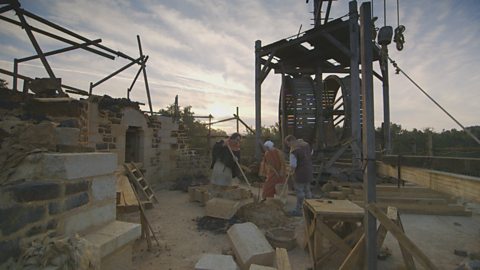
Here, in the Burgundy region of France is Guédelon Castle.The world's biggest archaeological experiment.17 years into a 25 year project, to build a castle from scratch.Using the tools, techniques and materials of the 13th century.Historian, Ruth Goodman.And archaeologists, Tom Pinfold and Peter Ginn, are joining the team at Guédelon to recreate 13th century life and discover the secrets of the medieval castle builders.
Thousands of tons of earth and stone were needed to build a castle, so it was essential these materials were nearby.Like many castles of the time, Guédelon is being built in a quarry.
PETER GINN:
In the quarry we have the sandstone, the primary building fabric. We also have the sand and the water; that can be used to make the mortar. We're on a clay lens here, and the clay can be used for firing tiles, roof tiles, floor tiles, and we're surrounded by forest, which is a source of timber; it's a source of fuel, so it can keep the blacksmiths going. Almost everything we need to build a castle is just a stone's throw away.
NARRATOR:The first job is to extract blocks of sandstone from the quarry, under the watchful eye of Guédelon's stonemason, Clement Guérard.Clement shows them how to split the stone using a chisel and a wedge.
PETER GINN:I don't think I've got the skills to do this.
TOM PINFOLD:
[laughs]
PETER GINN:
I'll, I'll give it a go.
TOM PINFOLD:
The pressure's on, I'm glad it's you and not me.
PETER GINN:
[laughs]
NARRATOR:First, Peter cuts into the stone, creating a hole for the wedge.
PETER GINN:So I'm making this hole to fit the wedge snugly. You hit it and that's gonna cause a fracture in the already pre-existing sediment lines and it'll split in half.
Wow! You can just see the fracture starting to appear. And this is not about brute force, it's about listening it's about looking precision engineering.
CLEMENT GUÉRARD:
Listen. Perfect.
NARRATOR:
These stones will form the main building blocks of the castle. The quarried stone is destined for the Great Tower…. already 18 metres high. When complete it will stand at over 30 metres. Tom and Peter are lifting the stone up the tower using a tread and a winch.
These were the cranes of the medieval building site. Using manpower and pulleys to turn rope around a spindle and lift or lower heavy loads.
PETER GINN:
I mean, these things are an absolute, well, godsend, aren't they? They are the machine of the medieval building site.
TOM PINFOLD:
[laughs]
PETER GINN:
Bringing up all the stone for the, for the walls.
TOM PINFOLD:
When you think, we've got 500 kg of weight we're pulling up, and yet we manoeuvre it so easily, the two of us.
PETER GINN:
And look there it is. This is the ultimate in medieval technology.
NARRATOR:
To lower the cargo onto the tower, the boys simply walk in the other direction.
CLEMENT GUÉRARD:
Okay, so walk, slowly, slowly.
PETER GINN:
Yeah.
NARRATOR:
Peter and Tom sort the stone into three different types.
PETER GINN:
The pith, the very, very hard sandstone that is used for facing, for the structure, for the, the external walls, whereas the paff and the pouf are actually used to infill the walls, and tie it all together.
NARRATOR:
One of the biggest challenges is ensuring the walls are absolutely straight. The strength and stability of the entire tower depend on it. The solution is simplicity itself, a lead weight on the end of a string known as a plumb line.
PETER GINN:
On the scaffolding here you'll notice there's about a 2 inch gap so you can get your plumb line down there and make sure the wall's absolutely straight. 'Cos if it's not, the tower starts going like that, it'll start going like that.
NARRATOR:
Most of these medieval tools and techniques have been around for millennia and are still used on building sites today.
PETER GINN:
Roman Britain. Medieval France or even a modern day building site, these are tools and techniques that every builder would have been familiar with. These have been honed over centuries of use. It is timeless, it really is.
NARRATOR:
So far, they've been working with roughly hewn sandstone to build the castle walls. But for the more intricate features, like arches, windows and stairs, limestone was preferred, as its fine grain meant it was easier and quicker to carve.
Tom and Guédelon's head mason, Florian Renucci, come to the tracing floor where they'll be planning a limestone spiral staircase.This was the nerve centre of the medieval building site, where the master mason drew full scale plans.
FLORIAN RENUCCI / MASON:
Bonjour.
NARRATOR:
Using a compass, the circumference of the spiral staircase is drawn actual size.
CLEMENT GUÉRARD:
This is a apprentice job.
TOM PINFOLD:
Always the apprentice, never the master.
NARRATOR:
For the medieval mason, geometry was the jewel in the crown of their art. Using just a compass, angles and shapes could be drawn, accurate to within a degree, with perfect symmetry. Florian divides the circle into six equal segments which are then subdivided to create 12 steps.
FLORIAN RENUCCI:
Now we have the steps, we can try the steps in the drawing first.
TOM PINFOLD:
I mean this is a fantastic way to actually make sure, before you start cutting stone, wasting materials and time…
FLORIAN RENUCCI:
Yeah.
TOM PINFOLD:
…that they work. And you can see there, they're bigger than my foot length. So, that's workable.
FLORIAN RENUCCI:
Now, we need to finish one step.
NARRATOR:
Because all the steps are the same, Florian needs to make just one template.
TOM PINFOLD:
This is a precision job now, you mess this up you're gonna mess up your stone in the castle. So the last thing to do is basically just cut the template.
FLORIAN RENUCCI:
It's ready. All done for you.
TOM PINFOLD:
[laughs] Thank you very much. Got our template now. Placed on top of our large piece of stone. We're marking it out; a bit of slate.[laughs] Magic, there it is, now it's ready.
CLEMENT GUÉRARD:
Just cutting.
TOM PINFOLDJust, [laughs] just cutting. [laughs] Five ten minutes.
CLEMENT GUÉRARD:
Oh! Two or three day.
TOM PINFOLD:
Two or three days.
NARRATOR:
Clement is putting the finishing touches to the step.
CLEMENT GUÉRARD:
Allez.
NARRATOR:
Now comes the delicate task of transporting it to the chapel.
PETER GINN:
Looks like your step's arriving.
TOM PINFOLD:
[laughs] Yeah.
PETER GINN:
Well, I say, your step. [laughs] These guys have been doing this for 15 years but it's amazing what they can move without the use of what, what we call machines. Wood and stone working together in perfect harmony.
D'you wanna nip down first Ruth?
RUTH GOODMAN:
Okay.
NARRATOR:
Each step must be absolutely level otherwise the staircase will veer to one side.
RUTH GOODMAN:
I suppose this staircase has still got quite a long way up to go, hasn't it?
And if this isn't absolutely perfect the, the first little bit of skew and that just gets magnified as you go up.
PETER GINN:
It has taken 17 years to build Guédelon to the stage it's at today. And the project is a triumph of skill, effort and determination. But, it's also a great insight into our world 800 years ago when castle builders designed the methods, the machines and the tools to create buildings that still stand today.
Video summary
Historian Ruth Goodman and archaeologists Tom Pinfold and Peter Ginn explore medieval castle building on site at the modern-day reconstruction project of Guédelon Castle in France.
The film showcases medieval materials, techniques and skills.
Many of the tools would be recognisable to modern builders: wooden rollers, the treadmill winch, compasses, a chisel and wedge, and plumb lines for accurate measurement.
This clip is from the BBC Two series, Secrets of the Castle.
Teacher Notes
In groups, pupils could view the piece, before they construct their own model castle.
The steps are outlined:
- design (selecting features to include)
- plan the tasks
- allocate tasks within the group
- build
- reflect on what went well and what may have gone even better in the project (from teamwork to materials used).
This series is suitable for teaching history at Key Stage 3 in England, Wales and Northern Ireland and at 3rd Level in Scotland.
Medieval daily life. video
Not everyone in the 13th century lived in castles. Ruth Goodman, Tom Pinfold and Peter Ginn visit a much humbler home to see how medieval peasants lived.
Inside a medieval castle. video
Those cold stone walls need some cheering up! Ruth Goodman, Tom Pinfold and Peter Ginn discover that medieval castles were lavishly decorated inside.
Medieval trades and skills. video
A medieval castle needed many skilled personnel to function. Ruth Goodman, Tom Pinfold and Peter Ginn meet some of the most important including the blacksmith and carpenter.
Medieval warfare. video
Once you have built your castle, how do you defend it? Ruth Goodman, Tom Pinfold and Peter Ginn find out how attackers and defenders conducted medieval warfare.
The medieval world. video
Medieval life was not completely static. Ruth Goodman, Tom Pinfold and Peter Ginn discover the effects trade, travel and pilgrimage had on daily life in the 13th century.