RUTH GOODMAN:
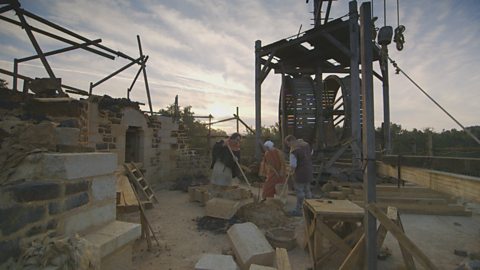
Building a castle involves such a lot of people and they've all got to live somewhere. So you get a sort of temporary community setting up at the edge of the building site. As all these different people come and go with their various skills, and naturally, over time that begins to become a bit more permanent; a village in the making. Indeed many villages right across Europe, in Britain as well as in France, can actually trace their origin to being camps for workers on a building site.
NARRATOR:
In the 13th century, workers' cottages were known as hovels.
RUTH GOODMAN:
The workers' cottages, somewhere like this, were always gonna be thrown up in a hurry and fairly sort of basic. But then so were those of most 13th century people. And this is our everything, this is all there is. Here is our kitchen, our living room, our sleeping quarters; just this one single space.
NARRATOR:
Ruth is going to set up home. Her first task is to create a fireplace. Off cut limestone, this will do perfect.
RUTH GOODMAN:
Ah!
NARRATOR:
The fire was not just used for cooking it also provided heat and light.
RUTH GOODMAN:
In grand houses obviously they sort of like cobbled this whole area. Uh! But we know from lots of archaeological digs that ordinary houses it's just a patch on the ground.
NARRATOR:
With the fire in place, the cottage needs a comfortable floor.
RUTH GOODMAN:
Now these I'm hoping are the secret ingredient to transform what is frankly a muddy hole into somewhere comfy to live.
NARRATOR:
Medieval sources tell us cottage floors were covered with dried rushes. Rushes grew in abundance on river banks making them easy to find and, best of all, free.
RUTH GOODMAN:
The temperature difference between putting your hand there and putting your hand there is…[laughs] quite astonishing. [laughs] That is cold and wet and nasty, that is warm and dry and comfy.
NARRATOR:
To prepare food, Ruth needs cooking vessels. Today, pots and pans are usually made of metal. But in the Middle Ages they were made from clay. Ruth's calling on potter, Jim Newbold.
RUTH GOODMAN:
What would people think about cooking with, with pottery? I mean I think people are scared of it, the idea of it now. But it used to be the way of cooking. I mean, it is the oldest form of, of cooking utensil of any sort.
JIM NEWBOLD:
That's it, even your iron ones are called cooking pots; there's the clue.
NARRATOR:
First, Jim makes the basic cooking pot on the wheel. Then he fits handles so it can be lifted on and off the fire. Clay was heavy and difficult to transport, so potters sourced it from as near to home as possible.
RUTH GOODMAN:
Where d'you get your clay from then?
JIM NEWBOLD:
From as close to the side of the road as you possibly can.
JIM NEWBOLD:
That's a pot hole.
RUTH GOODMAN:
[laughs]
JIM NEWBOLD:
One way you could lose a wagon and team.
RUTH GOODMAN:
[laughs]
JIM NEWBOLD:
Into it. You'd…
RUTH GOODMAN:
That's fabulous.
JIM NEWBOLD:
…You'd pull over.
RUTH GOODMAN:
It's a hole where you've dug clay for pots; it's a pothole.
NARRATOR:
Jim shapes the base of the pot. The curved shape helps the heat to spread.
JIM NEWBOLD:
And then, with a sharp bladed knife we start taking off the edge there.
NARRATOR:
The round bottom means it won't sit on a flat surface, so the medieval cook pot had legs.
JIM NEWBOLD:
There's the, the cook pot.
NARRATOR:
By 13th century standards, the hovel is now fully equipped.
RUTH GOODMAN:
And they'd have all sorts of food supplies hanging about, and hanging is the [laughs] operative word.
Because I don't want anything on the floor where mice and rats can get it so hanging it either from the walls, like the the vegetables in nets or from the underside of the roof, keeps them safe, away from all the crawling vermin. And the smoke as it percolates its way out keeps away flies.
NARRATOR:
After a day's work, the boys have returned to the cottage.
RUTH GOODMAN:
When they say they haven't got a bed and that's, that's it, you just get a blanket and this is what you sleep on, it sounds a bit horrendous but it's not. It's alright.It is a tiny space though to live your complete life, just one little space like this, isn't it?
PETER GINN:
I mean, I'd rather be in a small space like this and get the heat in, you know, it's an easier…
RUTH GOODMAN:
Yeah, good point.
PETER GINN:
…easier space to heat.
TOM PINFOLD:
And also, how much time are you gonna spend in here really.
Er, these days you think, well, you know, sitting room with a tv and a big sofa, 'cos you're gonna relax in there. We're gonna be working most of the time and you've got all your jobs and tasks to do.
RUTH GOODMAN:
Mm, mm.
TOM PINFOLD:
So that sort of like rest and relaxation isn't as important.
RUTH GOODMAN:
There's less time for it.
TOM PINFOLD:
Yeah.
PETER GINN:
Speak for yourself.
TOM PINFOLD:
[laughs] Cheers
PETER GINN:
Cheers.
TOM PINFOLD:
Salute.
NARRATOR:
It's morning and the team are getting ready for work.Knowing what ordinary medieval people wore is a challenge, as few records remain.
But fortunately some items of clothing survive.
RUTH GOODMAN:
The most useful garments would survive because they were actively kept, because they were the clothes of saints. They have been preserved in churches right across Europe.So this yellow dress that I'm wearing, this is er, er, something that has been derived from two early to mid 13th century saints; Saint Elizabeth from Germany and Saint Clare from Assisi in Italy.
PETER GINN:
It is faintly ridiculous, I think, that medieval underwear is as big as this.
They feel a bit like a pair of 1950s football shorts although, in the light, vaguely see through.And then we've just got the hose.A single-legged hose at this stage. However, if they were sewn onto the pants, pretty soon you'd have a pair of trousers; you can kind of see where the evolution of clothes comes from.
NARRATOR:
Ruth's headwear is inspired by the medieval French queen, Eleanor of Aquitaine.
RUTH GOODMAN:
And as she got older she decided that her chin was sagging a bit and she wasn't looking quite as lovely as she did so she invented a barbette, which goes under the chin and onto the top of the head. And pins there. And then with a barbette you always wear a fillet, and er, this is the fillet, it's just another band sewn into a circle. And you wear that almost crown-like on top.It's a very 13th century look. So that's it, my French look. [laughs]
NARRATOR:
There's not much evidence to show what medieval peasants ate in the 13th century.
It's likely they grew simple herbs and vegetables and added wild plants like dandelions and nettles to their cooking.But weeds and barley were also essential ingredients.Flour was expensive so workers ground their own using a device that's been around for 10,000 years.The quern.
RUTH GOODMAN:
This is the sign of the past.
Ah! A rotary quern like this is estimated to require about an hour to an hour and a half's work every day.This is the daily grind.You pop a handful of grain in the centre.Barley in this case, and off you go.
NARRATOR:
Using greens from the garden and the ground barley, Ruth is cooking a medieval pottage.
RUTH GOODMAN:
So, a little bit of water in there. I'm gonna start with my leeks.That's softened down a bit now.
NARRATOR:
She adds the grain to create a porridge-like dish.
RUTH GOODMAN:
How was it today?
PETER GINN:
It's going very, very well.
NARRATOR:
The team are getting used to medieval food.
PETER GINN:
You're a hungry man.You've been pounding all day at the stone, walking on the tread wheel, anything is good to eat.
RUTH GOODMAN:
And it's not exactly easy either, grinding the darn stuff. [laughs] I'll, I'll bet it's just as hard work as pounding away all day at the, in the st, in the quarry.
TOM PINFOLD:
There's no easy jobs in the Medieval Age.
RUTH GOODMAN:
No, there aren't, are there? [laughs]
Video summary
Historian Ruth Goodman and archaeologists Tom Pinfold and Peter Ginn discover domestic life in a medieval peasant's hovel.
They reconstruct how the poorest members of 13th century society prepared their food, clothed themselves and furnished their homes.
This clip is from the BBC Two series, Secrets of the Castle.
Teacher Notes
You could ask your pupils to write an illustrated medieval version of a house and home magazine.
The magazine might inform a new peasant householder on food, “domestic appliances” and clothing.
Alternatively, this might be presented via a computer presentation using original source images from the internet.
This series is suitable for teaching history at Key Stage 3 in England, Wales and Northern Ireland and at 3rd Level in Scotland.
Building a medieval castle. video
Historian Ruth Goodman and archaeologists Tom Pinfold and Peter Ginn rediscover medieval castle-building techniques.
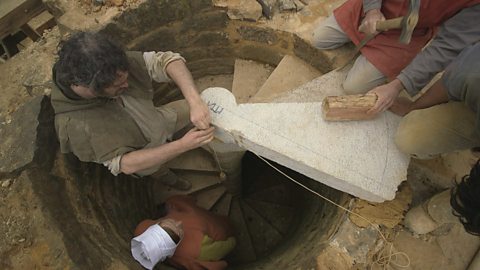
Inside a medieval castle. video
Those cold stone walls need some cheering up! Ruth Goodman, Tom Pinfold and Peter Ginn discover that medieval castles were lavishly decorated inside.
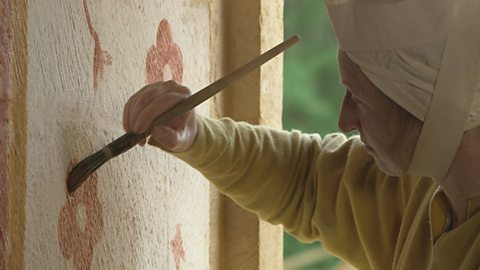
Medieval trades and skills. video
A medieval castle needed many skilled personnel to function. Ruth Goodman, Tom Pinfold and Peter Ginn meet some of the most important including the blacksmith and carpenter.
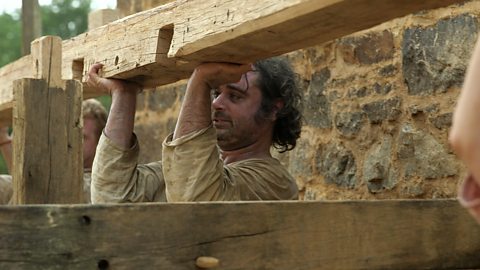
Medieval warfare. video
Once you have built your castle, how do you defend it? Ruth Goodman, Tom Pinfold and Peter Ginn find out how attackers and defenders conducted medieval warfare.
The medieval world. video
Medieval life was not completely static. Ruth Goodman, Tom Pinfold and Peter Ginn discover the effects trade, travel and pilgrimage had on daily life in the 13th century.