TOM PINFOLD:
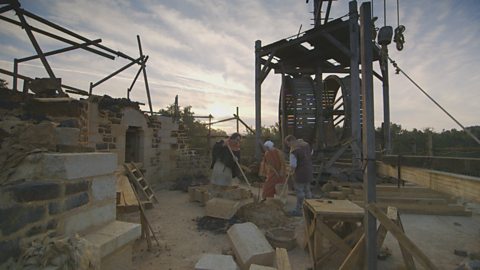
In the uncertain world of the Medieval Age, castles were a hub of shelter, work and security.They became large communities of workers, soldiers and nobility who all needed supplies of food and drink, tools and weapons. The answer was to build watermills, a flour store, workshops and blacksmiths' forges nearby. With these in place, the castle had everything it needed to survive.
NARRATOR:
Castles depended on a community of skilled workers and craftsmen whose combined expertise sustained daily life.As well as stonemasons, building a castle required tile makers, carpenters, wood cutters and rope makers. And at the heart of this network were the blacksmiths.
Martin Claudel is Guédelon's blacksmith.
TOM PINFOLD:
Is it true er, Guédelon, if there's no blacksmiths here for two days work stops?
MARTIN CLAUDEL:
Yes, work stops because er, we have to fix a lot of stonemasonry tools and er, if we don't do that they can't work.
NARRATOR:
Repairing tools is a daily task.To sharpen a blunt chisel it's heated to a thousand degrees.This is achieved by blowing air through the fire with bellows.
PETER GINN:
One goes up, the other one goes down, so it's, it's a constant airflow, isn't it?
NARRATOR:
Martin draws the chisel to a point on the anvil.Then sharpens it using a file.But, unless it's hardened, the chisel will be blunt again in no time.Hardening metal is one of the great discoveries of the Medieval Age. The chisel is heated with carbon, in the form of charcoal.As it gets hot the tip changes colour and this tells the blacksmith how hard it is.
Too soft and it won't cut, too hard and it will shatter. To carve stone it must be yellow.
PETER GINN:
He watches for the colours appearing on the surface of the metal; blue, the red and, most importantly the straw yellow at the very end.
NARRATOR:
It's then plunged into water to lock in the hardness.
PETER GINN:
Now, it's ready for the masons.
NARRATOR:
Another trade that relied on the blacksmiths for their tools were the carpenters.They would construct the scaffolding for building the castle walls and were responsible for essential wooden fixtures like doors, bridges and shutters.And this gallery being built on the inside of the Chapel Tower.
In the Middle Ages, carpenters used geometry to plan their wooden structures. They drew on the floor because parchment was expensive and paper still very rare.
PETER GINN:
Every piece of wood in Guédelon Castle starts its life here on the tracing floor.First of all, the plans, they are drawn on the floor to a 1 to 1 scale.
NARRATOR:
In French, the word for inch, pouce, is the same as the word for thumb, as it was based on the length of a man's thumb.However, this thumb measurement could vary from site to site.
PETER GINN:
If we were to turn up there at the start of the build in the 13th century, on a board it would say, 'this is what an inch is on this site, this is what the…
RUTH GOODMAN:
Yeah, based on one person's body.
PETER GINN:
…arm span is, the hand span is.'
RUTH GOODMAN:
We don't know quite which person's body but…
PETER GINN:
Yeah.
RUTH GOODMAN:
…based on somebody's body.
PETER GINN:
And if they were to pass away those would have been written down to be used until the end of the build.
NARRATOR:
To make a straight line on the tracing floor.
CARPENTER:
It needs to be quite tight.
RUTH GOODMAN:
[laughs]
NARRATOR:
They used string painted with red ochre powder.
CARPENTER:
Yep, okay.
NARRATOR:
Corresponding lines are made on each section of wood.Before matching them to the floor plan.Once everything is lined up they can cut the joints.They also chisel carpenters marks into the wood.These are a code to identify the pieces of the frame, making it easier to reassemble on the castle walls.
Each team would have had their own code.Finally, they assemble the completed frame.
PETER GINN:
Here at Guédelon they almost think that carpentry it's, it's almost a form of genius, there's so much thinking involved.I mean, this line running through all these beams, it, it's precise.
So this can be unassembled by the carpenters, it can be put to one side,it can be hoisted up, reassembled outside the Chapel Tower. It doesn't need to be the same carpenter 'cos you've got all the marks here.
It is a flat pack medieval gallery.And this is how you build a castle.
NARRATOR:
The wooden gallery is ready to be installed beside the Chapel Tower.
TOM PINFOLD:
It's time for beer.
PETER GINN:
Chocks out. Ooh!And the gallery's in place.
NARRATOR:
With the basic frame installed, long beams are now needed for the roof section.
LADY:
Up. No, no, no.
MAN:
Hold on.
LADY:
Okay, yes, yes, going to.
PETER GINN:
Yeah, drop down.
LADY:
Yeah.
PETER GINN:
Yeah, yeah. Did it?
MAN:
Yeah.
ALL:
[applause]
TOM PINFOLD:
It's physical work but to think when we first saw that drawing of what this was gonna look like.
PETER GINN:
Yeah.
TOM PINFOLD:
I didn't think we'd actually see this at the end of it.
PETER GINN:
Yeah.
TOM PINFOLD:
It's brilliant.
NARRATOR:
An even more complex use of the carpenters' skills is the construction of a watermill.According to the Doomsday Book there were over 5,000 watermills in England in the year 1080.It's one of the most ambitious projects undertaken at Guédelon.
Calling on the expertise of almost all of the craftsmen.The masons, the blacksmiths, the carpenters and rope makers.Watermills sustained daily life by grinding grain into flour.Peter and Tom are going to grind their first bag of grain.
TOM PINFOLD:
It's unbelievable how many pieces, manmade each one of them, are actually involved in this wheel alone, let alone the rest of the actual building.
PETER GINN:
Yeah.It's, it's a lot of wood.
TOM PINFOLD:
It's a lot of wood. [laughs]
NARRATOR:
Phillippe Delage shows Peter and Tom how the mill works.
PETER GINN:
Fill the hopper with grain. It's ready to be made into flour.
PHILLIPPE DELAGE:
Yeah.
PETER GINN:
I suppose all we need is Tom to open that gate.
PHILLIPPE DELAGE:
Yeah. You are ready Thomas?
TOM PINFOLD:
Ready.
PHILLIPPE DELAGE:
You can open.
PETER GINN:
Here it comes. Tom's opening the sluice gates.The water's coming down.It's about to hit the wheel, it's about to hit the wheel.Hit the wheel.
NARRATOR:
The mill has a paddle wheel, 8 feet in diameter.This turns an axle, turning the smaller pit wheel.The teeth of this turn the lantern wheel, which turns the spindle.This powers the millstone, over 3 feet in diameter.
The bottom stone, the bed stone, is fixed but the top one, the runner stone, revolves to grind the grain.
PETER GINN:
The water is turning that wheel and our stones are going.
NARRATOR:
One mill could make as much flour in a day as 40 people grinding by hand.
PETER GINN:
You're managing to turn a stone that is 200 kilogramsand you're managing to grind the grain into flour.
This is the beginning of industry I suppose, and to have this associated with the castle you can free up people from the daily grind to do other things.
TOM PINFOLD:
I mean, it's just amazing how much work it actually takes to create one mill. I mean hundreds and hundreds of bits of wood.These massive bits of stone. You've gotta channel all that power from the water. Now this is a big effort but if you're gonna create bread, you've gotta feed families, soldiers, workforces.
PETER GINN:
It's all worth it.
TOM PINFOLD:
(…UNCLEAR…) Yeah, exactly. It all comes back, what does a castle need? It needs to be fed, and this is what makes it happen.
Video summary
Historian Ruth Goodman and archaeologists Tom Pinfold and Peter Ginn learn about the various craftsmen and skills a castle relied upon to function.
Blacksmiths and carpenters were vital and their trade extended to building complex structures like the water mill.
This clip is from the BBC Two series, Secrets of the Castle.
Teacher Notes
You could challenge your pupils to create a job advert for either a medieval carpenter or a medieval blacksmith.
To supplement this video, pupils could research for more evidence of the skills and experience needed for their advert.
The advert might include an illustration of the likely projects to be completed. This could be the gallery or water mill.
This series is suitable for teaching history at Key Stage 3 in England, Wales and Northern Ireland and at 3rd Level in Scotland.
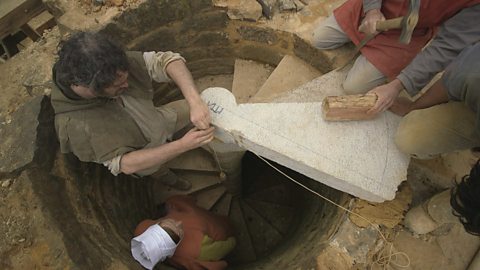
Building a medieval castle. video
Historian Ruth Goodman and archaeologists Tom Pinfold and Peter Ginn rediscover medieval castle-building techniques.
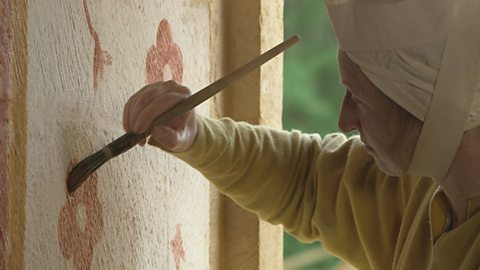
Inside a medieval castle. video
Those cold stone walls need some cheering up! Ruth Goodman, Tom Pinfold and Peter Ginn discover that medieval castles were lavishly decorated inside.
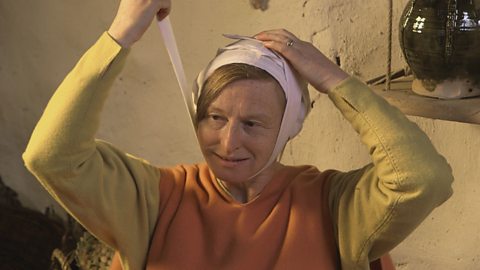
Medieval daily life. video
Not everyone in the 13th century lived in castles. Ruth Goodman, Tom Pinfold and Peter Ginn visit a much humbler home to see how medieval peasants lived.
Medieval warfare. video
Once you have built your castle, how do you defend it? Ruth Goodman, Tom Pinfold and Peter Ginn find out how attackers and defenders conducted medieval warfare.
The medieval world. video
Medieval life was not completely static. Ruth Goodman, Tom Pinfold and Peter Ginn discover the effects trade, travel and pilgrimage had on daily life in the 13th century.