PETER GINN:
Castles were part of the wider world linked by travel and trade. Silks and spices were arriving from China and the Far East, brought mostly overland. They were passed from merchant to merchant, along routes that spanned halfway across the globe. Many of the fine fabrics found inside a castle and the exotic spices used in the kitchen were global goods.
The world was becoming a more connected place.
NARRATOR:
In the 13th century, Europe was undergoing huge changes.Agriculture boomed and as population grew so did the number of castles.With better roads and plenty of reasons to travel, many ordinary people had more access to the wider world than ever before.One group of craftsmen that would certainly have travelled widely from project to project were the stonecutters, elite members of the construction team.
Their experience of different sites would have made them experts, both in military and religious architecture, gathering influences from across the known world.
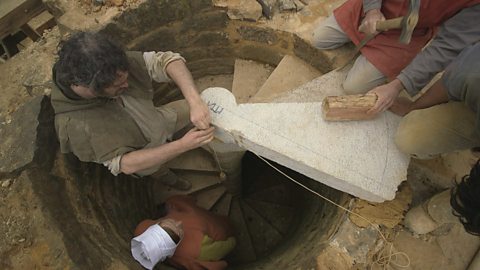
Masons were paid according to how many stones they dressed, so the final job is to add an identifying mason's mark to the stone.
CLEMENT GUÉRARD:
From the line and poke, poke.
NARRATOR:
Using these marks, archaeologists have been able to trace the movement of particular masons through the landscape.
PETER GINN:
So we have a, a 'T' for Tom, a 'P', Peter, and an 'R' for la Rus.
NARRATOR:
As they travelled, medieval masons would have taken ideas and inspiration from castles and cathedrals across Europe.
NARRATOR:
At Guédelon, Master Mason, Florian Renucci, is in charge of the design of the castle.He's brought Peter to the town of Vézelay, to the Basilica of St Mary Magdalene.The Basilica was an extremely important church in the 12th and 13th centuries. The start of a major pilgrimage route, it was also where Richard the Lionheart set off on the third Crusade. And Florian has been captivated by a particular architectural feature.
FLORIAN RENUCCI:
All this architecture er, looks from er, example, coming from Byzantine or Roman art. For instance they do use the two kind of stone.
PETER GINN:
You've got a Romanesque arch with black stone, white stone, black stone, white stone.This is Romanesque, it's Byzantine so it's coming from the sort of er, to, from the East.
NARRATOR:
The technique of using coloured stone, alternating with white stone originated in Byzantium.It spread to both the Islamic world and to Western Europe where it inspired masons, who were rediscovering ancient techniques.The Byzantine-style black and white arches at Vézelay can be seen in medieval buildings throughout Europe, and Florian has incorporated it into the design at Guédelon.
The arch is being built into the castle's chapel.Arches are one of the earliest feats of engineering. As each stone pushes against another the structure becomes self-supporting.
By the 13th century, medieval Europe was a busy, developing connected place, as workers and traders flowed across the continent.A network of roads had been established linking villages and mills, castles and their outlying centres of administration and, at major junctions, market places grew up.As well as everyday items these markets now sold goods from across the known world, exotic luxuries like silks and spices.Spices were perhaps the most expensive commodities in a castle kitchen.Imported from the East they were a delicacy originally favoured by the returning Crusaders - but soon used liberally in the kitchens of wealthy nobles.
Ruth is making gingerbread. Because of its long journey to Europe from China, ginger was only available in dried form and must be ground into a powder.
RUTH GOODMAN:
Every single grain of spice that was used had to come the overland route; the old Silk Route.You mustn't think of a Chinese merchant making his way all the way to medieval France. Instead you must think of that Chinese merchant selling his wares to another merchant who takes them to the next market and sells them to another merchant.
By the time it gets here it may well have passed through 30, 40 different hands with a small profit accrued at every stage of the journey.
NARRATOR:
Spices were desired as a status symbol as much as for their flavours.Gingerbread also included nutmeg, red peppercorns.Cloves and cinnamon.
RUTH GOODMAN:
The extreme expense of something like this, and I do mean extreme expense, meant that the only people who could afford it were the nobility and royalty. You were, after all, eating something that was worth more than pure gold by quite a long way.
NARRATOR:
It wasn't just workers and goods that travelled in the 13th century. Ruth is going to experience something which would have been commonplace yet extraordinary; going on a pilgrimage.For people who lived in the same community their whole lives, this was a chance to see the world and temporarily escape the monotony of daily life.
In the 13th century, Vézelay attracted thousands of pilgrims.Ruth has come with Chris Kelly, who runs the Visitors' Centre, to follow in their footsteps.
RUTH GOODMAN:
It sort of looks like a castle doesn't it, or, or a fortified city I suppose.
CHRIS KELLY:
Absolutely, it is a fortified city.
You can see the width of this gate, which is more than 4 metresWhich is enormous.
RUTH GOODMAN:
Er, you get…
CHRIS KELLY:
So, in fact, you can understand it's not for defensive purposes it's for processions.In fact, it’s the pilgrim entrance.So wide because there were so many people.And this goes direct up to the Basilica.
NARRATOR:
From the early 11th century the relics of Mary Magdalene were displayed at Vézelay.News of miracles spread, and the church soon became a centre for pilgrims.Vézelay was a religious destination of huge importance.Today, the Pilgrimage of Les Pères de Famille is taking place.
This ritual of walking across the landscape to come for spiritual reflection is the same now as it would have been in the Middle Ages.
RUTH GOODMAN:
I think most us when we think about medieval people and their,and their experience of religion we, we tend to think that people were largely ignorant but this, this is a very sophisticated way…
CHRIS KELLY:
Sophisticated.
RUTH GOODMAN:
…of thinking.
CHRIS KELLY:
Of course, the monks their roles is to explain to eat person when they arrive.
RUTH GOODMAN:
You could think of it like a visit to the Mona Lisa in the Louvre.And experts have to tell you what to think, almost, about it.
CHRIS KELLY:
Yes.
RUTH GOODMAN:
It's got an element of that tourism and.
CHRIS KELLY:
Yes, you might call it spiritual tourism.
NARRATOR:
A once humble church, the Basilica was expanded to make room for all the pilgrims. Kings, nobles and abbots came along with thousands of ordinary folk to venerate the relics and confess their sins.
RUTH GOODMAN:
So this is very much a 21st century pilgrimage. But look at the passion and how important this is to these people. This is part of a, a tradition that certainly goes back to the 13th century.
Pilgrimage can be understood as a physical journey that helps you to have a spiritual journey. By leaving behind everyday life you are putting yourself into the right frame of mind to help yourself grow inside.
PETER GINN:
I suppose once this project was finished, workers like ourselves would have had to have moved on, moved to the next castle, and that might have been the next town, could have been the next country.
RUTH GOODMAN:
So there must have been 13th century, ordinary working people who were better travelled and had a wider world view than many modern people.
Video summary
Historian Ruth Goodman and archaeologists Tom Pinfold and Peter Ginn go beyond the castle walls to explore wider medieval life, including travel, trade and pilgrimage.
Trade increased the variety of goods available to people, while travel had far-reaching effects on architecture.
This clip is from the BBC Two series, Secrets of the Castle.
Teacher Notes
This video could be used as a stimulus for further research into medieval life.
Pupils could research and write a pilgrimage diary, reflecting what a pilgrim might have seen.
Examples might include traded goods, markets, cathedrals, villages and castles.
This series is suitable for teaching history at Key Stage 3 in England, Wales and Northern Ireland and at 3rd Level in Scotland.
Building a medieval castle. video
Historian Ruth Goodman and archaeologists Tom Pinfold and Peter Ginn rediscover medieval castle-building techniques.
Inside a medieval castle. video
Those cold stone walls need some cheering up! Ruth Goodman, Tom Pinfold and Peter Ginn discover that medieval castles were lavishly decorated inside.
Medieval daily life. video
Not everyone in the 13th century lived in castles. Ruth Goodman, Tom Pinfold and Peter Ginn visit a much humbler home to see how medieval peasants lived.
Medieval trades and skills. video
A medieval castle needed many skilled personnel to function. Ruth Goodman, Tom Pinfold and Peter Ginn meet some of the most important including the blacksmith and carpenter.
Medieval warfare. video
Once you have built your castle, how do you defend it? Ruth Goodman, Tom Pinfold and Peter Ginn find out how attackers and defenders conducted medieval warfare.