RUTH GOODMAN:
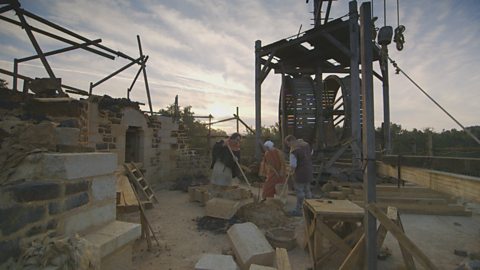
This is how many of us think of the interior of castles. Bare stone, echoey, damp, gritty underfoot, but that's because we're used to ruins.When they were in use, back in the 13th century, they were rather different. You have to imagine tiled floors and plaster on the walls, perhaps painted, whitewashed, and then hangings of fabric over the top.An entirely different beast.
NARRATOR:
If the outside of the castle showed the lord's strength then the inside must show his wealth and status.
GUIDE:
This is the castle's Great Hall.
RUTH GOODMAN:
Great is the word.
NARRATOR:
The Great Hall was the political and business hub of castle life, many of the social rituals of the day were held here. So it was important the interior showed off the lord's prosperity and rank.
TOM PINFOLD:
I mean, this room is a statement of power and prestige isn't it?
GUIDE:
Absolutely, which is why it's important to bear in mind, of course, once it's finished we won't have these bare stone walls.
NARRATOR:
Other spaces in the castle had more practical uses.Indoor toilets were an integral feature of castle design. They were known as garderobe, the French word for wardrobe.Clothes were often kept inside them because it was believed the smell of ammonia from urine kept parasites at bay.Garderobe protruded from the castle walls, allowing the waste to drop down through the hole and outside the castle.It was a Paige's job to prepare the garderobe.
RUTH GOODMAN:
Their first job of the day, before their lord is up,is to prepare the privy. And he's told to make it extremely clean; he's got to sweep it out and make it clean.
He's also go to put cloths in there and sweet smelling herbs.
PETER GINN:
Yeah.
RUTH GOODMAN:
So that it's somewhere comfortable and pleasant to be.
PETER GINN:
Yeah, I, I think, I mean, it wouldn't have smelt too bad. I mean, I know the poo's going down and, yes, if it's not getting moved there might be a bit of wafting up, but those herbs would certainly have taken the edge off.
RUTH GOODMAN:
And there is, of course, the question of toilet paper.
PETER GINN:
There is.
RUTH GOODMAN:
[laughs]
PETER GINN:
I mean, many people think leaves and moss but let's face it, deforestation. [laughs]
RUTH GOODMAN:
Where the heck are you gonna get a leaf of the right size in the middle of January.I mean, honestly. But I do wonder ifmaybe the more normal system, especially in a castle, would have been to have your own cloth or rag or flannel…
PETER GINN:
Or even.
RUTH GOODMAN:
…to wash yourself with.
PETER GINN:
Or even a communal rag.
RUTH GOODMAN:
Quite possibly.
PETER GINN:
And washed out in a bucket.
RUTH GOODMAN:
And washed out in a bucket.
PETER GINN:
I know.
NARRATOR:
Even small domestic spaces, like the garderobe, would have been decorated.
TOM PINFOLD:
Cosy workspace.
NARRATOR:
Rooms in castles didn't have bare stone walls like the ruins we see today.
They were covered with a layer of mortar, the medieval equivalent of plaster.Next, they were given a coat of limewash, a white mixture of lime and water.They were now ready to be painted.Because so few original castle interior features have survived, it's difficult to know how they would have been decorated.
But just a few miles from Guédelon, in the village of Moutiers, is the Church of St Peter, built around the year 1000.Here, original 13th century murals have been discovered.They've provided Guédelon with an authentic and illuminating resource from which to draw inspiration for the interior décor of the castle.
Ruth is applying some of this artwork to Guédelon's guest bedchamber.
RUTH GOODMAN:
Obviously the domestic spaces within a castle are intended to impress; they have to look gorgeous. It's about the look of the place as much as anything else, and naturally people painted their walls. This was about showing your power, it was about prestige.
That, up there, that little bit where it's painted to look as if it's masonry, with the little roses in front, often called stones and roses is perhaps the most typical, as far as we can tell, of all interior decorating designs of the mid-13th century.
That is what the Queen of England had on her bedroom walls in the Tower of London.Stones and roses, the very height of fashion.
NARRATOR:
Another key feature of the castle's interior was floor tiles, and the medieval manufacture of tiles for a castle's roofs and floors was an industry in itself.
At Guédelon, 28,000 tiles cover the roof of the Great Hall, and it will take around 80,000 to complete the castle.Clay from the quarry is used to make Guédelon's tiles.Tom and tile maker, Aymeric Guillot, must first remove the twigs and stones, and soften the clay.It's then packed into a template which is greased, just like a cake tin.
AYMERIC GUILLOT:
As for a cake.
TOM PINFOLD:
[laughs]
AYMERIC GUILLOT:
You put it inside.
TOM PINFOLD:
Just work that round and that’s to actually lubricate the side of the template, is it?
AYMERIC GUILLOT:
Yes.
TOM PINFOLD:
So the tile will come out easily at the end.
AYMERIC GUILLOT:
It's very important to have good corners in the tile, if not the masons are really not satisfied.
TOM PINFOLD:
[laughs]
AYMERIC GUILLOT:
To work is very hard for them.
TOM PINFOLD:
What do you think?
AYMERIC GUILLOT:
This is perfect.
TOM PINFOLD:
Oh, yeah. [laughs]
AYMERIC GUILLOT:
It's very good, yes, yes. The masons will be happy.Okay, you put it there and we'll do like this.
NARRATOR:
To harden the clay, the tiles are heated to a very high temperature. This is called firing and is done in batches of 4,000.So these two tiles are just the beginning of a long process.
When 4,000 are ready they're stacked in an oven, called a kiln, ready to be fired. They're carefully arranged, leaving gapsso that the heat reaches every tile, producing an even, hard finish.
PETER GINN:
I mean, one of the problems with these tiles, when you dry them out, if there's any water in there and you fire it too quickly, the kiln, that water will expand 'cos it will turn into a gas that will blow the tile apart, you'll hear a pop, and if these are stacked incorrectly, if one tile goes, several tiles could go.
NARRATOR:
It will take hundreds of armfuls of wood and many hours to build the roaring blaze needed to fire the tiles.We now know the optimum temperature for a successful firing to be around 1,000 degrees centigrade.Tilers in the 13th century used only their experience, their senses and costly trial and error.
They were paid by the tile, so any mistakes could be disastrous for a tiler's livelihood.As darkness falls, Peter and the team finally succeed in getting the temperature up to a thousand degrees centigrade.It takes several days for the kiln to cool down and every tile must be examined.
PETER GINN:
That ringing sound is what you're looking for.
AYMERIC GUILLOT:
Eh, perfect. Ah.
NARRATOR:
If unsure, they would spit on the tiles and if it was not absorbed the tile was good.
Now the tiles will be used on Guédelon's roofs and floors.It will take thousands more tiles and several more years of rendering, limewashing and painting, before the entire castle finally looks the way it might have done in the 13th century.
TOM PINFOLD:
I'll be honest I did not appreciate how much work and effort it would take to get this stage actually happening.But when you see it, it's unbelievable.Well, it emphasises that it's actually a living space and not just a defensive building, doesn't it?
RUTH GOODMAN:
Yeah.
TOM PINFOLD:
It's not all about warfare when it comes to castles.
RUTH GOODMAN:
Yeah.
Video summary
Historian Ruth Goodman and archaeologists Tom Pinfold and Peter Ginn discover castle interior design and decoration, from the great hall to the toilets.
Medieval castles were not bare stone inside like today's ruins. Instead, walls were plastered and decorated with paint, while floors were tiled.
This clip is from the BBC Two series, Secrets of the Castle.
Teacher Notes
After watching this short film, pupils could study source examples of decorations similar to those shown.
They could then design their own to convey prestige or reflect the relevant uses of the castle room.
An example might be the design of the great hall to impress visiting barons and give political messages about the household of the castle.
This series is suitable for teaching history at Key Stage 3 in England, Wales and Northern Ireland and at 3rd Level in Scotland.
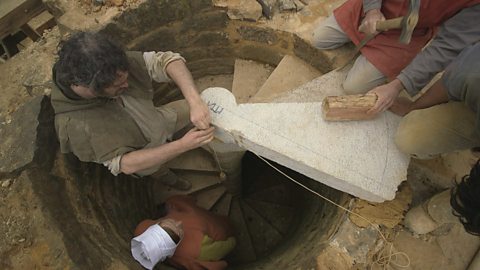
Building a medieval castle. video
Historian Ruth Goodman and archaeologists Tom Pinfold and Peter Ginn rediscover medieval castle-building techniques.
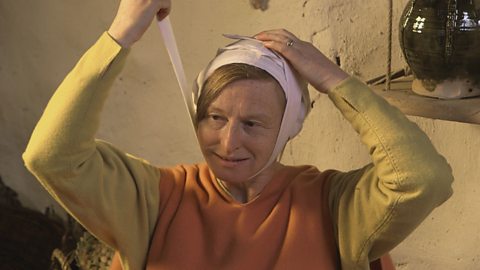
Medieval daily life. video
Not everyone in the 13th century lived in castles. Ruth Goodman, Tom Pinfold and Peter Ginn visit a much humbler home to see how medieval peasants lived.
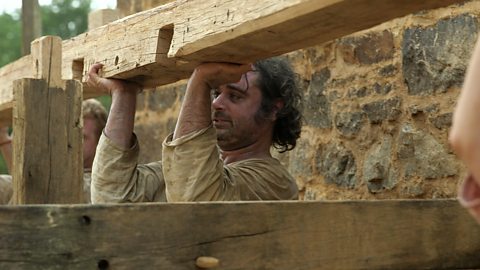
Medieval trades and skills. video
A medieval castle needed many skilled personnel to function. Ruth Goodman, Tom Pinfold and Peter Ginn meet some of the most important including the blacksmith and carpenter.
Medieval warfare. video
Once you have built your castle, how do you defend it? Ruth Goodman, Tom Pinfold and Peter Ginn find out how attackers and defenders conducted medieval warfare.
The medieval world. video
Medieval life was not completely static. Ruth Goodman, Tom Pinfold and Peter Ginn discover the effects trade, travel and pilgrimage had on daily life in the 13th century.