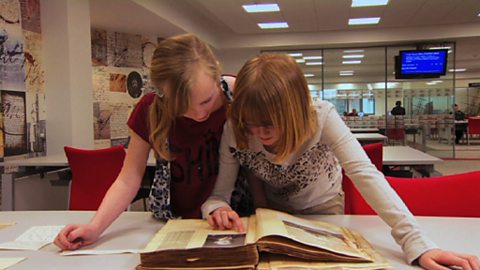
JOE CROWLEY:'If you want to go history hunting, you need to dig deep. 'The best way to uncover the facts, 'is to use the same skills and methods 'that real professional historians use.'
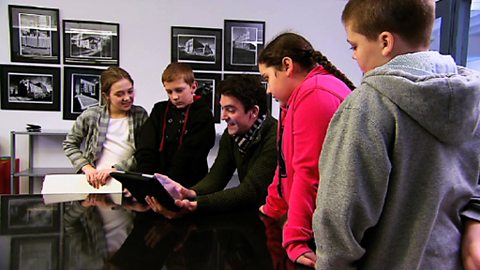
JOE CROWLEY:Today we're going to be focussing on interviewing people. You can find out lots of information from people who are part of or knew someone from history.
JOE CROWLEY:But to get the best out of them, you'll need to know how to question them, and how to think about what they've told you.
JOE CROWLEY:'Family members or friends of figures from history, 'often have photographs, or objects that used to belong 'to the people you're investigating.
JOE CROWLEY:'Ask them to bring anything like this along to a meeting, 'or if you're going to see them, 'tell them to have a good look for anything that could be useful.'
UNKNOWN MALE #1:And this was my father's hat, that he wore on his travels. And this is his faithful suitcase that he took with him on many of his journeys overseas.
JOE CROWLEY:'It's best to ask them in advance 'as then they'll have time to get things ready for you.
JOE CROWLEY:'And if you can, take copies in some way. 'Then you can look at them in detail afterwards.'
JOE CROWLEY:It's not just what you ask, it's how you ask it that's important too. Good interviewers use open questions. Things like, "Tell me what your grandfather was like.", or, "How did he invent that?".
JOE CROWLEY:Poor interviewers use closed questions, things that just call for a yes or no answer. Ask these type of questions and you won't find out much.
UNKNOWN FEMALE #1:How did the Titanic sink and how did it affect your family?
JOE CROWLEY:'You'll want to ask a lot of questions, 'and it's always good to do plenty of research beforehand.
JOE CROWLEY:'This might be your only chance to meet these people. 'Therefore you need to know the right questions to ask.
JOE CROWLEY:'Do your homework 'and work out what areas they're likely to be able to help you with.'
UNKNOWN FEMALE #2:Why was George Caley so important?
UNKNOWN MALE #2:He studied why it was that birds flew and from that, why an aeroplane might fly.
JOE CROWLEY:'It's also vitally important that you listen carefully. 'They might tell you something you didn't expect, 'so you can ask a follow up question that would get you more information.'
UNKNOWN FEMALE #3:So tell me a bit more about the photograph.
UNKNOWN FEMALE #4:This photograph showed, really, what the structure of a DNA was.
JOE CROWLEY:'And always remember, that people are often biased 'when they're talking about friends or relatives.
JOE CROWLEY:'They might exaggerate their importance, or hide their faults.'
UNKNOWN FEMALE #4:But what happened was somebody showed it to Crick and Watson, and that's what they used to do their discovery. But she didn't know that they'd got hold of it.
JOE CROWLEY:'It's up to you as historians to work out what you need to check up on, 'by using methods such as talking to other people, 'or looking at documents in archives.'
JOE CROWLEY:So, be careful. Think about what seems sensible and what needs to be confirmed using other sources.
JOE CROWLEY:But if we bear all that in mind, speaking to people who knew historical figures can be a great way of finding out things that are otherwise really hard to discover.
JOE CROWLEY:And they can provide photos and details that give us an insight into what a person was really like.
One of the most interesting and revealing methods of historical inquiry is personal testimony – learning about history by talking to people who have a connection to an historical figure or theme.
Presented by Joe Crowley, this is a guide for primary aged children on how to get the best from personal testimony by conducting well-prepared interviews.
It gives tips on how to get the best from interviewees and what type of questions to ask.
This clip is from the series History Hunt Episode 2.
Teacher Notes
After watching the clip, pupils could practice interviewing one another and then move on to interviewing older relatives and friends, to gain an insight into how life has changed over recent decades.
The children could develop a shared list of suitable 'open' questions.
For example, they could ask general questions such as: "How have things changed since you were very young?" and more specific ones, such as: "How have fashions changed since you were young?"
The children could record their interviews and take photographs, to share with the class.
Curriculum Notes
This clip is suitable for teaching History at KS2 in England, Wales and Northern Ireland and at National 2 Level in Scotland.
More from History Hunt:
An investigation into the life and work of Muriel Matters. video
A team of young historians investigate Muriel Matters, who fought for equality and broke the law to become the first woman 'to speak' in the House of Commons.
An investigation into the life and work of Thomas Andrews video
A team of young historians investigate Thomas Andrews, the man who designed the Titanic. They consider his role as designer and whether he was at fault for the loss of life.
How to use archives. video
A practical guide to finding historical material in archives, this clip gives a taste of what kind of material is found in archives; how to access it and how to interpret it.
How to research archive pictures. video
A practical guide from Joe Crowley in which she passes on some practical tips on how to find and use photographic archives
How to research film archives. video
Presented by Joe Crowley, this is a guide to researching film archives or newsreels as a way of investigating historical figures or themes.
How to research newspapers. video
A practical guide to using newspaper archives to find out about more about particular subjects and historical figures.