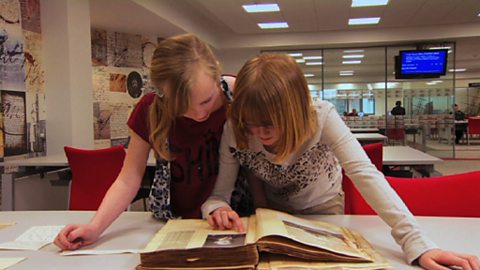
JOE CROWLEY:'If you want to go history hunting, you need to dig deep. 'The best way to uncover the facts, 'is to use the same skills and methods 'that real professional historians use.'
JOE CROWLEY:Today we're looking at motion picture or film archives. Now archives are places or online websites where information is collected and stored.
JOE CROWLEY:And film archives can be full of information that's really useful to our historical enquiries. But to get the best out of them, you'll need to learn how to use them properly.
JOE CROWLEY:'Today when we want to find out about news, 'we often look on the internet or turn on our TV.
JOE CROWLEY:'However until relatively recently, 'most people didn't have a television or a computer.
JOE CROWLEY:'People got some of their news from newspapers 'but if they wanted to actually see moving pictures of people and events, 'they had to go to the cinema to watch cinema newsreels. 'They were like the TV news bulletins that we have today.'
NEWS REPORTER:Across the north sea, steamed the British fleet and off the coast of Jutland, they met.
JOE CROWLEY:'There were a number of companies who made the bulletins. 'The biggest were Pathé, Movietone and British Gaumont.'
JOE CROWLEY:These bulletins are full of useful stuff for historians. Because of the internet, anyone can now go online and search through them for people or events that would have been in the news.
JOE CROWLEY:It's a fascinating way of looking into the past, to find out what happened and what people thought about historical events.
JOE CROWLEY:'You'll probably have to register, 'giving your name and an email address. 'You can then search for footage 'by typing in the name of the thing you're investigating.
JOE CROWLEY:'You can do a broad search, 'or you can narrow it down by looking at particular years or decades. 'You have to be patient. 'Sometimes you won't find anything, but it's worth persevering.'
UNKNOWN MALE:Sorry your search was offering no records.
JOE CROWLEY:'Once you have your results, it's then a matter of looking 'for the newsreel footage that you think will be helpful.
JOE CROWLEY:'You need to look at the shot descriptions 'as well as the actual footage.
JOE CROWLEY:'That will help you make sense of what you see on screen 'because sometimes the footage is mute which means there's no sound.
JOE CROWLEY:'Remember too that newsreels were often very supportive 'of the government of the day, 'especially during war time.'
REPORTER:Brave ships died with their crews. In attempting to cut off the enemies from its bases, the British rang for all steam.
REPORTER:All steam.
JOE CROWLEY:'You need to bear that in mind 'when you think about the facts and opinions that are in the films. 'They may be exaggerating.'
JOE CROWLEY:So like any historical source, you need to think about who made the film or newsreel, and why. You can't just take them at face value.
JOE CROWLEY:However, they can be fascinating sources for historians. They give you the chance to see and hear the actual people and events you're investigating.
JOE CROWLEY:And that can be invaluable. Imagine how quickly it would have spread through the entire world.
Many film archives used to be restricted to specialist researchers and were not available to the general public.
In recent years, this has changed and many film and newsreel archives are now widely accessible to anyone.
Presented by Joe Crowley, this is a guide to some of the richest sources of film and newsreel archives including tips on how to find the archives and use the films that they contain as a way of understanding history.
This clip is from the series History Hunt Episode 2.
Teacher Notes
After viewing the clip, pupils could visit an online film archive with strong historical content, such as the British Pathé archive.
A web search for 'UK film archives' will reveal other sources, too.
Pairs or groups of pupils could be tasked with finding out about particular subjects (such as sporting triumphs in the 1930s, or housing in the 1950s).
Ask each set of pupils to prepare a brief report, telling the rest of the class what they found out.
You could even film these reports and establish your own class film archive.
Curriculum Notes
This clip is suitable for teaching History at KS2 in England, Wales and Northern Ireland and at National 2 Level in Scotland.
More from History Hunt:
An investigation into the life and work of Muriel Matters. video
A team of young historians investigate Muriel Matters, who fought for equality and broke the law to become the first woman 'to speak' in the House of Commons.
An investigation into the life and work of Thomas Andrews video
A team of young historians investigate Thomas Andrews, the man who designed the Titanic. They consider his role as designer and whether he was at fault for the loss of life.
How to use archives. video
A practical guide to finding historical material in archives, this clip gives a taste of what kind of material is found in archives; how to access it and how to interpret it.
How to interview people. video
A practical guide to interviewing as a way of learning about historical figures or themes, the clip also gives tips on how to get the best from interviewees and what type of questions to ask.
How to research archive pictures. video
A practical guide from Joe Crowley in which she passes on some practical tips on how to find and use photographic archives
How to research newspapers. video
A practical guide to using newspaper archives to find out about more about particular subjects and historical figures.