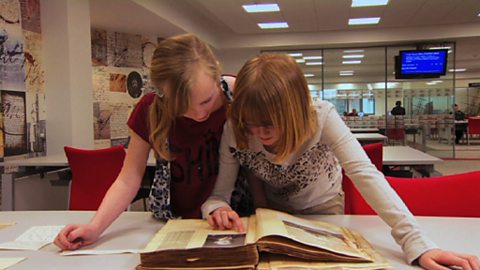
JOE CROWLEY:'If you want to go history hunting, you need to dig deep. 'The best way to uncover the facts, 'is to use the same skills and methods 'that real professional historians use.'
JOE CROWLEY:Today we're going to be looking at picture archives. Now archives are places or online websites, where information is collected and stored.
JOE CROWLEY:And photographs and paintings can be really useful when we're researching the past.
JOE CROWLEY:Now obviously they show us what people look like, but there can also be clues in them that tell us more about history than you might realise at first.
JOE CROWLEY:'You won't be surprised to learn that many picture libraries 'are now online.
JOE CROWLEY:'This gives a great way of finding photographs quickly and easily. 'Not all archives are the same.
JOE CROWLEY:'Some are general archives with many different types of pictures. 'Others are more specific, 'and feature particular types of pictures, 'such as really interesting buildings for example.'
JOE CROWLEY:What does that look like?
CHILD #1:A telephone box.
CHILD #2:A telephone box.
JOE CROWLEY:A telephone box! So that is clearly the design, on paper, for the telephone box. 'You can use them just like any normal internet search.
JOE CROWLEY:'Typing in the name of something you're researching 'and then looking through the results.'
JOE CROWLEY:Of course you can find photographs in other places. Local archives often have sections full of pictures, and most families have their own picture collections.
JOE CROWLEY:In fact you've probably got photos of your grandparents, or even your great grandparents. You might not realise it but they could be really useful to historians.
JOE CROWLEY:'Whether you find the pictures online, or in a picture archive, 'they can be a real mine of information.'
ELDERLY MAN:That hole, would have been about 6, 7 feet across.
JOE CROWLEY:'Study them carefully, it's often worth it. 'The details they contain can tell us a lot more 'than we might imagine at first glance.'
JOE CROWLEY:That's actually his brother, this is war time. You want to keep people's spirits up, because they want people to feel good about the war and keep going.
JOE CROWLEY:'We can see how people and places from many years ago looked 'and how they've changed. 'We can see what people wore, and what activities they carried out.'
JOE CROWLEY:So photographs can be really useful, but you have to be careful what you do with them. You may want to put them in a school magazine or on a website but you may need to get permission or even pay to do this.
JOE CROWLEY:That's because of something called copyright. Our copyright rules are complicated and vary depending on when the photograph was first published or who took it.
JOE CROWLEY:So you need to find out as many details as you can and then check the rules. You'll find them online.
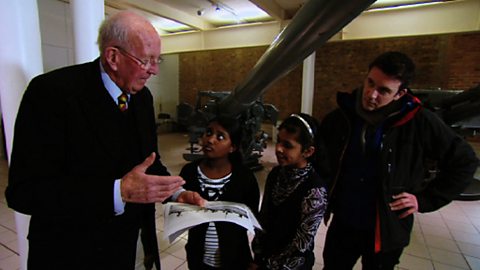
MAN WITH PICTURE:And you see the little boy on his shoulder? Guess who that is.
A picture paints a thousand words and archive photographs are a rich source for historians.
Presenter Joe Crowley passes on some practical tips on how to find and use photographic archives.
Joe considers both specialist archives, where a specific type of photo might be held, as well as general sources.
He also looks at the value of personal and family photographs as a way of understanding historical figures and themes.
This clip is from the series History Hunt Episode 2.
Teacher Notes
After viewing the clip, challenge pupils to begin developing a picture archive for your school (including the street the school stands on, and the neighbourhood that surrounds it).
Pupils could write letters to relatives and a range of local organisations and businesses, asking for copies of old photos and any information that exists about them.
They could photograph and document the school as it stands today, to add to the archive.
Teachers at your school may have photographs that illustrate its past, too.
Children could look at an online picture archive to gain tips about how to label their finds.
Finally, you could arrange a visit to a local picture archive (for example at a nearby library), so the children can find out more about their area and about how to organise their own archive.
Curriculum Notes
This clip is suitable for teaching History at KS2 in England, Wales and Northern Ireland and at National 2 Level in Scotland.
More from History Hunt:
An investigation into the life and work of Muriel Matters. video
A team of young historians investigate Muriel Matters, who fought for equality and broke the law to become the first woman 'to speak' in the House of Commons.
An investigation into the life and work of Thomas Andrews video
A team of young historians investigate Thomas Andrews, the man who designed the Titanic. They consider his role as designer and whether he was at fault for the loss of life.
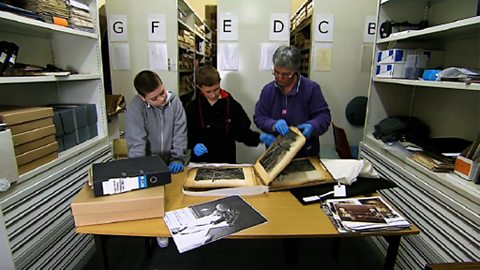
How to use archives. video
A practical guide to finding historical material in archives, this clip gives a taste of what kind of material is found in archives; how to access it and how to interpret it.
How to interview people. video
A practical guide to interviewing as a way of learning about historical figures or themes, the clip also gives tips on how to get the best from interviewees and what type of questions to ask.
How to research film archives. video
Presented by Joe Crowley, this is a guide to researching film archives or newsreels as a way of investigating historical figures or themes.
How to research newspapers. video
A practical guide to using newspaper archives to find out about more about particular subjects and historical figures.