Paul:
The first time I came to the Wye was fishing with my dad as a kid and I was blown away by its beauty.
Narrator:
The adult salmon may not feed the river, but the young fish do. After two years as fry, the little salmon change. They are now known to fishing folk as Parr.
Paul:
Back then, everywhere you looked there was an abundance of life. And it was surrounded by the sounds of nature. But sadly for this beguiling river, things have changed dramatically.
Newsreader 1:
Beneath the surface, all is not well. Parts of the Wye have been overwhelmed by pollution, with devastating consequences.
Man:
The River Wye turned lime green. It should be clear. It was absolutely shocking.
Newsreader 2:
But a major source of river pollution from agriculture, with the Wye one of those badly affected.
Paul:
Many of the upper stretches of the Wye are being affected by problems linked to intensive farm. I'm meeting up with an old fishing mate, who has witnessed the many woes of the Wye. He's someone I've fished with many times over the years.
John Bailey.
John:
Paul Whitehouse.
Paul:
Look at you in the river already. You didn't wait for me, did you?
John:
Well, I never know when you're going to arrive.
Paul:
Haha, that's a good point.
John:
You've missed absolutely nothing. Are you going to get your chesties on?
Paul:
Urgh.
John Bailey is somebody I'm very close to. He certainly knows his stuff about the River Wye and has fished the Wye for probably 40 years but he's really young. Ooh. Straight in.
Bit slimy, isn't it?
John:
If I brought you here ten years ago, we'd be dive bombed by swallows, swifts, stilts, sand martins, there would have been swans in their scores on here. It would be carpeted as far as the eye could see with luxuriant waving weeds.
Paul:
Ranunculus.
John:
Yeah, ranunculus. Look at it now.
Paul:
So, we've got a tiny bit of weed there. Look. There's an even tinier bit just there. It's like a blade of grass, isn't it?
John:
A blade of grass in a desert. If we pick up a stone, here, any one will do. You know, so.
Paul:
Oh yeah, yeah.
John:
So, so you've got this, you've got this green-y silt algae all over it.
Paul:
I can see John, it's everywhere is right. It's right the way across the river.
John:
Back in the 90s, these gravels would've been polished like diamonds.
Paul:
It's just been carpeted, hasn't it?
John:
Carpeted with growth. Why? I think it's definitely fertiliser.
Paul:
Right.
John:
It's an overloading of nitrates, phosphates.
Paul:
The biggest source of the sludge on this riverbed is farming, and it works a bit like this. The animals we intensively rear for food, produce a lot of poo and filth, Richard the Third's, you know what I mean.T
This stuff is full of nutrients like phosphate, so farmers spread it to grow grass for livestock and crops for us. When it rains, these nutrients can end up in the river and it all starts to go a bit Pete Tong. T
The algae go mad for the stuff and grow like no one's business taking over the river and killing off other life.
John:
It has a disastrous effect on how the river looks and of course, very many summers, uh, this just runs like pea green soup. You know, the algae growth is horrendous.
There have always been phosphates on their land and hence in the river. It is just a fact that they are approaching 20 million chickens, 20 million chickens in the Wye catchment.
Paul:
That's more than the population of Belgium.
John:
It is a huge amount. A huge amount of poo has to be got rid.
Paul:
You're witnessing the decline of a thing of majestic beauty.
John:
It is to all intents and purposes, mate, dead.
Paul:
The demise of the Wye has angered many locals like John. Much of this anger is directed at the intensive chicken industry, which has exploded across the country in recent years to satisfy our need for cheap food.
I've crossed over the border into Wales, following the Wye up to its higher tributaries. The Ithon flows directly into the Wye and is a river plagued by high levels of phosphate pollution.
Using my vast brain, I'm pretty sure we must be in agricultural territory because I just saw some cows. The Ithon Valley has a high concentration of our feathery friends.
The chicken run, the chicken run. Old West Ham chant there. Yep, that's it.
Hello, Sharon.
Sharon:
Hello, Paul. How are you?
Paul:
I'm good, thanks. Sharon runs one of the many farms in the Ithon Valley, rearing sheep, cows and a lot of chickens. Sharon's got a lovely pile of chicken poo ready to be inspected.
Sharon:
Yeah, so here's our pile of poo.
Paul:
Let's get upwind of it, shall we?
Sharon:
This is some of the litter that came out, some of it has already been spread, but this, this is not that old, hasn't been there that long. So let me just show you the consistency of it.
Paul:
Smells a bit cheesy. My problem with it is that there's so much of it. If he gets into a river system and is causing the problems that phosphates do, it promotes algal growth and that is not good for anyone or anything.
What if there's a torrential downpour overnight?
Does it not then start to run off into the ditches and into the streams?
Sharon:
Right, so the whole point of it is, is because, because it's so solid and, you know, you've demonstrated that with the chunk that you had, that it doesn't wash away that easily. Also, we are not allowed to place these heaps anywhere near to watercourses.
Paul:
Sharon's fields border and the Ithon, and so the careful spreading of the chicken muck and is crucial.
Sharon:
So what we've got here is what is known as a buffer strip.
Paul:
Yeah.
Sharon:
So if you stand about there and look back up and you can look in that direction as well. I think you can start to pick out a sort of a line.
Paul:
Yeah, I can see a very well defined line actually.
Sharon:
Ok, so anything that we apply to the ground is not allowed to be less than three metres from the rivers.
Paul:
See, that seems quite close to me, Sharon. I mean, who decides that?
Sharon:
Well that, that was, that, that's a Welsh Government directive.
Paul:
You can see all the stones, but there is a level of sediment. To me the riverbed looks dead, you know.
Sharon is clearly trying to reduce the farm's impact on the river, but her job is made tougher by the relentless demand for cheap foodhere in the UK.
How many birds do you have here at any one time?
Sharon:
40 thousand birds in each house. Maximum.
Paul:
And how many houses have you got?
Sharon:
Paul:
Right, so you have 120 thousand at any given time. And what does that mean over a year then ?
Sharon:
We would have about seven crops a year.
Paul:
Right, so that's nearly a million. That's a lot of litter, essence, poo. What can be done about that? Because it is causing problems in the river, isn't it.
Sharon:
Yes, so although in this area there might be an excess of nutrients because of all the livestock in the area, in other areas of the country that's not the case.
Could that litter and farmyard manure be transported across the country to where it's needed, to where they're buying chemical fertilisers?
Unless you're going to have that sort of the system into, it has to concentrate in an area because that makes the environmental impact of hauling things around less.
Paul:
Agricultural pollution is definitely had a part to play in the decline of our rivers.
The millions of chickens that are in and around the Wye Valley are bound to have an effect on the environment, obviously.
However, when you meet somebody as engaging as Sharon, you realise that the individuals involved are doing their level best to try and come up with solutions.
The drive for cheap food is a real issue for our rivers, adding to the pollution problems caused by water companies, industry and us.
Paul Whitehouse looks at how agricultural pollution is affecting the River Wye.
The River Ithon (Afon Leithon) rises in the Welsh uplands and flows from its source north of the Welsh village of Llanbadarn Fynydd, to its confluence with the River Wye just south of Newbridge-on-Wye.
The River Wye flows from its source in the mountains of mid Wales for some 155 miles (250 kilometres) to the Severn estuary, marking the border between England and Wales for much of its length.
In the recent past, these rivers supported diverse and thriving wildlife populations but studies show that both rivers are heavily polluted, with little life to be seen. Many of the upper stretches of the River Wye and its tributary the River Ithon, are affected by problems linked to intensive farming.
The Wye catchment area supports intensive chicken farms, with a population of about 20 million chickens at any one time, and this activity produces a lot of chicken manure.
Farmers spread the manure on their land as fertiliser as it is rich in nutrients and phosphates. However, if washed into nearby rivers, it encourages rapid algae growth and this, in turn, kills off other wildlife, rendering rivers lifeless.
This video is part of UK rivers case studies, a series of clips taken from Paul Whitehouse: Our Troubled Rivers – available on BBC iPlayer.
Teacher Notes
Before watching the film:
- Ask students who eats chicken and how many times a week. Can they guess how many chickens go to slaughter on average in the UK each week? According to government statistics, that figure is between 20 and 21 million. So, what do they know about the production of this popular food? Take ideas and explore the term ‘intensive agriculture’.
- Ask students if anyone has heard of or visited the River Wye. It is a well-known British river and the Wye Valley, through which the river flows for about a third of its length, is an Area of Outstanding Natural Beauty (AONB) and popular with activity and wildlife enthusiasts. Find it on a map and discuss the landscapes it passes through.
- Ask students what they know about the state of the River Wye today and the threats it faces. Explain that sections of the river are nearly lifeless and ask students to watch the film carefully so they can explain why.
During the film:
- You may wish to stop at relevant points during this short film to pose questions and check understanding or wait until the end. Useful questions might include:
- Why has there been a large increase in the chicken industry? (To satisfy our need for cheap food).
- Why and how are the rivers being polluted?
- How can you tell if a riverbed is dead without testing? (silting, lack of water weeds, may be green with algae growth).
- What is a buffer zone?
- How many chickens are on this one farm at any one time? (about 120,000)
- How many chickens are ‘processed’ on this one farm throughout the year? (nearly a million)
Following on from the film:
- Students could draw an annotated diagram to show some of the causes and impacts of river pollution from agricultural practice.
- The farmer explained that buffer zones are designed to keep the pollution to a minimum but what is going wrong if the rivers are still being polluted?
- Ask students to suggest some reasons why and create a list. For example:
- Does the buffer zone need to be bigger?
- Does the number of chickens farmed need to be smaller?
- If the buffer zone is not being adhered to, does enforcement need to be more stringent?
- Are we eating too many chickens?
- Are chickens too cheap?
- Is chicken farming too concentrated in one region?
- Discuss this issue and challenge students to come up with some suggestions for a workable solution and create a written report with appropriate maps and diagrams.
- What are the pros and cons then of intensive farming? Ask pupils to think about this using the evidence from the film and watching the Class Clip Geography KS3/4: Intensive farming.
- Can students think about other perspectives too such as the impacts on the health of a local economy where jobs may be scarce (economic); impacts on flora and fauna (environmental); and on recreational opportunities and healthy places to live and work (social).
- Remind students that this is just one pollution source. Other sources include human sewage and chemicals.
Curriculum Notes
All these short clips build on students’ understanding of human and environmental interactions and provide opportunities to practice geographical skills such as enquiry, mapping and fieldwork.
At KS3, students learn more about how human and physical processes interact to influence, and change landscapes, environments and the climate.
At KS4, the film supports understanding about fluvial environments, flooding hazards and climate change, environmental management and fieldwork investigation.
This clip could be used to support the delivery of geography KS3 and KS4 students.
Specifically, this topic appears in OCR, Edexcel, AQA KS4/GCSE in England, WJEC Progression Step 4/5 in Wales, CCEA GCSE in Northern Ireland and SQA S4/5 in Scotland.
The film might also be used for example, to contribute to case studies about human interactions on fluvial environments (CCEA), or Social Development Issues and Environmental Challenges (WJEC).
Further clips from Paul Whitehouse: Our Troubled Rivers
Water industry privatisation. video
A look at the background to the privatisation of ten regional water authorities in 1989.

River Wharfe and wastewater systems in the UK. video
Paul visits the River Wharfe in Ilkley, West Yorkshire to see how it is affected by pollution from sewage.
Lake Windermere eutrophication. video
Paul visits Lake Windermere to hear how tourists may be contributing to pollution levels.
Beavers and rewilding in the UK video
Paul visits the River Tamar in Devon to hear about a project that aims to let nature restore ecosystems.

Pharmaceutical pollution in the River Clyde video
Paul visits the River Clyde in Glasgow to hear about pharmaceutical pollution and its consequences.
River monitoring and 're-wiggling' on the River Ribble. video
Paul visits the River Ribble in Lancashire to look at biodiversity monitoring and a project that is putting meanders back into the river.
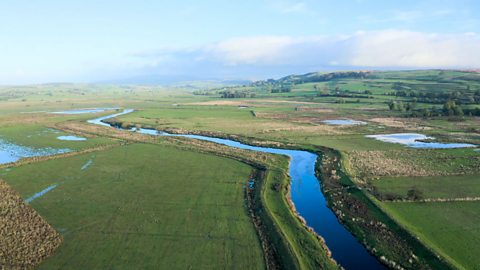
River Tame microplastic pollution. video
Paul learns about how microplastic pollution affects the River Tame in Greater Manchester.
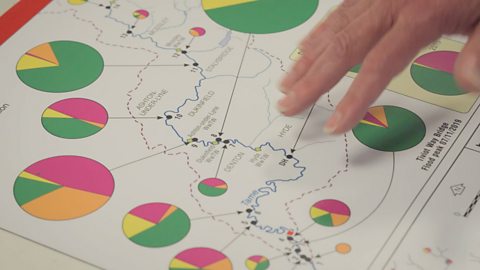
River Test and UK chalk streams. video
Paul visits Hampshire to look at a very rare habitat – England contains 85% of all chalk streams in the world.
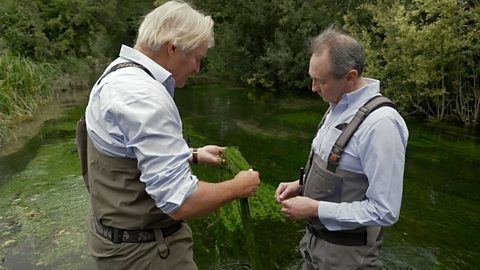
River Thames Tideway project video
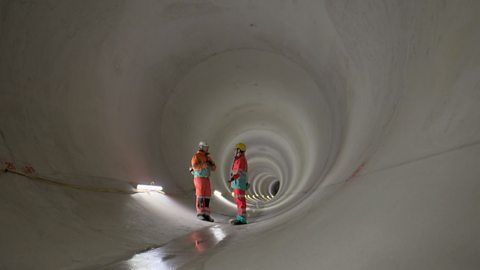
Paul visits the construction site of a 'super sewer' in London.