Paul:
Now, the water industry in England and Wales is unusual. In that it's not the Government that operates our water, private companies do. And to truly understand this, we've got to go back to 1989.
High on the agenda for the government of the 80's was privatisation. They'd sold off oil, gas. Next up was water.
News presenter 1:
Britain's water supply is to go private and it'll be the biggest sale yet of nationally owned assets.
News presenter 2:
The ten authorities in England and Wales would become ten private companies. A new system of regulation will be introduced to safeguard the environment, and there will be controls to prevent companies overcharging consumers.
Dieter Helm:
The industry was privatised for a couple of reasons. One was essentially ideological. The belief that private, good. Public, bad.
Emma Gatten:
The hope was that private industry would be able to provide a level of investment that just wasn't happening from the government and we would have a much more efficiently run water industry.
Margaret Thatcher:
Under privatisation, the consumer will have much better protection and so will the environment.
Dieter:
The EU directives would require a substantive cleaning up of water and Sewage Services and the government at the time were squeezing public expenditure and came up with selling the existing companies. And then the government wouldn't have to pay the costs of that investment.
Paul:
Whatever your views on it, privatisation changed the water industry almost overnight.
Member of public 1:
Well I just think it might be a good investment.
Member of public 2:
I'm late for work and everything now, but you've got to make your money, haven't you?
Emma:
The water companies were listed, so anyone could buy parts of them. It was open to the public under a government campaign.
News presenter 3:
The water minister Michael Howard said tonight the sell-off had been the success that government had always known it would be.
Michael Howard:
I'm delighted. It's obviously a very enthusiastic response and a great success.
Dieter:
They started off with quite a wide diffuse, effectively public ownership in the sense that the public bought their shares. But, quite quickly, the investment flows came from abroad.
News presenter 2:
The French water company Lyonnaise des Eaux has bought large stakes in three of Britain's newly privatised water companies.
News presenter 4:
Those sort of prices are rather low and the gross of English companies is rather good.
Emma:
This system opened up our water companies to investment from just about anyone, whether that was pension funds, private equity funds or foreign governments.
Paul:
As we move through the 90's, more and more foreign investors saw the benefits on offer of owning part of our water industry. Big dividends.
Dieter:
The whole point of privatisation is to excite the profit incentives and there's absolutely nothing wrong with profit. But what actually happened was that the profitable opportunities turned out to be less in efficiency terms and much more in terms of extracting money.
Stuart Colville:
We hear a lot of criticism about profits and dividends and other issues with the water industry, but it's an efficient model which has mobilised huge amounts of private capital, while making sure that bills are kept under control. Now, there's still plenty more to do, there are clearly still problems there. But in terms of where we were in the 1980's, the transformation has been profound.
Emma:
You might say that it doesn't matter who owns our water companies, what matters is how they are running them and how they are regulated.
Dieter:
So the water industry is regulated by two main bodies.
The Environment Agency, which is supposed to set the environmental requirements.
And we've got OFWAT, the economic regulator, which is basically meant to make sure that the water companies were efficient and didn't make excess returns.
Think about them as a monopoly regulator basically.
A lot of criticism of the companies, but the overall problem is how do we have an investment programme which can actually be paid for and people are willing to pay for it.
And that has never been resolved.
Video summary
This film looks at the background to the privatisation of ten regional water authorities in 1989.
The water privatisation in 1989 involved the transfer of the provision of water and wastewater services in England and Wales from the state to the private sector through the sale of the ten regional water authorities.
The water companies charge for and provide a service that is covered by a regulatory framework set up with the aim of ensuring fair prices and high standards.
The Office for Water Services (OFWAT) act as the economic regulator of the water and sewerage sectors.
The Department for Environment, Food and Rural Affairs (Defra) sets the overall water and sewerage policy framework in England, while the Welsh Government does this in Wales. Natural Resources Wales are the environmental regulator of the water and sewerage sector in Wales, and the Environment Agency carry out this regulation in England.
Things are different in Scotland and Northern Ireland. Scottish Water provides water and sewerage services across Scotland and is accountable to the public through the Scottish Government. They are regulated by The Water Industry Commission for Scotland. Northern Ireland Water is a Government Owned Company set up in April 2007 to provide the water and sewerage services.
This video is part of UK rivers case studies, a series of clips taken from Paul Whitehouse: Our Troubled Rivers – available on BBC iPlayer
Teacher notes
Before watching the film:
- Establish what students know about the term ‘privatisation’. Create a definition for this and other terms as a class:
- Company
- Ideological
- Privatisation
- Shares
- Environment Agency
- OFWAT
- Ask students to watch the film and be prepared to explain why water was privatised and when.
During the film:
- You may wish to stop at relevant points during this short film to pose questions and check understanding or wait until the end. Useful questions might include:
- Why do you think members of the public might want to buy shares in the privatised water companies?
- Why do you think foreign investors were keen to invest in our water industries?
- What is the purpose of organisations like the Environment Agency and OFWAT?
Following on from the film:
- Discuss students’ views on the privatisation of water assets in England and Wales.
- It is claimed that privatisation has improved water quality since the 1980s. Can students find evidence to support or rebut this claim? What do current trends show for England Wales?
- How does this compare with water quality in Scotland and Northern Ireland? Ask students to evaluate different sources of information and extract relevant and reliable evidence.
- Identify your own local water company and carry out an enquiry to establish and map the area they cover, naming some of the key waterways.
- Ask students to investigate the water company’s record of managing water safely and sustainably. Can they identify some pros and cons of their water management programme and make recommendations?
Curriculum Notes
All these short clips build on students’ understanding of human and environmental interactions and provide opportunities to practice geographical skills such as enquiry, mapping and fieldwork.
At KS3, students can learn more about how human and physical processes interact to influence, and change landscapes, environments and the climate.
At KS4, the film supports understanding about fluvial environments, flooding hazards and climate change, environmental management and fieldwork investigation.
This film develops understanding of economic activity and natural resources (KS3), and supports students in researching and debating ethical issues in geography (KS4).
Further clips from Paul Whitehouse: Our Troubled Rivers
River Wharfe and wastewater systems in the UK. video
Paul visits the River Wharfe in Ilkley, West Yorkshire to see how it is affected by pollution from sewage.
Lake Windermere eutrophication. video
Paul visits Lake Windermere to hear how tourists may be contributing to pollution levels.
Beavers and rewilding in the UK video
Paul visits the River Tamar in Devon to hear about a project that aims to let nature restore ecosystems.

Pharmaceutical pollution in the River Clyde video
Paul visits the River Clyde in Glasgow to hear about pharmaceutical pollution and its consequences.
River monitoring and 're-wiggling' on the River Ribble. video
Paul visits the River Ribble in Lancashire to look at biodiversity monitoring and a project that is putting meanders back into the river.
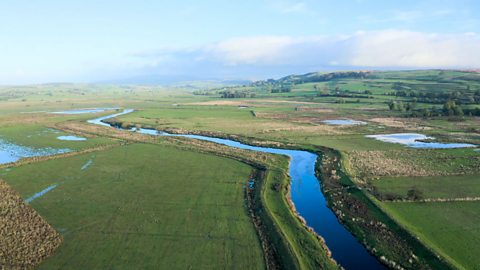
River Tame microplastic pollution. video
Paul learns about how microplastic pollution affects the River Tame in Greater Manchester.
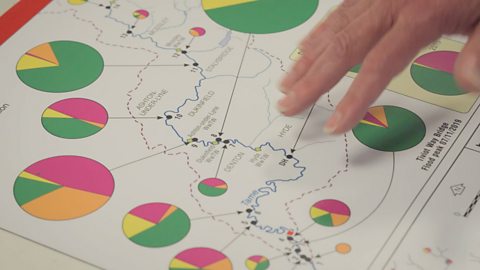
River Test and UK chalk streams. video
Paul visits Hampshire to look at a very rare habitat – England contains 85% of all chalk streams in the world.
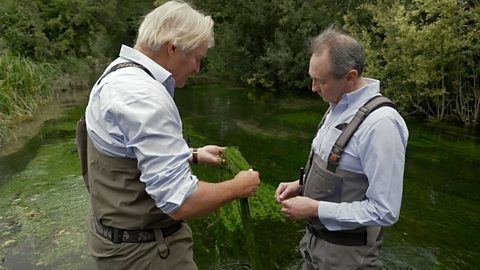
River Thames Tideway project video
Paul visits the construction site of a 'super sewer' in London.
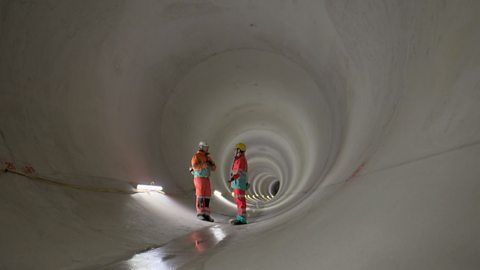
Intensive chicken farming and the River Wye video
Paul looks at how agricultural pollution is affecting the River Wye.