Paul:
It's time to head east, to the chalk hills of southern England. This unique landscape has given rise to some of my favourite stretches of river.
The chalk streams.
There are just over 200 in the world and Hampshire is home to many. One of the finest examples is the River Test.
My guide to the Test is Simon Cooper, a chalk stream expert who takes care of stretches of the river.
(to Simon) Quintessential chalk stream.Simon Yep. Let's get in it.
Simon:
There's one.
Paul:
Yeah.
Simon:
One just shot over there.
Paul:
A lot of wild fish here, Simon.
Simon:
It just honestly, this is a tremendous stretch.
Chalk streams are different to most rivers.
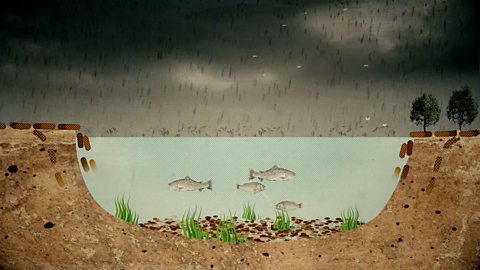
So most rivers, the rainfall comes down from the hills and, within a few hours or a few days, the water's all in the sea.
But with a chalk stream, the water we're standing in now actually fell as rain six months ago, twelve months ago.
Paul:
Right.
Simon:
And so this fell on the chalk downs, the chalk sort of absorbs it like a giant-
Paul:
Big, big sponge. Giant sponge.
Simon:
Like a giant sponge!
Paul:
It's called an aquifer, isn't it?
Simon:
Yes.
Paul:
And it's a sort of subterranean reservoir that feeds these rivers.
Simon:
Exactly and it, and it sort of, and then it seeps out in sort of gazillions of tiny little springs.
Paul:
Yeah.
Simon:
That then aggregate to create these chalk streams. And so the thing about them is they're always clear and that always ten degrees C.
I mean, the water looks crystal clear, but the problem is there are huge numbers of pollutants in this water.
If I can show you, we got a weed down here called blanket weed, so-
Paul:
Normally you would, you know, weed is an indication of a healthy river, isn't it?
Simon:
Exactly, and, and, and the king of weed.
Paul:
I know what it is, it’s King Ranunculus.
Simon:
Ranunculus! Exactly and Ranunculus relies on sunlight, but unfortunately, because of phosphates that come out of agriculture and out of sewage. It promotes blanket weed and if we pull it up it's this sort of long filamentous weed.
Paul:
Right, yeah. You can, I can see why it might choke, you know, the bed and.
Simon:
And it does what it says on the label.
Paul:
Yeah.
Simon:
It's blanket.
Paul:
It's blanket.
Simon:
Blanket and so what it does.
Paul:
It really is blanket weed, isn't it?
Simon:
But the problem is if you get too much it cuts off the sunlight and the Ranunculus dies.
Paul:
Get out of here.
There's another real problem for the chalk streams though, isn't there, which is the abstraction, the removal of drinking water from the aquifer. By the water companies or the water company.
Simon:
The water companies, well, I mean yes, we're sort of ten, fifteen miles down from the source of the River Test and if we went up to the headwaters of the River Test, we'd actually find they're drying up.
Paul:
Chalk streams across the south are suffering the same fate as the Test, as abstraction by water companies and climate change put pressure on the aquifers.
Newsreader 1:
The Black Bourn is a chalk stream that rises south of Bury St. Edmunds.
In places it's all but dried up causing fish, invertebrates and plants to die.
Newsreader 2:
A chalk stream in trouble. Hardly any water and, beneath the surface, hardly any life.
Simon:
The difficulty is, since the last drought in 1976, the water demand has increased. So in 1976, you probably had a bath once a week.
You probably, but now you probably we have a shower every day and you're not alone in that, most people are like that.
So the average consumption per person has gone up to 150 litres a day.
Paul:
And the population has increased immensely, as well.
Simon:
Yes, and we haven't built a single new reservoir since 1989. And so, where do you take the water from? You suck it from the aquifers.
Paul:
Yeah.
Simon:
And if you taking it from the aquifers, it's not going into the rivers and the rivers that had water are literally dying.
Paul:
We point the finger, don't we, at people around the world who are damaging their ecosystem. And here we are with this extraordinary landscape and we're not treating it very well, are we, Simon?
Ofwat, the water regulator for England and Wales said:
"Ofwat is working with other regulators to develop a programme of new water resource infrastructure projects, including water transfers and new reservoirs.
These projects will help to address the country's long term needs alongside action to increase water efficiency and further reduce leaks. There are currently 18 projects going through the gated process of development."
Paul Whitehouse visits the River Test in Hampshire which has one of the most well-known chalk streams.
Chalk streams are sometimes called England’s equivalent of the Rainforests or Great Barrier Reef, as they are a rare habitat, and important for biodiversity.
England, particularly the south and east, has 85% of the world’s chalk streams; these are mostly found in Yorkshire, East Anglia, the Chilterns, Kent, Hampshire and Dorset.
Chalk streams are produced after rainwater has percolated through chalk beds, re-emerging as clear water through many springs, after a period that can be as long as six to 12 months. Water reserves in porous rocks are called aquifers.
The River Test is one of the most well-known chalk streams. It rises west of Basingstoke, near the village of Ashe and flows for just over 40 miles (65 kilometres) to its mouth at Southampton Water.
Pollutants like phosphates from agriculture and sewage, encourage the growth of blanket weed, which blocks sunlight and prevents photosynthesis of useful vegetation that support biodiversity.
In addition, water extraction causes water levels to drop and streams to dry up. This problem is made worse by increased demand and population growth; lack of investment in additional storage facilities such as reservoirs, and climate change.
This video is part of UK rivers case studies, a series of clips taken from Paul Whitehouse: Our Troubled Rivers – available on BBC iPlayer.
Teacher Notes
Before watching the film:
- Ask students if they have heard of chalk streams and what they think they are. Look at a map that shows the geology of the UK, such as that provided by the British Geological Society and ask students to identify where they might be found.
- Using digital mapping software such as Digimaps, Arc GIS, or Google Maps, ask students to locate source of the River Test, which rises near the village of Ashe, and to map its mouth.
- Discuss the nature of chalk stream processes and how water is stored in aquifers. Students could provide a definition of the following terms:
- Aquifer
- Chalk stream
- Permeable
During the film:
- You may wish to stop at relevant points during this short film to pose questions and check understanding or wait until the end. Useful questions might include:
- Why do you think the water of the Test emerges looking sparkling and clean? (months of filter and percolation through chalk).
- What is the main threat of pollution? (Nutrients, such as phosphates, from agriculture and sewage causes the growth of blanket weed which kills off natural vegetation, making the river unfit for its natural wildlife).
- What other threats are there? (Water extraction, increased drought due to extraction and climate change).
- What solutions might there be? (Investment in infrastructure, such as new reservoirs, and better management to penalise and prevent pollution).
- How valuable are chalk streams to the UK? (England has 85% of the global total, a rare habitat.)
Following on from the film:
- Ask students to research and write their own set of recommendations for protecting the Test, with suitable explanations.
- Plan for fieldwork at a water course near you, especially if you are near a chalk stream, to investigate the signs of a healthy river such as the wildlife in and near the river and the amount of blanket weed.
- Design an assessment sheet to record findings that will help assess the river or stream you are visiting.
Curriculum Notes
All these short clips build on students’ understanding of human and environmental interactions and provide opportunities to practice geographical skills such as enquiry, mapping and fieldwork.
At KS3, students can learn more about how human and physical processes interact to influence, and change landscapes, environments and the climate.
At KS4, the film supports understanding about fluvial environments, flooding hazards and climate change, environmental management and fieldwork investigation.
This film develops understanding of economic activity and natural resources (KS3), and supports students in researching and debating ethical issues in geography (KS4).
Further clips from Paul Whitehouse: Our Troubled Rivers
Water industry privatisation. video
A look at the background to the privatisation of ten regional water authorities in 1989.

River Wharfe and wastewater systems in the UK. video
Paul visits the River Wharfe in Ilkley, West Yorkshire to see how it is affected by pollution from sewage.
Lake Windermere eutrophication. video
Paul visits Lake Windermere to hear how tourists may be contributing to pollution levels.
Beavers and rewilding in the UK video
Paul visits the River Tamar in Devon to hear about a project that aims to let nature restore ecosystems.

Pharmaceutical pollution in the River Clyde video
Paul visits the River Clyde in Glasgow to hear about pharmaceutical pollution and its consequences.
River monitoring and 're-wiggling' on the River Ribble. video
Paul visits the River Ribble in Lancashire to look at biodiversity monitoring and a project that is putting meanders back into the river.
River Tame microplastic pollution. video
Paul learns about how microplastic pollution affects the River Tame in Greater Manchester.
River Thames Tideway project video
Paul visits the construction site of a 'super sewer' in London.
Intensive chicken farming and the River Wye video
Paul looks at how agricultural pollution is affecting the River Wye.