Paul:
I'm on the Thames in London, a river which has long suffered from sewage pollution. Finally, there is now a ray of hope for this legendary river.
(to Darren) Hello. Nice helmet.
Darren:
Hello Paul.
Paul:
Hello Darren. Don't feed me.
Darren:
Welcome to Tideway.
Paul:
Thanks very much.
Darren is project manager of the Tideway, a major infrastructure development for the Thames, which will help free the river of dirty discharges.
Darren:
This is my world, this is my domain, it's where I live.
Paul:
Once completed, this 4.4 billion pound mega project will be operated by Thames Water. Greenwich is one of 24 sites across the capital upgrading the Victorian system and building a new future for the Thames.
Darren:
Here we are.
Paul:
Yes.
Darren:
Yeah, so this is, uh, Greenwich's, Thames Water Pumping Station.
Paul:
Uh huh.
Darren:
So Thames Water own this, this asset. It's, er, it's a listed building, it's dealing, it's fully live, fully operational. The reason behind Tideway is just, an old age problem that the river's just too dirty and the amount the sewage, forty million tonnes a year, um, being directly pumped into the river was just not acceptable and we need to do something about it.
Paul:
Yeah, I mean it's, it's an extraordinary project but you can see evidence all around of the pressure that is on the river because there'snew flat developments there, all, all around us, aren't there?
Darren:
Poke your head over the side there.
Paul:
Okay.
Darren:
That's the one. So, if you look down there now, you can see the live sewers, Paul, coming through. So there's three sewers coming into here from all the parts of Greenwich and Lewisham.
Paul:
That's not too bad.
Darren:
No, it's not too bad.
Paul:
No, not at the moment. I bet, I bet on some, oh, there we are.
Darren:
Excuse the smell, it wasn't me.
Paul:
Oh.
Darren:
Someone just flushed.
Paul:
Oh, yeah, it's pretty grim, isn't it, yeah.
Darren:
Yeah, so what you can see here, Paul, is uh, where the sewers come in from all over Greenwich on a day to day basis. They go through here, go into the pumping station, pumped off for treatment as, as normal. When the flows get too much - heavy rain, big storms, it back flows all the way down to the river and into the river, which we don't wanna see. That is why we're here,
Paul:
So get on with it.
Darren:
Yeah, yeah. We're building a CSO combined sewer out-flow and that will intercept this overflow. Then all of it will go out to Beckton for treatment and then it'll be all treated into clean water at Beckton and pumped out to sea as, as clean water.
Paul:
Brilliant. Have you got something against Beckton or something?
Darren:
No they just love treating dirty water. So we're going to give it all to them.
Paul:
Hat, hats off to 'em.
Darren:
We're going to give it all to them.
Paul:
They wouldn't want to do it in Chelsea, would they?
Darren:
Correct, yeah. If you carry your little re-breather with you.
Paul:
Okay.
Darren:
Throw it over your shoulder.
Paul:
Will do. Do I need to do this up here?
Darren:
You don't have to , that's up to you.
Paul:
Oh okay, I won't then.
Darren:
And I'll take mine. Right, let's go down the stairs and we'll have a little look at what we're building.
Paul:
This one?
Darren:
Yeah, follow me.
Paul:
Having avoided it for so long and now is the time to head into the sewers below.
Darren:
Follow me.
Paul:
Right.
Darren:
In it's current set up, about eight million tonnes of sewage a year, just from this area, just from Greenwich, get dumped directly into the river untreated.
Paul:
No.
Darren:
Yeah. So, we're intercepting 95-more per cent of all of that. That, that's going to get intercepted by our Tideway Tunnel and out for treatment. Right Paul, we're now going to head down 57 metres to the bottom of the shaft.
Paul:
No we're not.
Darren:
Let's go.
Paul:
Alright.
You take me to all the most wonderful places, don't you? How long does it take?
Darren:
Couple of minutes.
Paul:
Okay. Descending two hundred fifty two stairs, I'm heading into the bowels of the Tideway.
Darren:
Here we are 57 meters down.
Paul:
It's incredible. It's like a sort of industrial Sistine Chapel, isn't it?
Darren:
Yeah, an upside down Chapel.
Paul:
Yes. Very bond, you know, especially all those noises as we were coming down. Whoop, whoop, all of that. Incredible.
This massive pipe is bigger than Nelson's Column and will intercept excess wastewater, diverting it along the 25 kilometer network of tunnels to be properly dealt with.
I mean, it feels like we're slightly walking to our doom.
Darren:
Yeah, we're walking downhill.
Paul:
Yeah.
Darren:
So, here we are Paul.
Paul:
Yeah.
Darren:
The Greenwich connection tunnel. That's the finished product. This is what Tideway is going to look like.
Paul:
It's, it's impressively smooth.
Darren:
Yeah.
Paul:
Some of my old classroom work wasn't as good as this.
Darren:
Yeah, yeah.
Paul:
So if we were down here, of course, when it's operational, we'd see a tidal wave of effluent.
Darren:
Yeah. You might need to bring a little boat with or maybe waders you use.
Paul:
Yeah, yeah true. It's very impressive, its very laudable. Extraordinary feat of construction.
Darren:
Yeah, fantastic.
Paul:
It's going to take a lot of pressure off the River Thames and I assume that you've built in extra capacity, operational capacity to deal with, you know, the excess demands that are going to occur.
Darren:
Yeah, I mean absolutely, this, this, this tunnel, all of the Tideway network has been designed for the population of London, with a 120 year design life. So it should last and it should do its capacity for the next 120 years, at least.
Paul:
I expected to have to look in detail at sewage at some point. I'm obviously more home, you know, looking around the chalk streams and our beautiful rivers.
But that's the story of our rivers, you know, they've been used as a dumping ground for waste and sewage. The river washes everything away. It washes your sins away. But unfortunately, sometimes your sins come back to bite you on the bum.
Tideway is a huge step forward for the Thames. But according to OFWAT, there are no plans to build any other Super Sewers in England, leaving many of our rivers at the mercy of outdated infrastructure.
Paul Whitehouse visits the construction site of the River Thames Tideway project in London.
London relies on a 150-year-old sewer system that was built for a population less than half its current size. As a result, around 40 millions of tonnes of raw sewage spills, untreated, into the River Thames each year.
The Tideway Project is a major development programme for the River Thames that will be operated by Thames Water to combat this problem. 24 of these systems need to be upgraded, including Greenwich.
In Greenwich alone, without Tideway, 8 million tonnes of untreated sewage are dumped into the River Thames each year.
Tideway has been designed to intercept and divert this excess untreated waste to the waste treatment plant at Beckton.
The design life is for 120 years and this should keep pace with the growing population of London.
However, OFWAT (Office for Water Services) has no plans to build more super sewers of this nature to alleviate the stress on other UK river systems.
This video is part of UK rivers case studies, a series of clips taken from Paul Whitehouse: Our Troubled Rivers – available on BBC iPlayer.
Teacher Notes
Before watching the film:
- Using digital mapping software such as Digimaps, Arc GIS, or Google Maps, locate the River Thames and zoom into the London region.
- Looking at Greater London on the map, discuss the likely pressure from the city’s population, on the River Thames before it flows out to sea.
- Recap the population of London (8.797 million in 2021) and ask students to say where the sewage goes to from this large population.
- Do students think it is all treated before being returned to the environment? If not, ask them to hazard a guess as to how many tonnes of sewage from London are released untreated into the Thames each year. Ask students to write down their estimate before watching the film.
During the film:
- You may wish to stop at relevant points during this short film to pose questions and check understanding or wait until the end. Useful questions might include:
- How many tonnes of untreated sewage are released into the Thames in London each year? (Before Tideway becomes operational)
- How many tonnes of untreated sewage are released each year just from Greenwich alone?
- When were the existing sewers built in London?
- Why have they not been upgraded before now to cope with the growing population?
Following on from the film:
- Ask students to discuss their reactions to the film and the revelation of 40 million tonnes of untreated sewage being released into the Thames each year.
- Investigate the scale of Beckton water treatment works, using the Tideway project website and other sources.
- How much land does it take up and can it be found on the map? Students could use a digital mapping programme to measure the area currently used for treatment works.
- Using the Tideway website and other sources, gather data and create an infographic about the project.
- If this ‘super sewer’ is urgently needed in London, where else do students think it may be needed? Ask students to identify other locations using annotated maps.
- Compare this solution to sewage treatment with that of other countries. How well do other major cities dispose of their sewage?
Curriculum Notes
All these short clips build on students’ understanding of human and environmental interactions and provide opportunities to practice geographical skills such as enquiry, mapping and fieldwork.
At KS3, students can learn more about how human and physical processes interact to influence, and change landscapes, environments and the climate.
At KS4, the film supports understanding about fluvial environments, flooding hazards and climate change, environmental management and fieldwork investigation.
This film develops understanding of economic activity and natural resources (KS3), and supports students in researching and debating ethical issues in geography (KS4).
Further clips from Paul Whitehouse: Our Troubled Rivers
Water industry privatisation. video
A look at the background to the privatisation of ten regional water authorities in 1989.

River Wharfe and wastewater systems in the UK. video
Paul visits the River Wharfe in Ilkley, West Yorkshire to see how it is affected by pollution from sewage.
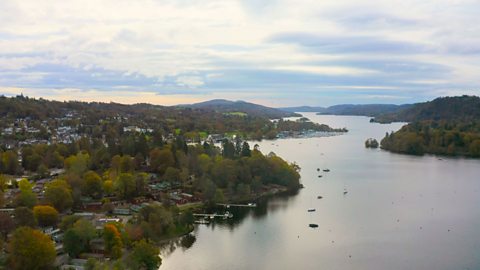
Lake Windermere eutrophication. video
Paul visits Lake Windermere to hear how tourists may be contributing to pollution levels.
Beavers and rewilding in the UK video
Paul visits the River Tamar in Devon to hear about a project that aims to let nature restore ecosystems.

Pharmaceutical pollution in the River Clyde video
Paul visits the River Clyde in Glasgow to hear about pharmaceutical pollution and its consequences.
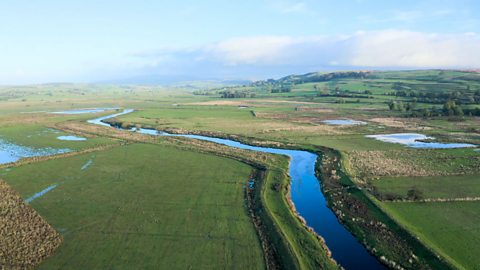
River monitoring and 're-wiggling' on the River Ribble. video
Paul visits the River Ribble in Lancashire to look at biodiversity monitoring and a project that is putting meanders back into the river.
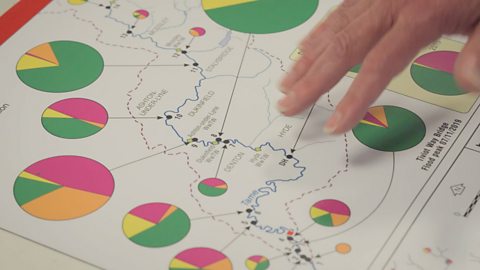
River Tame microplastic pollution. video
Paul learns about how microplastic pollution affects the River Tame in Greater Manchester.
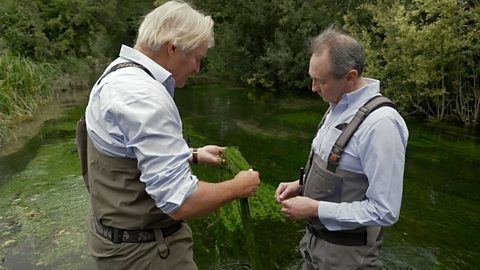
River Test and UK chalk streams. video
Paul visits Hampshire to look at a very rare habitat – England contains 85% of all chalk streams in the world.
Intensive chicken farming and the River Wye video
Paul looks at how agricultural pollution is affecting the River Wye.