Paul:
I've come to Glasgow, home to the River Clyde. Running through the heart of the city, it's a river that has impacted by an industrial heritage and a growing population.
Doctor John Wilkinson and Professor Alistair Boxall, from the University of York, have been conducting research into the health of rivers across the world, including the Clyde, focusing on the presence of pharmaceuticals in our waterways.
What a preposterous bucket you've got there.
Dr John Wilkinson:
It's a little one, yeah. The nice thing about it is it's small and it's light and we can send it to every corner of the planet. Some of the places that we do a lot of work are places like Nairobi in Kenya, across the United States and China, in Australia. Every continent on the Planet.
Paul:
Antarctica? You said seven continents.
Dr John Wilkinson:
We do have Antarctica, yeah.
Alistair Boxall:
And a really remote village in the Amazon.
Paul:
Alistair and John's research has been ground-breaking, winning worldwide acclaim and awards. But it's their findings closer to home which are some of the most damning.
Dr John Wilkinson:
Some of the pharmaceuticals that we tend to find most frequently in the UK are things like metformin. It's used to treat type 2 diabetes.
We also find things like ibuprofen, paracetamol and even some antidepressants as well. Anything that we put in our bodies that will eventually make its way to a sewage treatment plant and eventually to a river.
On the River Clyde is where we measured the highest levels of pharmaceutical contaminants that we observed across the entire UK.
Paul:
So the Clyde is the most contaminated - this part of the Clyde - contaminated river in the UK?
Dr John Wilkinson:
From what we observed, yeah, when we were, when we were monitoring the Clyde and that has a lot to do with what's just to our right here, which is the sewage treatment works.
So we will see residues of the things that we put in our bodies that come out of these plants.
The wonderful thing about waste water and sewage is that it is a mirror of the health and well being of people who live above it.
Paul:
The wonderful thing about it.
Dr John Wilkinson:
If there is anything.
Paul:
If there's anything wonderful about it.
Dr John Wilkinson:
What we think happened was probably a permitted discharge under a combined sewage overflow. You always are going to have some signature of the chemical lives that we live in treated waste water.
But when that wastewater completely bypasses that treatment process in a CSO event, that's just magnified.
We get astronomical concentrations of these contaminants and therefore we start to pick chemicals up in our analysis that we don't usually see.
So, for example paracetamol is typically really well degraded by Wastewater Treatment Plants like this one.
But when we see these combined sewage overflows, that sewage is not being treated and therefore, we end up seeing a load of it in the river that we wouldn't normally see.
Paul:
You know, I love, I love rivers and I'm really starting to feel their pain. I'm getting a bit tree-huggy here, but it is, it's very sad, isn't it. And you can almost hear 'em crying, the poor things. You know? We've just, we've just abused them for so long.
Paul Whitehouse visits the River Clyde in Glasgow to learn about pharmaceutical pollution and its damaging effects.
The River Clyde flows through the centre of the city of Glasgow and is impacted by the effects of a growing population and an industrial heritage that includes shipbuilding.
Today, this river is also contaminated by pharmaceuticals that have been passed into the river via human consumption, and then the wastewater and sewage system.
The level of pharmaceuticals found here is the highest in the UK, according to researchers from the University of York.
Researchers from the University of York test water health across the world in every continent and examine the presence of pharmaceuticals in water systems.
The signature of a range of drugs such as those used for diabetes, Ibuprofen, anti-depressants and paracetamol can be found in the Clyde, even after processing from waste treatment plants.
When untreated wastewater, and sewage, is released directly into the river via a Combined Sewage Overflow (CSO) pipe, the concentration becomes extremely high.
This video is part of UK rivers case studies, a series of clips taken from Paul Whitehouse: Our Troubled Rivers – available on BBC iPlayer.
Teacher Notes
Before watching the film:
- Pose the question to the class, ‘What does pharmaceutical mean?’… and create a class dictionary definition. Split the class into half and ask the students to list as many pharmaceutical products as they can within 30 seconds.
- Explain that not only have pharmaceutical products been found in rivers such as the Clyde, this particular river has the highest concentration of pharmaceuticals recorded in the UK.
- Ask students if they have ever heard or visited the River Clyde and do they know where it is situated within the UK? Can students locate its source and mouth?
- Recap the meaning of a Combined Sewer Overflow (CSO) and what it is designed to do. (Release untreated wastewater and sewage at times of high flow and stress such as heavy rainfall).
During the film:
- You may wish to stop at relevant points during this short film to pose questions and check understanding or wait until the end. Useful questions might include:
- What are these researchers looking for when they test water? (The presence of pharmaceuticals)
- Why are they doing this? (As a measure of river health)
- Where in the world have the researchers tested water quality in this way? (Ask students to make a list as they hear the researchers recount this. Later, students could use an atlas and suggest which rivers in the continents and places mentioned may have been tested)
- When is contamination by pharmaceutical pollutants likely to be high? (When the wastewater and sewage is discharged directly via CSOs. This might be because of extreme rainfall but may not always be the case)
- What contributing factors make the level of contaminants higher in the Clyde than in other UK rivers? (Answers might include the following factors: The population density / Amount of pharmaceuticals consumed by the population / Amount of wastewater and sewage being released into the river directly without treatment / The number of CSOs along the route through the city near the testing area)
Following on from the film:
- Students locate the River Clyde on a digital map, zooming in to the heart of the city of Glasgow and locate and annotate the presence of Sewage Works and Outfalls.
- In pairs, students write letters about discharges from CSOs. One person writes a letter of complaint to the Environment Agency, their local water company or their local MP, about the role of CSOs in releasing additional pollutants into our rivers. The other person writes a response from the perspective of the Environment Agency.
- Students research various economic activities that take place in the Clyde and how well they are doing. Which economic activities are thriving and why?
- As Glasgow continues to grow as a city, how important and fragile is the health of the River Clyde? Students consider the impact of a growing urban population and how this might impact on water quality.
Curriculum Notes
All these short clips build on students’ understanding of human and environmental interactions and provide opportunities to practice geographical skills such as enquiry, mapping and fieldwork.
At KS3, students can learn more about how human and physical processes interact to influence, and change landscapes, environments and the climate.
At KS4, the film supports understanding about fluvial environments, flooding hazards and climate change, environmental management and fieldwork investigation.
The film might also be used for example, to contribute to case studies about human interactions on fluvial environments (CCEA), or Social Development Issues and Environmental Challenges (WJEC).
This clip could be used to support the delivery of geography to KS3 and KS4 students.
Specifically, this topic appears in OCR, Edexcel, AQA, KS4/GCSE in England WJEC Progression Step 4/5 for Wales, CCEA GCSE in Northern Ireland and SQA S4/5 in Scotland.
Further clips from Paul Whitehouse: Our Troubled Rivers
Water industry privatisation. video
A look at the background to the privatisation of ten regional water authorities in 1989.

River Wharfe and wastewater systems in the UK. video
Paul visits the River Wharfe in Ilkley, West Yorkshire to see how it is affected by pollution from sewage.
Lake Windermere eutrophication. video
Paul visits Lake Windermere to hear how tourists may be contributing to pollution levels.
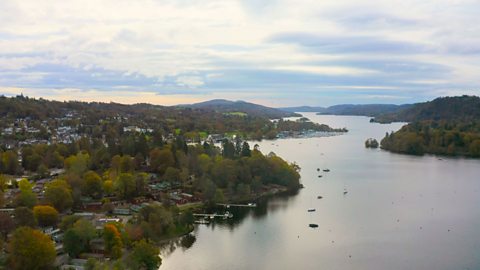
Beavers and rewilding in the UK video
Paul visits the River Tamar in Devon to hear about a project that aims to let nature restore ecosystems.

River monitoring and 're-wiggling' on the River Ribble. video
Paul visits the River Ribble in Lancashire to look at biodiversity monitoring and a project that is putting meanders back into the river.
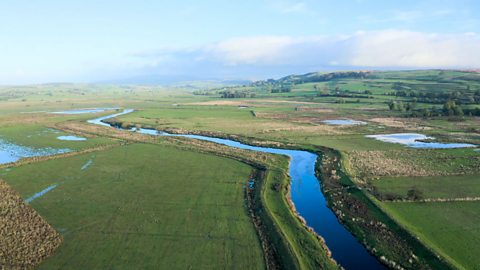
River Tame microplastic pollution. video
Paul learns about how microplastic pollution affects the River Tame in Greater Manchester.
River Test and UK chalk streams. video
Paul visits Hampshire to look at a very rare habitat – England contains 85% of all chalk streams in the world.
River Thames Tideway project video
Paul visits the construction site of a 'super sewer' in London.
Intensive chicken farming and the River Wye video
Paul looks at how agricultural pollution is affecting the River Wye.