Paul:
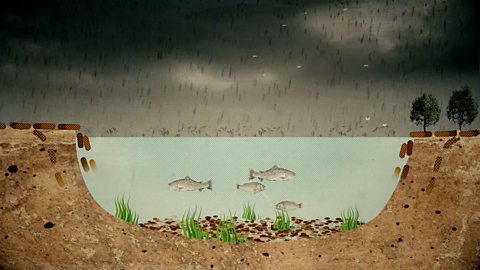
Studies have shown that discharges from water companies can contain a cocktail of chemical pollutants. From toxic nutrients to illicit drugs. All of which affect river life and water quality. The problem is, how to gather evidence in a river which, by definition carries their troubles away. Jamie.
Jamie:
Paul. Nice to meet you. Thanks very much for coming,
Paul:
Thank you. It's a little bit daunting coming back into an academic institution.
Jamie:
I'm sure you'll fit in perfectly.
Paul:
Jamie Woodward is a professor of physical geography at the University of Manchester.
He and his team have been testing waters across the region, including Chris's section of the Tame, focusing on the presence of microplastics and what that can say about the river's health.
Jamie:
The scientific definition of a microplastic particle is a piece of plastic smaller than five millimetres. The microplastics that we find on these riverbeds, most of them are smaller than one millimeter and, actually, many of them are smaller than half a millimetre.
So that's about half the size of the end of a ballpoint pen. This is the River Tame catchment, East Manchester.
We've taken samples along the whole length of the river and we found very very high concentrations of microplastics.
In fact, just downstream of one of these treatment plants at Duckenfield, we found the highest concentration of microplastics that we've seen on any river bed in this area and I haven't seen a value higher than that anywhere else in the world.
Paul:
In the world?
Jamie:
In terms of the concentration of microplastics on a riverbed, I haven't seen a figure higher than this.
Paul:
That's extraordinary. I mean, let's just repeat that. The highest concentration of microplastics in the world, depending on how you collate your data, was found in the River Tame just there?
Jamie:
Site 8, near Dunkenfield. That's the highest concentration of microplastics has recorded on any riverbed.
Paul:
It's a dubious honour, isn't it? That the Tame has.
Jamie:
For every kilogram of sand spread out across that river bed, you'd find 130 thousand micro plastic particles, so that is what we call an acute contamination hotspot.
Paul:
There's no getting away from the fact that plastics play a huge role in our lives. Most of the equipment here is plastic.
The last time I checked our rivers, didn't have much need for them. So their presence is down to human contamination.
Jamie:
You're looking at a sample of microbeads there, from the River Tame. There's still a little bit of sediment attached to them as well.
Paul:
Oh, is that what those little bits is, right.
Jamie:
They're used in a process called shot-blasting or bead-blasting, removing paint and rust and coatings that you want to get rid of and then at the end of the day they just get washed down the grid and end up in our drainage system.
And if we look at this image here, you've got a whole range of microplastic types here. And these all come from the riverbed of the River Tame.
Paul:
I mean, we can see these. They're so uniform, aren't they?
Jamie:
Well, absolutely. And the presence of microbeads is really important because the microbeads must have come in from the wastewater system.
Paul:
Right.
Jamie:
Whereas these fragments, theoretically, could have broken down from larger pieces of plastic in the river.
But when you find them in the assemblages like this, fibres, fragments, beads.
We know they've all come into the river together. They've all come into the wastewater system. So we can link the microplastics problem with the wastewater, the sewage problem.
Paul:
Hm, very clever.
Jamie:
Now, the interesting thing about these plastics, because they come from the wastewater system, is they're marinated in sewage.
Paul:
Nice.
Jamie:
And we know that fish ingest plastic.
Paul:
That's practically Michelin two stars, isn't it?
Jamie:
Absolutely. Some of these sharp plastic fragments can scratch the intestinal wall for example, some of the larger fragments can get stuck in the gut, there could be obstructions.
Paul:
And as you say, they're toxic already.
Jamie:
Yeah, so it's what we call the Trojan horse effect. These plastics will be coated with those materials and they will be taken into the gut of fish and then they'll start to break down.
And we are only starting to really begin to think about what those consequences might be. Now, microplastics will come into the rivers during flood events, during exceptional flow events, washed off streets, washed off roads.
And we know, our research has shown well those microplastics get washed downstream, we never see those. Because rivers and floods will wash the microplastics away.
So the very presence of these microplastics at high concentrations and all these different types on the riverbed proves that they must be coming in to discharge into still waters.
Paul:
Right.
Jamie:
For the fact for them to settle out.
Paul:
So they're discharging wastewater in times of low flow because if they did it in times of high flow, these would all be washed way.
Jamie:
Absolutely. Now, of course, the water companies, whether it's United Utilities or Thames or Severn Trent, whoever, they don't want another big problem put on their doorstop.
Paul:
No
Jamie:
This is a new tool that we've developed that, basically, can identify poor wastewater practice. Of course, the water companies don't like that.
Paul:
I still find it astonishing that water companies would put untreated sewage into our rivers. I can't, sort of, begin to rationalise it on any level.
Jamie:
There's lots of research that's shown that existing wastewater treatment practices are actually very very good at removing microplastics.
Often up to 99 percent of the micro plastic load and certainly very good at removing microbeads. So when we see microbeads in the river, that is significant because it means the wastewater treatment process, isn't happening.
Paul:
Given that we can remove up to 99 percent of these microplastics using existing waste strategies, why don't, why don't we?
Jamie:
Well treating wastewater is expensive. You can tackle the sewage problem and tackle a big part of the microplastic problem at the same time by, by treating the wastewater.
And that requires investment to make sure you've got sufficient capacity to treat that wastewater but absolutely, it also means that don't discharge wastewater into low flow rivers because that's illegal.
And it's ecologically reprehensible.
Paul:
Yeah.
In response to criticism surrounding microplastics United Utilities told us:
'Wastewater systems are not designed to treat plastics on microplastics. We're working hard with customers and regulators to minimise the amount of plastic ending up in our sewers.
We understand people's concerns about storm overflows, we have invested to deliver 100 percent monitoring of overflow operation along the River Tame. We are also working with community and environmental groups and supporting independent scientific research in North Manchester to better understand the sources of microplastic pollution.'
Paul Whitehouse learns about how microplastic pollution affects the River Tame in Greater Manchester.
The river has its source high on Denshaw Moor in the Pennines, above the village of Delph.
The Tame flows to Stockport where it joins the River Goyt and becomes the River Mersey, eventually emptying into the Irish Sea.
Before it joins the Goyt at Stockport, the River Tame passes through industrialised areas and centres of population such as Stalybridge, Ashton-under-Lyne, Dukinfield, Denton and Hyde.
It is not to be confused with the river of the same name in the West Midlands, that becomes a tributary of the River Trent.
Today, the River Tame that flows into the Mersey, contains pollutants including plastic, chemicals and sewage.
A study has shown it has the highest recorded levels of microplastic contamination in the world. Prof Jamie Woodward from the University of Manchester told BBC News that, at the most contaminated site in the River Tame, there were "concentrations over 130,000 microplastic particles per kilogram of sediment on the riverbed".
This video is part of UK rivers case studies, a series of clips taken from Paul Whitehouse: Our Troubled Rivers – available on BBC iPlayer.
Teacher Notes
Before watching the film:
- Students could use digital mapping software to locate the source of the Tame, above the village of Delph in the Pennines. They could track its flow to its confluence with the River Goyt on the south-eastern edge of Stockport and note the urban centres it passes through or near to.
- Ask students what they understand by the term ‘microplastics’. A definition is given in the film clip that students could listen out for and check against their own description.
During the film:
- You may wish to stop at relevant points during this short film to pose questions and check understanding or wait until the end. Useful questions might include:
- How accurate was your definition of ‘microplastics’ compared with that given in the film?
- Where did Prof Jamie Woodward from the University of Manchester and his team find the highest levels of microplastics in the Tame (the highest found anywhere in the world)? (Dukinfield)
- What does ‘an acute contamination hot spot’ mean?
- How do the research team know that the plastic pollution has come from the wastewater system?(Microbeads are washed into the wastewater system and they are found mixed with other kinds of plastic which means the material is likely to originate from the same source. They are also covered in sewage).
- Why is this pollution harmful to wildlife? (A mix of sharp plastic and toxic material).
- At times of high flood and flow, wastewater might have to be released. How do the team know releases are happening at times of low flow too? (This pollution has settled onto the river bed, indicating calm water).
- Can effective wastewater treatment filter out microplastics? (Yes, about 99% can be captured).
- Why do water companies release untreated or poorly treated wastewater into river systems? (Cost: mainly lack of investment to cope with growing capacity such as population growth).
- It may be useful for students to watch the clip all the way through first and then discuss the questions. The students could then watch the clip again and use it to find the answers.
Following on from the film:
- Students could locate Dukinfield and annotate a map to show patterns of land use around the river there showing how they might be affecting river quality. (There are sewage outlets and several industrial estates, as well as housing).
- Ask students to identify causes and possible solutions to ensure a cleaner and healthier river.
- Can students identify and classify environmental, social and economic impacts and actions?
- For example, The Rivers Trust has some useful lists of pollution sources and activities that affect rivers such as: Industry, Urban and Transport, Agriculture, Water Industry and Mining and Quarrying.
- Ask students to investigate and report, as to why and how microplastic pollution is a global problem, as well as a national one.
Curriculum Notes
All these short clips build on students’ understanding of human and environmental interactions and provide opportunities to practice geographical skills such as enquiry, mapping and fieldwork.
At KS3, students can learn more about how human and physical processes interact to influence, and change landscapes, environments and the climate.
At KS4, the film supports understanding about fluvial environments, flooding hazards and climate change, environmental management and fieldwork investigation.
This film develops understanding of economic activity and natural resources (KS3), and supports students in researching and debating ethical issues in geography (KS4).
Further clips from Paul Whitehouse: Our Troubled Rivers
Water industry privatisation. video
A look at the background to the privatisation of ten regional water authorities in 1989.

River Wharfe and wastewater systems in the UK. video
Paul visits the River Wharfe in Ilkley, West Yorkshire to see how it is affected by pollution from sewage.
Lake Windermere eutrophication. video
Paul visits Lake Windermere to hear how tourists may be contributing to pollution levels.
Beavers and rewilding in the UK video
Paul visits the River Tamar in Devon to hear about a project that aims to let nature restore ecosystems.

Pharmaceutical pollution in the River Clyde video
Paul visits the River Clyde in Glasgow to hear about pharmaceutical pollution and its consequences.
River monitoring and 're-wiggling' on the River Ribble. video
Paul visits the River Ribble in Lancashire to look at biodiversity monitoring and a project that is putting meanders back into the river.
River Test and UK chalk streams. video
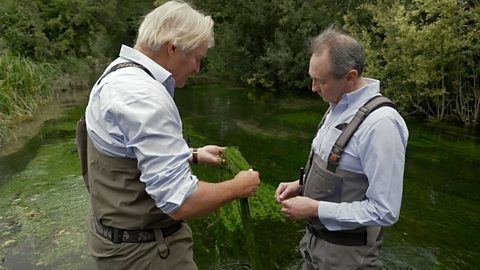
Paul visits Hampshire to look at a very rare habitat – England contains 85% of all chalk streams in the world.
River Thames Tideway project video
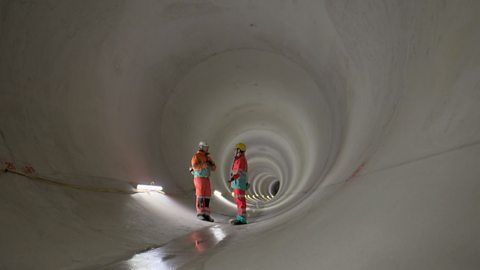
Paul visits the construction site of a 'super sewer' in London.
Intensive chicken farming and the River Wye video
Paul looks at how agricultural pollution is affecting the River Wye.