Life Under The Ocean With Inka Cresswell
Today I'm going to be checking out the wonders of nature, but not here on dry land. No no. In here. Underwater adventure. Here we come. This is Wembury beach on the beautiful Devon coast. Perfect for a morning swim. But I won't be doing it alone. I'll be joined by Inka Cresswell. Inka is a filmmaker and marine biologist who has swum in seas all over the world and is passionate about preserving the health of our oceans.
Hi Joe.
How are you doing?
Good, thanks. Why are our oceans so important?
Our oceans are vital to global health. Not only do they support a huge variety of species, but they also help to sustain us. Now, what have you got planned for me today?
I'm hoping that I'm going to go out and find some amazing underwater wildlife. I've got my camera ready. Fingers crossed we're going to see an underwater forest.It sounds magical. I can't wait to see it. I can't help but think I probably don't have the right gear.
Don't worry. I've got some kit for you. Let's go. Let's go. Underwater gear. Check. Beautiful beach check. Safety diver Laura. Check. Highly experienced underwater filmmaker. Check. Excited Blue Peter presenter. Check. That would be me right. Inka let's go do this thing. Ready?
Ready. Come on let's go. I'm taking a deep breath and setting off on our underwater seek Sea Kelp search. As soon as I start swimming, the cold really hits me. Hi team, update here. Really cold.
How are you feeling Joe?
Cold. It's a bit choppy. I'm struggling to see and I think my camera work might be better left to the professionals. I hope there's something usable there guys. Time to head back to the shore for a quick catch up with Inka.
Oh Inka. What a treat. Did you have fun?
It was so much fun. There's Kelp all around us. So this right here. This is Oar Weed. Which is a type of Kelp.
Oh. Right. It’s slippy that. I did see some of that while I was inside it looks a bit like my hair right now. And what's this?
So this here is what would be attached to the end of that piece of Oar Weed, this is a hold fast. So similar to trees on land they anchor themselves to the Seafloor. And this is their roots. And that's one of the amazing things about Kelp is they store huge amounts of carbon, actually more than any tree that you'd find on land.
You're joking.
That's because they're so fast growing. So as well as providing a habitat for a whole variety of marine species, they also help us to fight climate change. So it's really really important.
Absolutely. I got you with that in mind shall we go and try find some more.
Let's do it.
All right let's get back in there. Whooo. Soon Inka spots the wonderful underwater forests that we've been looking for. It's the Oarweed that we saw on the shore. It really is a magical world under the waves. It's amazing to think that these underwater forests are just as important as the forests on land, helping to keep our oceans thriving with life.
Well Inka that was fun. But what did we actually get?
So we saw some amazing Oarweed. And as you can see in the footage there it is an underwater Kelp forest. Wow. Oarweed is amazing as it creates a home for many small species. Just like this Sea star spotted right here at Wembury Beach. But it also provides protection for bigger species like this wonderful Grey Seal. We are encouraging kids up and down the country to get involved in reviving our oceans.
Why is that so important?
It's really important because our Kelp forests do amazing things for us. They have super powers, they can protect our coastlines from erosion and they can even provide us with amazing things like fertilizer that we can use. But they are under huge amounts of threat. So we've actually had a massive decline of Kelp forest across the UK. In some parts up to 96% of our Kelp has been lost, and that's a lot due to trawling that can harm our Kelp forests. On this part of the coast laws have been passed to ban trawling and work is underway to help restore and regrow Kelp forests.
But what can we do to help?
When we visit the beach being a little bit more mindful about the way we interact with it by taking all of our litter home with us. Using Reef Safe sunscreen are all great ways that we can help support the ocean.
Teacher notes
Oceans are full of wonders and worth reviving. Kelp forests, for example, not only provide habitats for many different creatures, but also help us to fix the climate by absorbing carbon from the atmosphere. We can all help to protect ocean environments by being a little bit more mindful about the way we interact with them.
Supports learning about oceans, habitats and climate change.
These teacher notes outline activities for you to try with your class and get pupils thinking about environmental challenges.
Classroom ideas
Talk about reviving oceans
Help pupils join the conversation by discussing and creating your own glossary of key terms together:
Holdfast – a part of the seaweed that anchors its roots to the sea floor.
Kelp - a type of brown seaweed that grows in forests in saltwater near the coast.
Marine Biologist - someone who studies life in the ocean.
Oarweed - a common type of Kelp seaweed found in shallow seas around our coasts
Sustain - support or keep something going
Global ocean
Introduce younger pupils to the names of the five major oceans around the world (Atlantic, Pacific, Indian, Arctic and Southern) and, using a globe, show how they are all connected. So, although we give each ocean its own name, there is just one ‘global ocean’, and it covers nearly three quarters of our Earth’s surface. Older pupils could revisit this knowledge and use maps and globes to identify the major ocean currents that drive global circulation. Having one connected ocean is good news for movement of plants and animals but it means pollution such as plastic waste can spread around the world more easily.
Get a feeling for kelp
Challenge pupils to compile some key facts about Kelp using sites like the Wildlife Trust UK such as where they can be found around the world (cool temperate and polar regions); the geology they prefer (rocky and stony); and preferred water depth (shallow water so that sunlight can reach them). Ask pupils to find out which marine species might live in Kelp forests, how fast-growing Kelp is, and why this makes them so good at absorbing carbon.
If you can source some Kelp, keep it wet and let pupils examine it at first hand to describe it, using as many of their senses as it is safe to do so. Pupils could look at it under a microscope and create an annotated sketch or a painting showing its hues of colour. Ask pupils to describe their feelings about it too. If you live nearby a suitable stretch of coastline this could be the focus for some fieldwork.
Protect kelp
Kelp forests only grow in the cool temperate and polar regions of the planet, but their distribution pattern could be affected by warming waters due to climate change which would threaten the habitats of the many diverse creatures they support. We need to protect and restore these important carbon-absorbing wonders of the ocean.
We can protect Kelp forests by taking away litter that might end up on the sea floor, only using ‘reef-friendly’ sunscreen when bathing and by finding out about how we can help fix the climate. Younger pupils could create posters reminding us how to keep our marine spaces safe. Older pupils could research ‘reef-friendly sunscreen’ using critical thinking skills and produce a guide.
Being a marine biologist
Invite a marine biologist to talk to the class and encourage pupils to prepare and ask their own questions. Pupils could use the information to write a job description. The world will always need people to help revive oceans and some of them need to be experts!
Curriculum links
England:
English, Science, Geography, Art and design
Northern Ireland:
Language and Literacy, The World Around Us, The Arts,
Scotland:
Literacy and English, Expressive Arts, Sciences, Social Studies,
Wales:
Languages, Literacy and Communication, Science and Technology, Humanities,
Where next?
The Waste Free Challenge
Sam Bentley meets Shini Muthukrishnan from Blue Peter. They look at sustainable packaging made from seaweed.
The Clean Air Challenge
Actress Bonnie Wright goes on a rickshaw ride around town and give us info on clean air.
The Nature Challenge
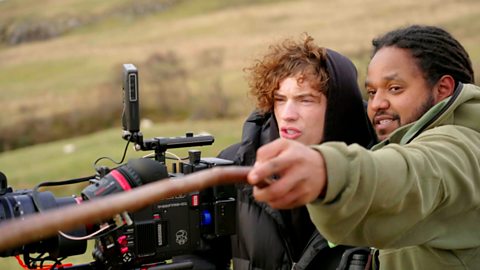
Wildlife cameraman Hamza Yassin meets Blue Peter's Joel Mawhinney and they film local wildlife on the west coast of the UK.
The Climate Challenge
TV presenter and naturalist Steve Backshall educating us on changes we can all make to protect our environment.