RADIO CHATTER
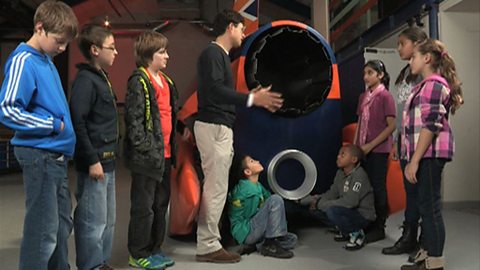
Dr Yan Wong:This is Bloodhound SSC. It's going to be the fastest car in the world. And with me are children from around the country who are investigating what will make this one of the most incredible vehicles ever to be built.
Narrator:It's called Bloodhound SSC. SSC stands for supersonic car. It's trying to travel over 1000 miles per hour. That's faster than a bullet fired from a gun. It's aiming to break the land speed record of 763 miles per hour, set by this car in 1997.
Dr Yan Wong:It's one thing going fast, a thousand miles an hour, but how do you stop? So, anyone, any ideas about how you slow this thing down?
Girl in grey:Maybe some brakes?
Boy in camouflage:Maybe a rocket in the other direction?
Dr Yan Wong:Well, those are both good ideas, but there's a lot more to slowing down than you might think. So, see what you can discover.
Boy:We've come to Santa Pod in Northamptonshire.
Girl:Home of the fastest motorsport on Earth.
Boy:Let's go.
Boy:We've come to meet Bloodhound engineer Annie Beresford, and away from the track we found a car that looked a bit like Bloodhound. It's long and thin, so we asked Annie how this car compares to Bloodhound.
Annie Beresford:Okay, guys, so this is the Split Second car. It's a jet-powered drag car, so that means it's powered by this jet engine here, and it goes in a straight line, just like Bloodhound does, so Bloodhound also has a jet engine, and is designed to go only in a straight line.
Annie Beresford:This is Julian, who is the driver, who's the mad guy sitting in the small cockpit there. How fast do you think this car can go?
Julian:Top speed, about 360 miles an hour.
Annie Beresford:So if it's going that fast, how do you think we slow this car down?
BOTH:Parachutes?
Annie Beresford?Parachutes, that's right. We've got two parachutes sitting at the back of the car.
Julian:Every time we use one parachute, there's a second parachute. If that one goes wrong, we've got a second one just in case.
Annie Beresford:It's kind of nice to know you're not gonna go all the way off the end of the track.
Boy:We asked Annie if there were any other types of brakes on the car.
Annie Beresford:Okay, so not only has this car got parachutes at the back of the car, it's actually got wheel brakes as well on the front of the car and on the rear wheels.
Girl:So why do these have to have brakes?
Annie Beresford:This has brakes purely to stop it at very low speeds, and to hold it on the start line. If you were to use these when the car was going as fast as it does, it would actually just burn out the brakes. So you need the parachutes for the high speed running, and then the wheel brakes for the low speed running.
Boy:Will Bloodhound have brakes?
Annie Beresford:Yeah, Bloodhound also has brakes, but exactly the same as on this car, we'll use them to hold the car on the start line and then also to just slow it down at lower speeds, so below 100 miles an hour.
Boy:Back on the track, it's time to take the car for a run. Julian uses his wheel brakes to line up on the starting line, and after a mega-fast run, reaching just under 230 miles an hour, it's the parachutes that slow him down, just like Bloodhound will do. The difference is that Bloodhound will go four times as fast, which is faster than a bullet fired from a gun. You don't have to be a grown-up to join in the fun.
Girl in grey:Some children as young as eight do this sport.
Boy:Meet 13-year-old Paige Wheeler, and her little sister Belle. Paige started the sport when she was just 10, but her 8-year-old sister is officially the world's youngest dragster racer.
Paige:Well, this is my car. I have a parachute here. Then I have the big tires. They're mainly that thick so that, you know, I can get a lot of traction on the track, so I can go faster. This is my engine, and then my car's really skinny at the front and big at the back, because it needs to be aerodynamic, so it can go faster.
Girl in grey:What's it like to drive your car?
Paige:Well, when I first put my foot down, my head goes right back into the seat. It actually really hurts.
Girl in grey:How fast do you go?
Paige:My top speed is 86 miles per hour, but we're restricted to 85.
Boy:Although her car is a lot smaller than Bloodhound, Paige has to consider all the same things how to accelerate as quickly as possible with her engine, and then how to slow down with her brakes before running off the end of the track, all in a matter of seconds. This is what it's like for her travelling up to 80 miles an hour. Imagine what it would be like for Bloodhound's driver Andy Green travelling over 12 times faster at a thousand miles per hour. So we know how Bloodhound will slow down, but just how quickly will it slow down?
Boy:Back at the racing track, we ask Bloodhound teammate Connor to help us find out how quickly brakes can stop a car.
Connor:So you guys are gonna put these boxes where you think is best, nicely in the middle of the road. Okay, guys, so look over to the side of the track. At the end of those green barriers there, that's where Simon, our friendly racing driver, is gonna start braking. He's in a family car, but the surface is quite grippy, nice grippy tires. Racing driver, so he'll be very good at the brakes. Have a think. It's your guess how far it will take him to stop. You don't want to hit the boxes, but you want to get it close. 60 miles an hour, so that's almost like motorway speed in your Mom and Dads' cars.
Connor:You think? So we're starting from here. You think that's enough?
Boy in hoodie:No.
Connor:Further. 60 miles an hour. Sixty.
Connor:There?
Boy in hoodie:Yeah.
Connor:Do you think we should get out of the way, then?
Girl in grey:Yep.
Boy in hoodie:Yeah.
Connor:I think we should get out of the way. Come on, then. So, you guys, you pretty much chose around the same distance. You're both putting the boxes down about the same point. How far do you think that is? Five meters, 10 meters?
Girl in grey:Yeah. About nine, seven.
Boy in hoodie:Yeah.
Connor:Maybe nine, nine meters?
Boy in hoodie:Seven.
Girl in grey:Seven.
Boy:When racing driver Simon gets to the end of the green barrier, he'll slam on the brakes. Let's see what happens.
Connor:What do you think, guys? Were you expecting that?
Boy in hoodie:No.
Girl in grey:No.
Connor:It took longer than you'd think, didn't it?
Girl in grey:Yeah.
Connor:And that's with the really grippy tires, with a racing driver, on a really clean, grippy circuit. So stopping, more of a challenge than you thought, yeah? How far off do you think we were?
ALL:About half.
Connor:Do you think Simon started braking slightly early, as well?
Boy in hoodie:Yeah.
Connor:I think he did.
Connor:I think he was worried about hitting the boxes in his car. So braking, slowing something down, huge challenge. Almost as difficult as getting a thing to go fast in the first place, and really important to do it safely as well.
Dr Yan Wong:So what have you learned about how Bloodhound's gonna slow down?
Girl in grey:It's going to need a lot of space to slow down. Well, the car will be going too fast for normal brakes, so it would overheat.
Boy in hoodie:I think it'll use a parachute.
Dr Yan Wong:Yeah, it's gonna use a parachute, and it's also gonna use these things on the side here, which are called air brakes. They pop out, and as the air hits them, it slows down. It creates something called drag. And that's what the parachute does as well. When these parachutes pop out, the air gets caught in them, causes the drag, and that's how this is gonna slow down. It's gonna be quite an experience for Andy Green to slow down so fast, I can tell you.
The young investigators are set a challenge by Dr Yan Wong.
Once the Bloodhound supersonic car has hit 1000 mph, how will it slow down again? They visit a motor sport event, where they meet Bloodhound engineer Annie Berrisford.
They find a car a bit like Bloodhound, a Split Second car powered by jet engines. It's slowed down in two ways - a parachute to bring it down from the top speed followed by wheel brakes.
Annie explains that Bloodhound will have both types too; the wheel brakes are for low speeds of less than 100 mph. They meet a young drag racer, who tells them what it's like to race at 85 mph.
Back in the hanger, Dr Yan shows them the air brakes on the side of the Bloodhound that will create drag, just like the parachute.
This short film is from the series The Bloodhound Adventure.
Teacher Notes
Students could be asked what their understanding of air resistance is, and think of examples of where they encounter it in everyday life.
To consolidate understanding, there could be a discussion about why the car needed both wheel brakes for lower speeds, and the parachutes for high speeds.
Challenge students to design their own parachutes using a selection of materials. They could test it on themselves by measuring the time taken to run 50 metres, then again with a plastic bag parachute attached, and again with a parachute made of different material. Which design had the most air resistance, and therefore slowed the students the most as they ran?
This experiment could be recorded as a video so that students can evaluate their experiment and streamline their parachutes.
Curriculum Notes
This clip will be relevant for teaching Science or Design and Technology at Key Stage 2 in England, Wales and Northern Ireland, and Level 2 in Scotland.

More from The Bloodhound Adventure
Experimenting with balloon-powered cars. video
Primary school pupils investigate which model car design is faster; one propelled by an elastic band around the axel, or a balloon-powered car which doesn't directly power the wheels.
Experimenting with reaction times video
Children from New Invention Junior School in the West Midlands investigate their reaction times and how these are affected by distractions.
What's Bloodhound like to drive? video
Primary school children investigate what driving a car at over 1000 mph would be like, by trying out at RAF flight simulator and taking a flight with Bloodhound's driver Andy Green.
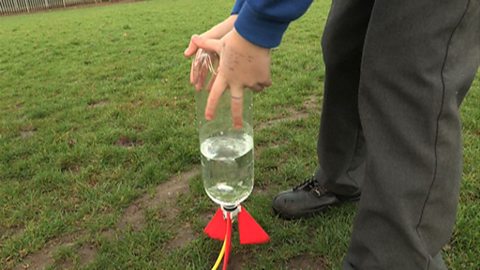
Experimenting propulsion with water rockets. video
Primary school children investigate the theory behind what makes the Bloodhound Supersonic car's rocket engine work, trying to make their water rockets travel the farthest.
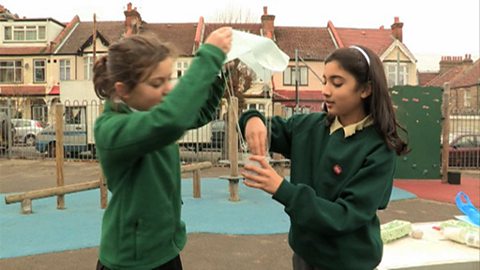
Harnessing air resistance with parachutes. video
Children from Links Primary School in London investigate harnessing air resistance in order to safely drop an egg, experimenting with different parachute designs.
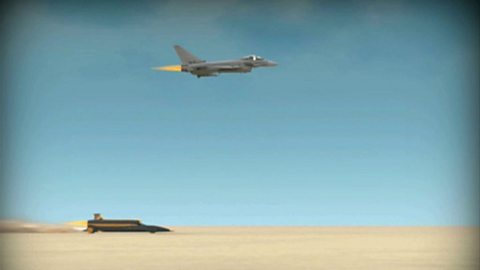
Investigating air and water resistance. video
Primary school children investigate which shapes travel fastest through water, to understand what is the best design for the Bloodhound Supersonic car.
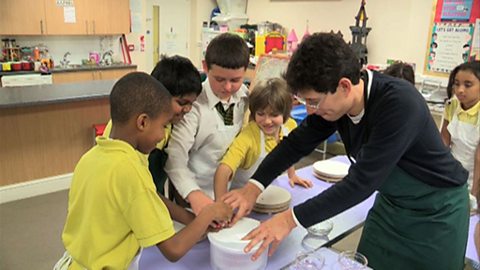
Investigating friction. video
Dr Yan Wong and children from Links Primary School in London investigate friction by trying to separate two interleaved books.
Is the Bloodhound SSC a car, a boat or a plane? video
Bloodhound Investigators find out if Bloodhound SSC is a car, a boat or a plane. They compare and contrast features of each with input from members of the Bloodhound team.
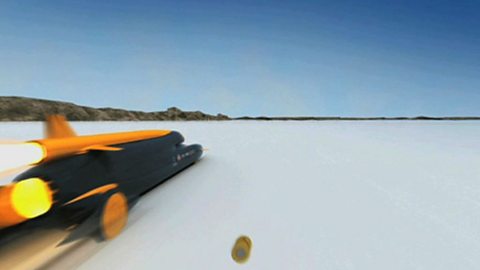
What impact does air resistance and density have on travelling fast? video
Primary school children try skydiving, flying a microlight and racing in a swimming pool to understand how air resistance and density will affect the Bloodhound Supersonic car.
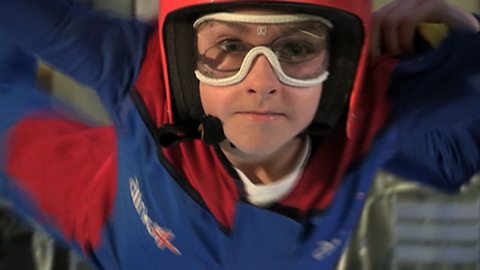
Why doesn't Bloodhound have tyres? video
Primary school investigate why cars normally have tyres - even though Bloodhound SSC does not. They visit a race track to find out about grip and traction, and ride bikes to find out about comfort.
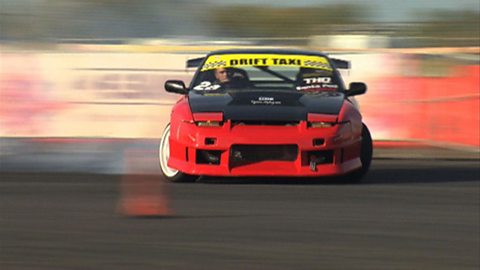
What makes a supersonic car move? video
Primary school children find out about the engines that will propel the Bloodhound Supersonic car to 1000 mph, a jet engine and a rocket engine.