RADIO CHATTER
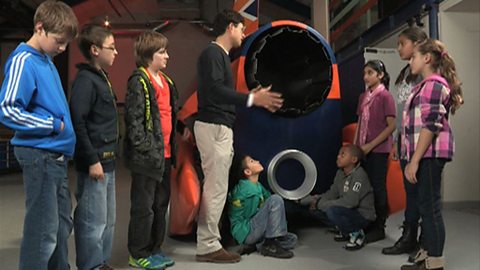
Dr Yan Wong:This is Bloodhound SSC. It's going to be the fastest car in the world. And with me are children from around the country who are investigating what will make this one of the most incredible vehicles ever to be built.
Narrator:It's called Bloodhound SSC. SSC stands for supersonic car. It's trying to travel over 1000 miles per hour. That's faster than a bullet fired from a gun. It's aiming to break the land speed record of 763 miles per hour, set by this car in 1997.
Dr Yan Wong:So Bloodhound's a bit like a boat, a plane, and a car. But that doesn't answer the question of what it's like to drive. What do you think it would be like, sitting in that cockpit, accelerating to a thousand miles an hour?
Nathan:Really exciting.
Girl:Really frightening.
Dr Yan Wong:Well, I'm sure it'd be both of those, but I bet there's a lot more to it as well, and I'd like you to find out.
Narrator:This is the man who's going to take his life in his hands driving Bloodhound. Andy Green is a fighter pilot in the RAF, and used to fly Phantom jets like these. We wanted to know what fighter pilot skills he'll need to drive Bloodhound.
James:Ah, the lovely countryside of North Yorkshire.
Nathan:Yeah, and we're here at this barn to find out what it's like to be Bloodhound driver Andy Green.
James:Really?
Nathan:Yeah. Come on. I'll show you.
OFFICER:Left, right. Left, right. Left, right. Left, right. Come on, hurry up. Left, right. Halt. Attention.
OFFICER:Good morning, Cadets. Today you're gonna learn what it's like to be a fighter pilot like Wing Commander Andy Green and have a go on our simulator. Are you up for that?
James:Yes, sir.
Nathan:Yes, sir.
OFFICER:Jolly good. In that case, would you like to follow me?
OFFICER:This is a photograph of the inside of the cockpit you're gonna be sat in.
Narrator:Just like Bloodhound, there are loads of dials and switches to get your head around.
OFFICER:Three dials is your air speed. That's ADI, and the altimeter. The power dials. Maximum flap, for maximum drive. Left engine, right engine. I've only shown you about a third of the controls that you'll have to use to fly this aircraft.
OFFICER:If you were to fly it in real life, you would need to know what every single one of those dials is doing, what every single switch and knob does and where it is. So you're doing an awful lot all at the same time.
James:Yes, sir.
Nathan:Yes, sir.
OFFICER:Did I catch you yawning there?
James:It's a lot to remember.
Nathan:I think I'm gonna struggle if I am gonna be flying it, but I hope James will do it, because I'm gonna struggle.
James:You're gonna struggle? I'm gonna struggle.
Nathan:The time has come to take the controls and get a sense of what Andy will have to deal with driving Bloodhound.
OFFICER:Now, that's 150. Now pull back very gently on the stick. Towards you. There you go. Now you've left the ground. Well done. You're flying.
James:Okay, what do I do now? Do I put the wheels up?
OFFICER:Yes, lift up the lollipop handle on the left. Well done. That's excellent.
James:Okay. Oh, this is well good.
Nathan:It was really difficult controlling the plane at high speed, especially when they had to try flying between the chimneys of a power station at 900 miles an hour.
Nathan:Because it was dark, you were trying to find the right buttons, and it was quite hard, but… when I crashed it, I felt really silly.
James:It felt like you were actually in a plane. It does-- It is a proper simulator.
Nathan:A Bloodhound with Andy Green in, it would be a lot faster than this.
James:It must be amazing going and doing what Andy does.
Narrator:So Andy Green's going to have a lot to think about driving the car, but what's it really going to feel like? we've come to meet the man himself, Bloodhound driver Andy Green, to show us his private plane, and to my amazement he's offered to take me out for a flight to demonstrate first-hand what sort of forces he'll feel on his body.
Boy:This is amazing. We're actually airborne.
Andy Green:Okay, and here we're coming up to the river Thames. You can see the river down on the right and all the boats.
Boy:Yeah, I see it. That is amazing. I never thought I'd see it from this height. Flying this loop the loop akes you feel three times the force of gravity, exactly what Andy will feel when he's accelerating in Bloodhound. It's time to hold on to my seat.
Andy Green:That's the flip right now. There's the ground upside-down.
Boy:The force on my body made me feel really heavy, and I couldn't lift up my hands. Pilots like Andy call this G-force, nd they feel it when the plane accelerates.
Andy Green:Going straight down. G's coming on as we accelerate. There we are. Back straight and level.
Boy:I think my veins are popping out of my skin.
Andy Green:Yeah, it does feel a bit weird.
Boy:To think we weren't travelling at speeds anywhere near to Bloodhound. No wonder they need Andy's skills as a fighter pilot to cope with all the forces he'll experience driving the car.
Andy Green:He did really, really well. Fantastic. Loved all of it. Natural pilot.
Boy:Wow. That was quite an adventure. But Andy told me everyone can get a sense of the forces you'll experience back on the grounds at the Fun Fest, which is why Nicole and I have come to meet Bloodhound engineer Annie Beresford.
Annie Beresford:Okay, guys, we've come to the fairground today so we can have a go on that ride. That's going to simulate G-force, which is exactly what Andy Green will feel on Bloodhound. Do you fancy a go?
Nicole:Yeah.
Boy:Yeah
Annie Beresford:Okay, let's go. Wait for me.
Boy:When Andy Green accelerates in Bloodhound, he'll be thrown back into his seat from G-force, and it'll feel just the same as we do on this ride. It makes simple things like lifting your hands really difficult to do, just like it was for me in Andy's plane.
Annie Beresford:This is what Andy Green will be feeling when he's going really, really fast.
Boy:I thought it would be terrifying.
Annie Beresford:Are you loving it?
Boy:It still is, but I'm loving it. I'm glad that I went on.
LAUGHING
Annie Beresford:How you feeling? Are you okay?
Nicole:I'm feeling great.
Annie Beresford:Okay.
Boy:The ride felt similar to how I felt in the plane. It's time to get off. Too much excitement for one day.
Boy: You felt like you were gonna be squashed. You felt like you were gonna vomit, but you weren't. It was just holding you there. There's nothing really holding you up.
Nicole:Yes.
Boy:Bloodhound's gonna be going really fast, and I think Andy Green's gonna be feeling like that, but even worse.
Dr Yan Wong:So what’s it gonna be like to drive?
James:Very difficult. There's so much to think about.
Nathan:Very noisy, and very hard work, too.
Girl 2You'd probably pass out because of the amount of G-force.
Dr Yan Wong:Yeah, and Andy Green's gonna have to concentrate really hard not just to watch all the instruments and to activate the engines, but also to control his body, to make sure that the forces on it don't make him black out.
A team of children investigate why Bloodhound SSC will be driven by RAF Fighter pilot Andy Green, rather than a racing car driver, and what he will experience.
They use a simulator to try flying an RAF Phantom, with all its complex control.
Andy Green takes them on a flight on a light aircraft, so they can experience G-force on a loop the loop.
They also go on a high-speed fairground ride, which is another place to experience G-force.
They conclude that the forces on Andy will be much stronger than in a normal car, much more like flying a plane.
This clip is from the series The Bloodhound Adventure
Teacher Notes
When investigating forces in action, pupils could make stomp rockets and paper aeroplanes to explore which shape is the most streamlined, reducing air resistance.
Measuring how fast different objects fall to the ground will also help children to investigate the force of gravity and the opposing force of air resistance.
Visiting the local park or using images of playgrounds can help children to identify the different forces exerted when playing on different equipment.
Curriculum Notes
This clip will be relevant for teaching Science or Design and Technology at Key Stage 2 in England, Wales and Northern Ireland, and Level 2 in Scotland.

More from The Bloodhound Adventure
Experimenting with balloon-powered cars. video
Primary school pupils investigate which model car design is faster; one propelled by an elastic band around the axel, or a balloon-powered car which doesn't directly power the wheels.
Experimenting with reaction times video
Children from New Invention Junior School in the West Midlands investigate their reaction times and how these are affected by distractions.
Experimenting propulsion with water rockets. video
Primary school children investigate the theory behind what makes the Bloodhound Supersonic car's rocket engine work, trying to make their water rockets travel the farthest.
Harnessing air resistance with parachutes. video
Children from Links Primary School in London investigate harnessing air resistance in order to safely drop an egg, experimenting with different parachute designs.
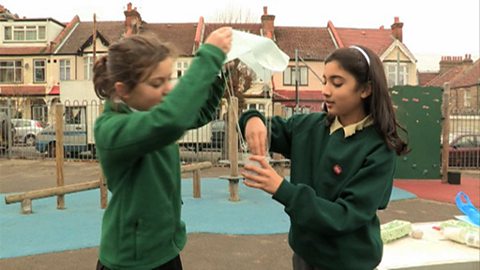
How air resistance slows down vehicles. video
Bloodhound Investigators find out how air resistance can be used to slow down vehicles. They also discover the importance of traction, drag and aerodynamics.
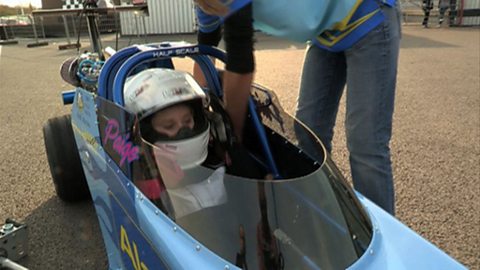
Investigating air and water resistance. video
Primary school children investigate which shapes travel fastest through water, to understand what is the best design for the Bloodhound Supersonic car.
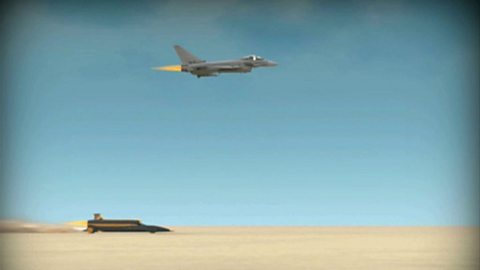
Investigating friction. video
Dr Yan Wong and children from Links Primary School in London investigate friction by trying to separate two interleaved books.
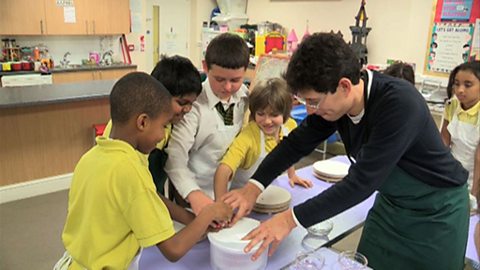
Is the Bloodhound SSC a car, a boat or a plane? video
Bloodhound Investigators find out if Bloodhound SSC is a car, a boat or a plane. They compare and contrast features of each with input from members of the Bloodhound team.
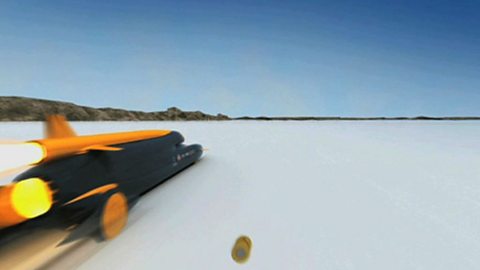
What impact does air resistance and density have on travelling fast? video
Primary school children try skydiving, flying a microlight and racing in a swimming pool to understand how air resistance and density will affect the Bloodhound Supersonic car.
Why doesn't Bloodhound have tyres? video
Primary school investigate why cars normally have tyres - even though Bloodhound SSC does not. They visit a race track to find out about grip and traction, and ride bikes to find out about comfort.
What makes a supersonic car move? video
Primary school children find out about the engines that will propel the Bloodhound Supersonic car to 1000 mph, a jet engine and a rocket engine.