MUSIC
Rocket systems firing.
Dr YAN WONG:This is Bloodhound SSC. It's going to be the fastest car in the world. And with me are children from around the country who are investigating what will make this one of the most incredible vehicles ever to be built.
NARRATOR:'It's called Bloodhound SSC. SSC stands Supersonic Car. It's trying to travel over 1000 miles per hour. That's faster than a bullet fired from a gun. It's aiming to break the land speed record of 763 miles per hour, set by this car in 1997.'
DR YAN WONG:All cars need an engine, but where do you get one that gets you to a thousand miles an hour? Well, that's the challenge for our team of investigators to find out. So, it's a big car, but have you spotted anything that would propel it forwards?
BOY IN GREY FLEECE:It seems to have two enormous exhausts.
DR YAN WONG:Well spotted. And what do you think's gonna go in there and in there? That's for you to find out.
RADIO CHATTER
SNEAKEY MUSIC
BOY IN GREY FLEECE:We're here at the secret rocket testing site in Buckinghamshire.
GIRL IN BLACK COAT:Shh. This way.
SPOOKY MUSIC
DANIEL JOB:Hello there.
GIRL IN BLACK COAT:Hi.
DANIEL JOB:Welcome to Bloodhound rocket test site. My name's Daniel Job. I'm the rocket scientist on Bloodhound SSC. Would you like to find out a little bit more about how rockets work?
BOY IN GREY FLEECE:Yes.
GIRL IN BLACK COAT:Yes.
DANIEL JOB:Excellent. Let's go and do some experiments.
ROCK MUSIC
BOY IN GREY FLEECE:So, what has tug of war got to do with rockets and Bloodhound?
DANIEL JOB:In order to understand how rockets work and what makes Bloodhound move, you have to understand about forces. So, at the moment, you're both exerting a force on this rope, but it's not moving, so the forces are balanced. But if you introduce a larger force like the thrust from a rocket or a jet engine, we can start things moving.
GIRL IN BLACK COAT:Stop.
BOY IN GREY FLEECE:'But to accelerate to a thousand miles an hour, 'Bloodhound is going to need a huge force 'to push it along. 'Although it will have a fighter jet engine, 'that won't be enough. It's going to need a rocket.'
DANIEL JOB:This is the kind of rocket you may be familiar with. It's a firework, but it works on exactly the same principle that we're going to use to propel Bloodhound across the desert at a thousand miles an hour. We have gunpowder inside this rocket. Now, that's a mixture of a fuel and an oxidizer in solid form.
DANIEL JOB:And when we ignite that, it generates a huge volume of hot gas, and we expand those hot gasses through a nozzle and accelerate them rearward at very high speed. That produces a force, thrust, acting on the rocket to propel it forwards.
BOY IN GREY FLEECE:Wow.
GIRL IN BLACK COAT:That's amazing.
GIGGLES
DANIEL JOB:So, to generate that enormous volume of hot gas in a rocket, we need to burn a fuel.
BOY IN GREY FLEECE:'Daniel showed us just how powerful some solid fuels can be. 'The secret is they contain their own oxygen, 'which everything needs to burn well. 'But Bloodhound's going to need something more advanced 'than a fireworks rocket.'
GIRL IN BLACK COAT:It's cool.
BOY IN GREY FLEECE:Cool.
GIRL IN BLACK COAT:'Instead, it's going to use a mixture of solid fuel 'and this special liquid called HTP, 'High-test peroxide, 'which is so reactive, it instantly burns a fuel. 'It doesn't even need a match to light it. 'This really is rocket science.'
DANIEL JOB:Now, in Bloodhound, we're using a very large quantity of high-test peroxide to burn a rubber fuel in our hybrid rocket.
COUGHING
GIRL IN BLACK COAT:Should've brought some marshmallows.
GIRL IN BLACK COAT:So, what's this contraption?
DANIEL JOB:This is the six-inch hybrid rocket that we've been developing for Bloodhound. It's not the full-size one that's going to go on the car. The full-size one will actually be three times the diameter and twice as long, but it will actually produce about 10 times as much thrust.
DANIEL JOB:In this combustion chamber, we've got our solid fuel. And in this big tank behind us, we've got our hydrogen peroxide, HTP.
GIRL IN BLACK COAT:Which way will the car move?
DANIEL JOB:Well, the car will move forwards, and the rocket exhaust is firing out the door, so the gases are being pushed in that direction, and that's exerting a force in this direction against the stand. So, would you like to go and see the control room, and watch a video of the rocket firing?
BOY IN GREY FLEECE:Yes.
DANIEL JOB:Let's go, then. Five… four… three… two… one… ignition.
BOY IN GREY FLEECE:'Wow. I wouldn't like to have that going off in the back my mom and dad's car.'
DR YAN WONG:So, what have you learned about how Bloodhound's gonna go forwards?
GIRL IN BLACK COAT:Bloodhound's gonna need a huge rocket to propel it forwards.
DR YAN WONG:Yeah, that's right. In fact, it's got two engines. It's got a jet engine up here, and that's gonna take you to 300 miles an hour, and then they're gonna fire off the rocket down here, which will take it to the full 1000. What do you think it's gonna be like when that goes off?
BOY IN RED T-SHIRT:Very noisy.
DR YAN WONG:Very noisy.
GIRL IN GREY HOODIE:Scary.
DR YAN WONG:Yeah, but it's only gonna last for 10 seconds, because once they've reached the land speed record, then the rocket's gonna cut out, and it'll be time to slow down again.
The Bloodhound SSC is a supersonic car, which aims to break the land speed record by travelling over 1000 mph.
The young investigators find out about jet engines and Bloodhound's main source of thrust - a rocket.
They meet a rocket scientist and learn about the forces acting on a vehicle.
They discover that fuel needs oxygen to burn, but Bloodhound's rocket will have HTP (high-test peroxide) pumped into its rubber fuel - this burns instantly without needing a match.
This clip is from the series The Bloodhound Adventure.
Teacher Notes
After watching the clip, children could be asked to think about the forces involved in propelling the car forward and carry out a test with their own mini rockets.
Using Alka Seltzer tablets and film canisters, children can mix different liquids to try and gain the ultimate rocket fuel to make their rocket propel itself the highest.
Children could be asked to think about what would make the rocket go higher, like considering the amount of gas produced but also the time taken for the gas to be produced. This would make a good link with the instantaneous fuel burned in the supersonic car.
Curriculum Notes
This clip will be relevant for teaching Science or Design and Technology at Key Stage 2 in England, Wales and Northern Ireland, and Level 2 in Scotland.

More from The Bloodhound Adventure
Experimenting with balloon-powered cars. video
Primary school pupils investigate which model car design is faster; one propelled by an elastic band around the axel, or a balloon-powered car which doesn't directly power the wheels.
Experimenting with reaction times video
Children from New Invention Junior School in the West Midlands investigate their reaction times and how these are affected by distractions.
What's Bloodhound like to drive? video
Primary school children investigate what driving a car at over 1000 mph would be like, by trying out at RAF flight simulator and taking a flight with Bloodhound's driver Andy Green.
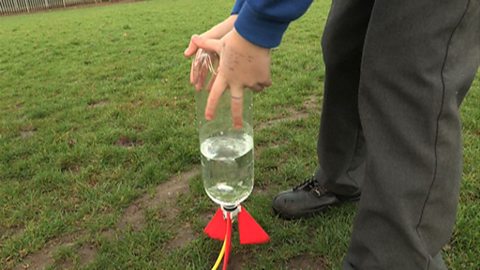
Experimenting propulsion with water rockets. video
Primary school children investigate the theory behind what makes the Bloodhound Supersonic car's rocket engine work, trying to make their water rockets travel the farthest.
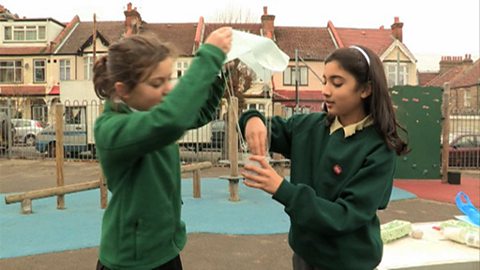
Harnessing air resistance with parachutes. video
Children from Links Primary School in London investigate harnessing air resistance in order to safely drop an egg, experimenting with different parachute designs.
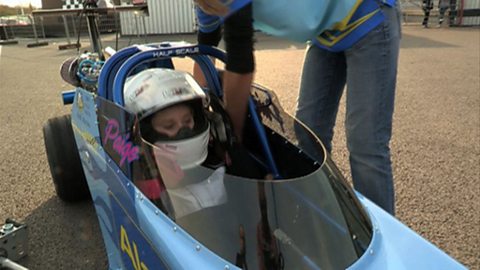
How air resistance slows down vehicles. video
Bloodhound Investigators find out how air resistance can be used to slow down vehicles. They also discover the importance of traction, drag and aerodynamics.
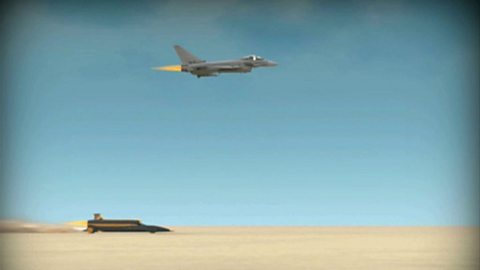
Investigating air and water resistance. video
Primary school children investigate which shapes travel fastest through water, to understand what is the best design for the Bloodhound Supersonic car.
Investigating friction. video
Dr Yan Wong and children from Links Primary School in London investigate friction by trying to separate two interleaved books.
Is the Bloodhound SSC a car, a boat or a plane? video
Bloodhound Investigators find out if Bloodhound SSC is a car, a boat or a plane. They compare and contrast features of each with input from members of the Bloodhound team.
What impact does air resistance and density have on travelling fast? video
Primary school children try skydiving, flying a microlight and racing in a swimming pool to understand how air resistance and density will affect the Bloodhound Supersonic car.
Why doesn't Bloodhound have tyres? video
Primary school investigate why cars normally have tyres - even though Bloodhound SSC does not. They visit a race track to find out about grip and traction, and ride bikes to find out about comfort.