RADIO CHATTER.
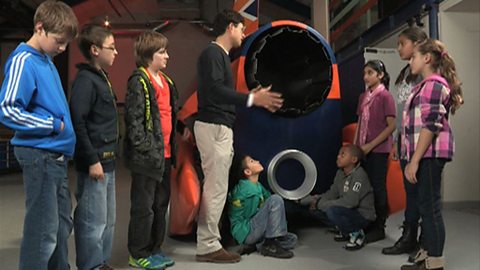
DR YAN WONG:This is Bloodhound SSC. It's going to be the fastest car in the world. And with me, are children from around the country who are investigating, what will make this, one of the most incredible vehicles ever to be built.
FEMALE NARRATOR:'It's called Bloodhound SSC. SSC stands for Super Sonic Car.'
MALE NARRATOR:'It's trying to travel over, 1,000 mph. That's faster than a bullet fired from a gun.'
FEMALE NARRATOR:'It's aiming to break the land speed record of 763 mph. Set by this car in 1997.'
DR YAN WONG:We're on a mission to find out what's needed to build the world's fastest car. Now, just like a normal car, Bloodhound has wheels. But there's something very different about them. Have you noticed what it is? Well, maybe my willing investigators have found something out.
DR YAN WONG:So like any normal car, Bloodhound has four wheels. But what's different about them? Have you noticed anything?
GIRL IN PINK HOODIE:It doesn't have any tyres.
DR YAN WONG:Yes, it doesn't have any tyres. And there's a very good reason for that. And what I'd like you to do is find out why.
MALE NARRATOR:'Unlike a normal car, Bloodhound only has to go in a straight line to break the land speed record, but surely it still needs tyres?'
GIRL IN GREY HOODIE:We've come to Mallory Park racing track in Leicestershire.
BOY IN GREY HOODIE:And we're gonna burn some rubber!
MALE NARRATOR:'Hundreds of different types of cars use this track every day, from racing cars to motorbikes. So where better to try to find out why tyres are normally so important for driving?'
FEMALE NARRATOR:'At the track today is Bloodhound team mate Conor and racing driver Simon.'
MALE NARRATOR:'They've put a swingometer device on top of the car, so what on earth is that all about? And more importantly, what's it got to do with Bloodhound?'
CONOR:We're going to go on the track this time with Simon in this car. But for this experiment we're gonna use this arrow to show what's going on with this car as the tyres grip as we go through the bends. So, when we're in the car and we feel our bodies being thrown left and right,
CONOR:we'll have a chat and try and figure out which way we think the arrow's going, which way the forces are acting on us in the car,
CONOR:as it goes round the bends. OK?
BOY IN GREY HOODIE:Yep.
GIRL IN GREY HOODIE:Yep.
CONOR:Let's go.
CONOR:We wouldn't be able to drive along like this now if we didn't have tyres. Simon would put his foot on the throttle and probably the wheels would just spin and spin and spin. Feel the grip. Feel the tyre gripping, pushing you right over that side.
GIRL IN GREY HOODIE:Woo.
CONOR:Which way did you feel yourselves go? We’re gonna change again. Get ready.
BOY IN GREY HOODIE:Left then right.
GIRL IN GREY HOODIE:Then right.
CONOR:Get ready for another change, another change. Well done.
SIMON:So, when you go into the corner, the car rolls one way. You change direction, the car rolls the other way.
CONOR:And if there were no tyres on these wheels, we'd just slip straight off the track, There's very little grip without having the rubber. Feel the forces again and when we go left, which way does your body go?
BOY IN GREY HOODIE:Right.
CONOR:And when we go right, which way does your body go?
BOY IN GREY HOODIE:Left.
GIRL IN GREY HOODIE:Left.
CONOR:Which way do you think the arrow went on the roof then? Same as you or different?
BOY IN GREY HOODIE:Left.
CONOR:Same as you.
GIRL IN GREY HOODIE:Same.
CONOR:Is that how your mum and dads drive?
BOY IN GREY HOODIE:No.
GIRL IN GREY HOODIE:My dad does. He's a maniac.
MALE NARRATOR:'But having tyres doesn't always mean your car will stay on the road. 'We wanted to know why these cars were spinning 'all over the place, even with tyres. 'So we asked Bloodhound team-mate, Annie Beresford.'
ANNIE:OK, guys, what we've got here is cars doing drifting. So they've got normal road tyres on, which is exactly like what you've got on your car that you came in today, but I bet you weren't driving like this. Now, your tyres are normally giving you the grip that you need to stay on the road and drive sensibly round corners.
ANNIE:These guys are actually spinning their wheels so fast that they're losing that grip and enabling them to slide. We're really lucky with Bloodhound in that we're going in a straight line only so we don't actually have to go round any corners.
MALE NARRATOR:'Bloodhound's wheels will need to travel so fast, they'd also lose grip. Tyres would get so hot, they'd explode.'
FEMALE NARRATOR:'If Bloodhound had tyres, the grip would actually slow the car down. But not having any tyres comes at a price.'
CONOR:So, you've seen how important tyres are in that car whizzing round the track. Gonna have a little play on these bikes now and see how important tyres are on abike. And see whether you can spot a difference, OK? Let's jump on and we'll go for a little ride around, then we'll have a chat. Ready, guys? Off you go.
FEMALE NARRATOR:'There's something very strange about Anton's bike that's making it very difficult to steer and so bumpy.'
CONOR:How was that?
BOY IN GREY HOODIE:Bumpy.
CONOR:Slippy?
BOY IN GREY HOODIE:Yeah.
CONOR:Did you feel like you were going to fall off at all? Wobbly?
BOY IN GREY HOODIE:Yeah, when I was turning back round, I felt like I was going to slip off.
CONOR:We sawyour back wheel was all over the place because there's no tyre. And you were fine because you had lovely squashy tyres, nice and grippy. Could you do that every day or was that a one-off?
BOY IN GREY HOODIE:One-off.
CONOR:One-off. So on the road, on bikes, tyres are a great thing. But for Bloodhound, we're too fast for tyres. The fastest tyres in the world, 450 mph, we're going 1,000, so Bloodhound has solid wheels. Just like you, we're running on the rims, no tyres. So we have to design that into the car.
MALE NARRATOR:'Bloodhound's wheels are also really thin for such a big car and we wanted to know why.'
BOY IN GREEN COAT:It's time to get our skates on.
ANNIE:Okay guys, how did you find that? Was it good?
BOY IN GREEN COAT:Yeah
GIRL IN BLACK COAT:Slippery.
ANNIE:Really slippy. Why do you think that was so slippy?
BOY IN GREEN COAT:Is it because our blades on the shoes are really thin?
ANNIE:Yeah, the fact that your blades are really thin and the fact that you're on a really, really slippy surface and there's very little friction between the two. Whereas if you were to step onto the Tarmac, it's really grippy and ctually, you wouldn't slide anywhere, and that's just like Bloodhound.
ANNIE:We've actually got very thin wheels so that we can cut through the ground very, very easily and there's not a lot of friction on those wheels.But, it also means stopping and slowing down is harder for us. And so, we can't use our wheel brakes because the wheels will slide quite easily.
DR YAN WONG:So what have you learnt about Bloodhound's wheels?
GIRL IN GREY HOODIE:Well, the wheels are made out of aluminium and if they were proper tyres, at high speed they would explode.
DR YAN WONG:Right, OK, anything else?
BOY IN GREEN COAT:Yes, the Bloodhound car did not have any tyres because the tyres would grip to the ground and make it go slower.
DR YAN WONG:Right OK, but if it doesn't have tyres, it must be really bumpy I imagine, yeah?
BOY IN GREEN COAT:Yeah, a normal car would have tyres to go round the bend, but the Bloodhound does not need tyres because it is going in a straight line.
DR YAN WONG:Well, glad I'm not riding it!
The young Bloodhound Investigators realise that the Bloodhound SSC doesn't have tyres - and set out to discover what effect tyres usually have on cars.
At a race track, they learn how tyres are useful for turning corners, giving grip and traction, and watch race cars skidding their tyres by spinning their wheels very fast.
They find that riding a bicycle without tyres is both bumpy and hard to control.
Bloodhound SSC has narrow aluminium wheels without tyres, as these would explode at high speeds.
At an ice rink they discover that thin tyres mean less friction with the ground, helping Bloodhound SSC to go faster.
They realise that Wing Commander Andy Green will be in for a very bumpy ride as Bloodhound will not have tyres.
This clip is from the series The Bloodhound Adventure
Teacher Notes
This could be used to provide further examples of friction in everyday life.
Pupils could carry out a class investigation to introduce the phenomenon of friction, by testing the hypothesis that objects will require more force if pulled along a rough surface.
This could be carried out using a plastic tub, a weight, a forcemeter and a variety of surfaces to pull the tub along.
Fair testing principles should be adhered to, predictions could be made and conclusions drawn.
Once friction has been explained via this experiment, pupils could provide examples where friction is useful in everyday life: tyres, brakes on bike wheels, grips on shoes.
The clip provides a question for the pupils to think about. Why does the Bloodhound not have tyres? This is an effective way of assessing pupils' knowledge about the usefulness of friction.
The clip then details frictional forces in action in everyday situations.
Curriculum Notes
This clip will be relevant for teaching Science or Design and Technology at Key Stage 2 in England, Wales and Northern Ireland, and Level 2 in Scotland.

More from The Bloodhound Adventure
Experimenting with balloon-powered cars. video
Primary school pupils investigate which model car design is faster; one propelled by an elastic band around the axel, or a balloon-powered car which doesn't directly power the wheels.
Experimenting with reaction times video
Children from New Invention Junior School in the West Midlands investigate their reaction times and how these are affected by distractions.
What's Bloodhound like to drive? video
Primary school children investigate what driving a car at over 1000 mph would be like, by trying out at RAF flight simulator and taking a flight with Bloodhound's driver Andy Green.
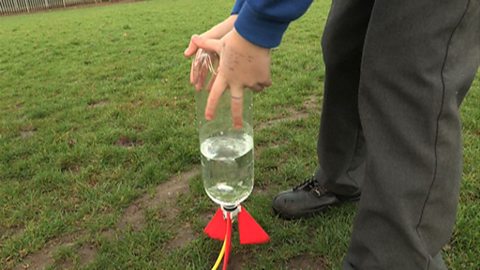
Experimenting propulsion with water rockets. video
Primary school children investigate the theory behind what makes the Bloodhound Supersonic car's rocket engine work, trying to make their water rockets travel the farthest.
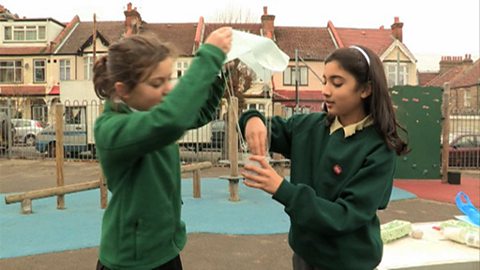
Harnessing air resistance with parachutes. video
Children from Links Primary School in London investigate harnessing air resistance in order to safely drop an egg, experimenting with different parachute designs.
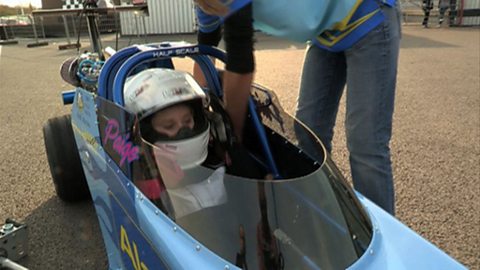
How air resistance slows down vehicles. video
Bloodhound Investigators find out how air resistance can be used to slow down vehicles. They also discover the importance of traction, drag and aerodynamics.
Investigating air and water resistance. video
Primary school children investigate which shapes travel fastest through water, to understand what is the best design for the Bloodhound Supersonic car.
Investigating friction. video
Dr Yan Wong and children from Links Primary School in London investigate friction by trying to separate two interleaved books.
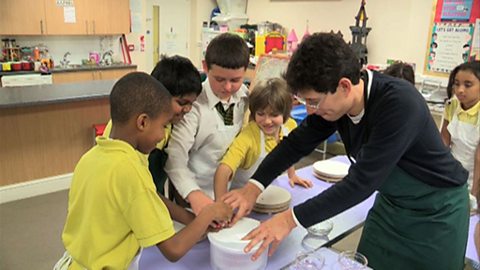
Is the Bloodhound SSC a car, a boat or a plane? video
Bloodhound Investigators find out if Bloodhound SSC is a car, a boat or a plane. They compare and contrast features of each with input from members of the Bloodhound team.
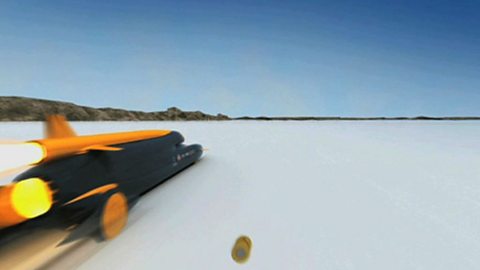
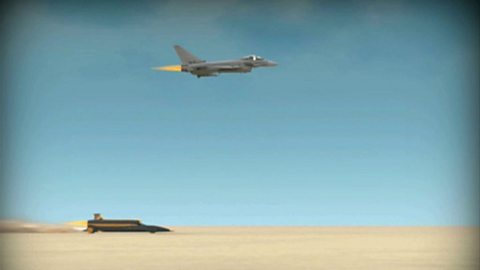
What impact does air resistance and density have on travelling fast? video
Primary school children try skydiving, flying a microlight and racing in a swimming pool to understand how air resistance and density will affect the Bloodhound Supersonic car.
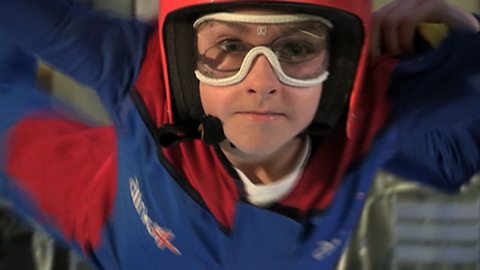
What makes a supersonic car move? video
Primary school children find out about the engines that will propel the Bloodhound Supersonic car to 1000 mph, a jet engine and a rocket engine.