RADIO CHATTER
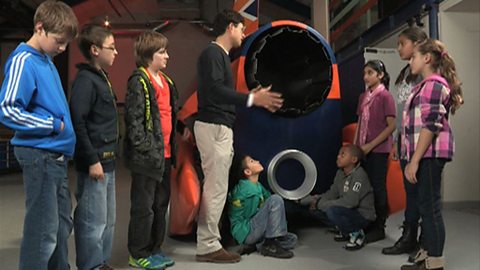
Dr Yan Wong:This is Bloodhound SSC. It's going to be the fastest car in the world. And with me are children from around the country who are investigating what will make this one of the most incredible vehicles ever to be built.
Narrator:It's called Bloodhound SSC. SSC stands for supersonic car. It's trying to travel over 1000 miles per hour. That's faster than a bullet fired from a gun. It's aiming to break the land speed record of 763 miles per hour, set by this car in 1997.
Dr Yan Wong:Whether you're flying a plane or cycling a bike, there's always a limit to how fast you can go, and the same is true for Bloodhound Supersonic Car. But why is that? So have you any idea why it's so hard to go so fast?
Girl:Is it because Bloodhound's really heavy?
Boy:Is it because the engine isn't powerful enough?
Dr Yan Wong:Well, those are both good reasons, but I think what you really need to be looking into is what's stopping it, what's holding it back. And so I'd like you to look into that, okay?
Nathan:We've come to Manchester.
James:Home of indoor skydiving.
BOTH:Let's go.
Narrator:Skydivers know what it's like to travel through the air fast, so maybe they can give us some clues about why it would be difficult for Bloodhound to travel so fast. We've come to meet Bloodhound engineer Sara Kovel. She's in charge of Bloodhound's mission control, the nerve centre of the land speed record attempt.
Sara Kovel:I guess you're wondering why we're here, at an indoor skydiving centre. This is Ben. He's an international skydiver, and he's basically gonna be simulating how difficult it is for things like Bloodhound to move through air at high speed. He's travelling-- He's probably in a wind speed of 150 miles an hour. If you can imagine, Bloodhound's gonna be in a wind speed of a thousand miles an hour. So this is gonna show us how difficult it is for Bloodhound to move. So what do you reckon? Do you want to go and have a go now?
Nathan:Yeah.
Sara Kovel:Come on, then. Let's go.
Ben:Here you are, that's yours.
James:Oh, thank you.
Narrator:It was really difficult for them to keep still in the hurricane force wind, but Ben knew how to carry Nathan right to the top.
Sara Kovel:So, then, boys, how did that feel?
James:Well good.
Sara Kovel:Can you imagine that 10 times faster?
James:No. It's too fast.
Sara Kovel:So you can imagine how difficult it's gonna be. You trying to keep your body still in there, how hard it's gonna be for Bloodhound to try and keep stable and go fast at ten times that speed.
James:I think we need to do another.
Nathan:Yeah.
Narrator:If we turn the camera on its side, Ben looks like he's travelling horizontally, just like Bloodhound, and we can see how important it is to be the right shape.
Sara Kovel:So what Ben's doing now is he's adjusting his body shape. So if he keeps streamlined, he's not got very much of a surface area. As he moves his body out, and moves his arms out, his surface area increases. So as his surface area increases, more of the wind hits his body. That's how he can rise so high up. That's what we have to try and look at. With Bloodhound, we need to be as streamlined as possible so we don't create any drag or any lift. As we can see now, Ben's got his body quite tight in. As he starts to move one side of his body out further, he creates more lift and more drag on the side of his body, causing him to spin, because he's got more force acting on one side of his body. With Bloodhound we need to try and keep the car completely symmetrical so that when we're running along at high speed, there's no spin.
Narrator:Like Bloodhound and the skydivers, airplanes have to be the right shape to push through the air at high speed, which is why Nathan and James have come to Manchester City Airport to find out how planes manage to keep stable. Sara's brought them to meet pilot Mark to show them his microlight aircraft. It's a very lightweight plane, a bit like a hang glider with an engine attached, which makes it easy to see how planes can fly.
James:So what's this go to do with Bloodhound?
Sara Kovel:Well, with Bloodhound we've got to be really careful to not generate any down force or any lift, and as Mark is about to show you, the smallest amount of movement in the wings can create a lot of lift, a lot of down force. So I'll pass over to Mark. He'll explain the controls to you.
Mark:If we push the bar forwards a tiny little bit, the first thing that happens is the nose will pitch up, and then the speed will start to drop off because we're producing more drag, we're producing more lift but we're also producing more drag. If we pull the bar back a tiny little bit, the nose will lower, we'll start to speed up, but we'll also start to descend as well. And if we move the bar sideways, from left to right, if we pull the left wing down it'll turn to the left. If we pull the right wing down it'll turn to the right.
Sara Kovel:In terms of Bloodhound, if you can imagine the tiny movements at these speeds, these slower speeds, it makes a massive difference. At a thousand miles an hour it's gonna make a huge difference. So we really need to watch our lift and our down force.
James:What would happen if Bloodhound did create lift or down force?
Sara Kovel:If Bloodhound created down force, the wheels are gonna be forced in and we'd lose speed. If we created lift, there's a danger that the car could lift and actually flip back over, if we created too much lift. So we need to watch the forces very carefully, and we've got winglets on the side of the car, like the wing of this microlight, that adjust constantly to stop that from happening.
Mark:Okay. Let's go.
Narrator:Now it's James' turn to fly in the microlight. And amazingly, after reaching just 40 miles an hour, pushing the bar forward is enough to get airborne. And just tiny movements on the bar is enough to make the microlight turn sharply through the air. Watch out.
James:That's cool, but it's scary at the same time.
James:Touchdown.
James:Bouncy bouncy.
Narrator:So once the steering has been taken care of, and with the power of the fighter jet engine onboard, you'd think Bloodhound would have no problem breaking the land speed record. But it's not as simple as that.
Sara Kovel:All right, guys, the reason we're down at the pool today is to try and help us demonstrate how Bloodhound needs to work really hard to cut through the air, so James, I want you to be a fast jet plane trying to fly along at ground level. Nathan, I want you to be a fast jet plane trying to fly along at high altitudes, at 40,000 feet. So when I tell you to, I want you to race to the other end of the pool, so on your marks. Get set. Go.
Sara Kovel:Come on, James.
Narrator:You might not think it, but there are similarities between air and water. But of course, water is much denser. When you move through them, both air and water have to flow past you. But James pushing through water is what it's like for a jet plane at ground level, because the air is so much thicker and it slows you down. At high altitude, the air is much thinner and easier to push through, so you can travel a lot faster.
Nathan:Winner. Come on, James, come on.
Sara Kovel:Come on, James.
Nathan:Come on, James
Sara Kovel:You took 12 seconds. You took 44 seconds. There's a big difference there, yeah? So what the pool's showing us is that actually air density at ground level is a lot higher. The air's a lot thicker and there's more resistance, so you've gotta work harder. Nathan, it's a lot easier for you because the air's a lot thinner. Ultimately, it shows us that Bloodhound has to work extremely hard to cut through the air.
Dr Yan Wong:So what have you learned about the problems of travelling really fast? You've been doing some really cool stuff, haven't you?
James:Yeah, we've been indoor skydiving, and we've also been in a microlight. When you're travelling at a high speed, it's quite hard to push through the air resistance.
Dr Yan Wong:Right, and so air resistance is a massive problem with this. Have you come across anything else?
Nathan:When we were in the microlight, the man made a little adjustment, and it just swerved and you think you're gonna fall out, but you're not, and it's just scary.
Dr Yan Wong:What's happening here is these little winglets that you have on Bloodhound, they can be adjusted a tiny amount, and that changes how the air flows over the body. But it's really difficult to get the engineering right, so that the whole thing stays on the ground. If you do get it right, well, you can be a world record breaker.
The young investigators are set the challenge of finding out what slows a vehicle like the Bloodhound Supersonic car down.
They try indoor sky diving to find out about air resistance, and discover that a small change in body shape has a huge effect on movement and stability.
They take a trip in a microlight, to understand about lift and drag.
By using a race between someone in water and someone in air, they understand about air density at ground speed.
This clip is from the series The Bloodhound Adventure.
Teacher Notes
This clip could be used as an introduction to the effects of air resistance on a moving object.
Firstly, ask the pupils to predict if they think air is a force and cite examples eg windsurfing, using an umbrella on a windy day, skydiving.
Take the pupils outside on a still day, then ask them to run with a large sheet of card. Do they feel a force? What is that force? What happens to the force of the air if you move faster? (the clip reinforces the connection between large surface area and increased air resistance.)
After watching the clip, the children could design a balloon-powered vehicle, using the information from the discussion and research to inform their design.
Whose is the fastest? What makes the winning design successful? Relate to the 'Bloodhound' design on the clip. How is the winning design similar and different?
Curriculum Notes
This clip will be relevant for teaching Science or Design and Technology at Key Stage 2 in England, Wales and Northern Ireland, and Level 2 in Scotland.

More from The Bloodhound Adventure
Experimenting with balloon-powered cars. video
Primary school pupils investigate which model car design is faster; one propelled by an elastic band around the axel, or a balloon-powered car which doesn't directly power the wheels.
Experimenting with reaction times video
Children from New Invention Junior School in the West Midlands investigate their reaction times and how these are affected by distractions.
What's Bloodhound like to drive? video
Primary school children investigate what driving a car at over 1000 mph would be like, by trying out at RAF flight simulator and taking a flight with Bloodhound's driver Andy Green.
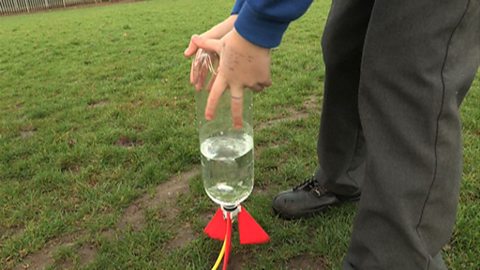
Experimenting propulsion with water rockets. video
Primary school children investigate the theory behind what makes the Bloodhound Supersonic car's rocket engine work, trying to make their water rockets travel the farthest.
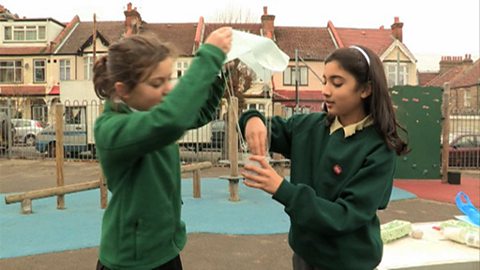
Harnessing air resistance with parachutes. video
Children from Links Primary School in London investigate harnessing air resistance in order to safely drop an egg, experimenting with different parachute designs.
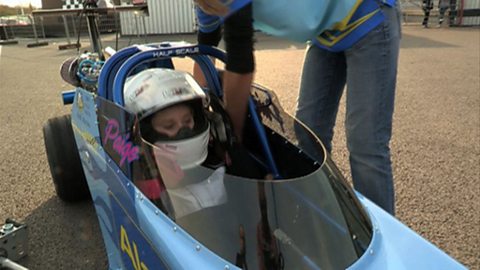
How air resistance slows down vehicles. video
Bloodhound Investigators find out how air resistance can be used to slow down vehicles. They also discover the importance of traction, drag and aerodynamics.
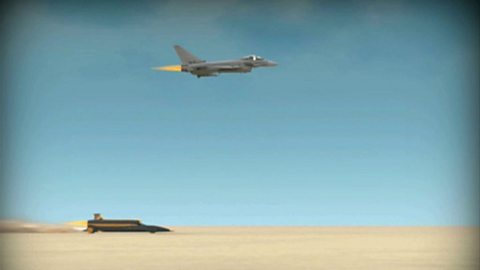
Investigating air and water resistance. video
Primary school children investigate which shapes travel fastest through water, to understand what is the best design for the Bloodhound Supersonic car.
Investigating friction. video
Dr Yan Wong and children from Links Primary School in London investigate friction by trying to separate two interleaved books.
Is the Bloodhound SSC a car, a boat or a plane? video
Bloodhound Investigators find out if Bloodhound SSC is a car, a boat or a plane. They compare and contrast features of each with input from members of the Bloodhound team.
Why doesn't Bloodhound have tyres? video
Primary school investigate why cars normally have tyres - even though Bloodhound SSC does not. They visit a race track to find out about grip and traction, and ride bikes to find out about comfort.
What makes a supersonic car move? video
Primary school children find out about the engines that will propel the Bloodhound Supersonic car to 1000 mph, a jet engine and a rocket engine.