Nowadays, miniature computersare everywhere,inside our tabletsand mobile phones.
This is a new generation computer,the size of a credit card.These tiny computersare what my hackers and Ihave come to see today.
I'm Lottie.
I'm Harry.
And this is Dave.Today, he's showing usthe exciting thingswe can do with a tiny computerand a bit of programming.
What is a Raspberry Pi?
It's a small computer, it's verycheap and it's very lightweight.
I thought it would beabout that big,but it's a lot smaller and it canstill fit everything you need.Some things you recogniseoff a normal computer,and there's other thingsyou've never seen beforebecause it's like on the inside,it's inside a computer.Because it's a fully functionalcomputer,you can programme it to doall sorts of amazing things,like building your own electronicsprojects.And because it's small,Dave and his friends have donesomething really cool.You might think these photoswere taken by satellite,but, actually, they were takenfrom this balloon.
Hanging from the balloon is a boxwhich contains an ordinary webcam,a sat nav tracker,a radio transmitterand, of course,the miniature computer,which Dave has programmedto snap the photosand then beam them back downto Earth.So this is what we havein the payload, as it's called,there's the webcamthat it takes photos with,and that's the aerial,so that dangles out the bottomof the box and that transmitssignals maybe 300, 500 miles away.
And how do you get the signals?
I've got a ten-metre polein the garden therewith an aerial up the top. Oh, wow!
'So Dave's connected the webcamand sat nav tracker as inputs'and the radio transmitteris the output.
'Now we know how it all works,'let's get the kitready for launch.'
Perfect, and then just slide in.
'The computer and webcamgo into the protective box,'and this will be hungunderneath the balloon.'
That's probably the biggestballoon you've ever seen.
'Dave fills the balloon with helium,just like a massive party balloon.'
It's attacking me.
SHE LAUGHS
'With Dave and his friends,we ease it up into the sky.'There's a balloon, a parachute,'our computer and a backuptransmitter'so we can find iteven if the computer goes wrong.'
Three, two, one!
THEY LAUGH
Bye-bye, balloon, see you later.
With the balloon launched,the webcam is alreadytaking pictures.Each picture is split upinto sectionswhich are transmitted piece by pieceover the radio transmitterback to Earth.
The photos look stunning,but the quality of the imageisn't very high.
The radio transmitter can send usthe photos from a long way away,but it's quite slow, so we can onlysend low-resolution pictures.
So, when I programme this, I haveto choose what size image to takeand how much to compress it downto a filethat takes not too long to send.So there's a compromisebetween a nice big imagethat's got lots of detailbut takes for ever to sendand then, a nice small imagethat we can send lots of.All of this only worksbecause Dave's written some programsfor the tiny computerwhich make everything work together.
So what does the code look like?
It just looks like somebody'srandomly done that.
Oh, yeah, that's how I buildmy programs.
It's not too bad actually.
One program tells the webcamto take the picturesand what resolution to take them at.This is written as a loopso the webcam keeps taking picturesone after another, every 30 seconds.Another program sends outputto the radio transmitter,transmitting the pictures to Earth.It also sends the positionfrom the sat nav tracker,so that Dave and his friendscan track the balloon.
With the balloon floatingup above Earth,Dave and his wife Julieset off to chase it.The program on the minicomputeris constantly transmittingits height and location,so we know exactly where it is.The balloon could land hundredsof kilometres away -it's even landed in the sea before.Let's hope that doesn't happentoday.
Meanwhile, back at Mission Control,with Dave's friend Anthony,we view the picturesas well as tracking the balloonand following Dave's progress.
OK, so those are just coming in now,those are slightly higherthan you would go in a plane.If you just go up a little bit,you see the sky's beginningto get dark. Yeah. Yeah.
And you're getting more and moreof the curvature of the Earth.
It's incredible, it's amazing.
I like that onebecause there's the sun,the Earth and the black of space.
Yeah, it's beautiful,it's gorgeous.
That's one of my favouritesbecause it's really bright.
Yeah. That's incredible.
It's amazing to think these photoswere takenby a computer the sizeof a credit cardfloating above the cloudsin a homemade box.
Dave even holds the recordfor the highest photographtaken by amateur equipment,nearly 40 kilometresabove the Earth.But today, our balloonis only travellingup to about 30 kilometres.That's still three times as highas a passenger plane flies.
Then, it bursts and starts itsdescent back to Earth by parachute.
OK, there it goes, it's just burst.
Oh, wow!
Looks like it's burst.
Oh, good,what altitude did it burst at?
30, 431.
30, 431. OK, that's good.
So Dave now knows,so he will go and track it down.
Yeah, he will have picked upin the car that it's burstand he will now be going.
'After about 30 minutes,the balloon lands back on Earth.'
So that's the field it's landed in.
'Once the height we're receivingstops going down,'we know the balloon's landed'and, of course, we also geta picture of the ground.'
Can we talk to Dave?
Yeah, absolutely, yeah,if you type in that box there,type in, "Dave, head up the M11."
We're heading left on the M11in a few miles. Excellent!
There's a road on the left there,so that's probably wherewe want Dave to get to.
As night falls,Dave pulls up in the field,but will he be ableto find the box in the dark?
There you go,so, how has it survived?
That looks pretty good,so almost completely intact,and that's what'sleft of the balloon.
TELEPHONE RINGS
Oh, there you go. Well, let's seewhere they're at. It's just moved.
Hiya, Dave.
Hey, Anthony, how are you doing?
Hey, excellent. 'I have some goodnews for you.'I am holding in my handa parachute, the full piece of latexand the Pi payload and buzz as well.
ALL: Yeah!
Superb!
'That's cool.'
They're quite pleased.
Very pleased, yeah.Speak to you soon.
'Thank you, bye-bye.'
Bye, cheers, bye.
This has been a record-breakingpiece of programming,and we've been able to takesome amazing pictures.
'By learning to program,'there's all sorts of thingswe can make possible,'whether it's creatinga game for our mobile phone'or doing something really coolwith a tiny computer.'The sky's the limit.
Video summary
Two young coders and science presenter Minna Kane meet an amateur photographer who uses a helium balloon to carry a Raspberry Pi computer, webcam and radio transmitter high enough to take pictures of the curve of the Earth.
Dave holds the world record for the highest photograph ever taken by an amateur, and shows the children how he’s programmed a tiny very basic Raspberry Pi computer to tell the webcam when to take photos, and the transmitter when to send them back to Earth.
They help him pack the hardware into a box with a GPS tracker, and attach it to a helium balloon that will carry the camera above the clouds.
He explains how the resolution of the pictures affects the amount of data the transmitter can send back, so he uses a lower resolution to get the pictures back quickly.
We see the looped code that tells the camera to take a photo every 30 seconds, the transmitter to send the image, and the GPS tracker to keep updating the location.
The program tells Dave when the balloon has burst, and the young coders help direct him to the field where his hardware has landed, using the GPS tracker.
This clip is from the series Cracking the Code.
Teacher Notes
Could be used as an illustration of designing and writing programs to accomplish specific goals.
It is also a good example of working with various forms of input and output.
This clip will be relevant for teaching Computing at KS1 and KS2 in England and Northern Ireland, Design and Technology KS2 in Wales and Computing Science and ICT at Second Level in Scotland.
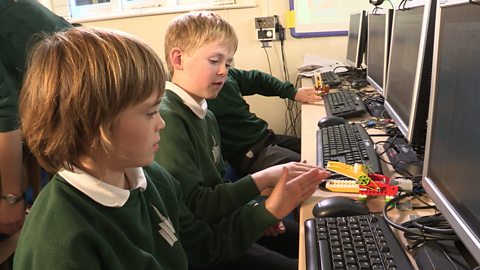
Computing KS1 / KS2: Programming a robot crocodile. video
A class builds a Lego crocodile and use Raspberry Pi computers and the Scratch programming language to make it snap its jaws!
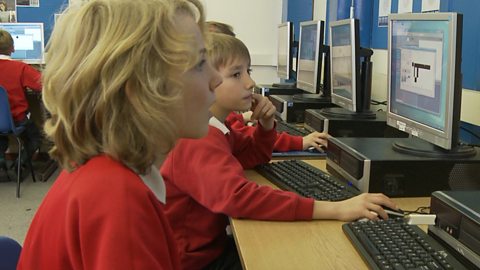
Computing KS1 / KS2: Creating a simple automated driving simulator. video
A car sprite is programmed to move around a racing track using repetition and selection.
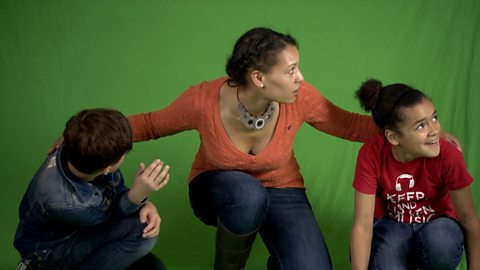
Computing KS1 / KS2: Creating computer generated visual effects. video
How visual effects in film and television use programs to control CGI behaviour.
Computing KS1 / KS2: Programming a computer game. video
Schoolchildren create their own simple games using on screen sprites.
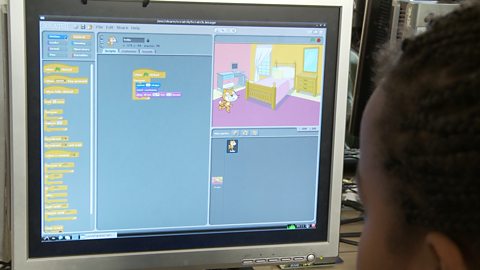
Computing KS1 / KS2: Programming a robotic toy car. video
A toy car is programmed to move between two locations on a town plan.
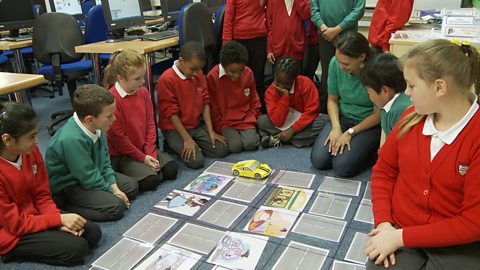
Computing KS1 / KS2: Programming robots to play football. video
How robots can be programmed to respond to what they see, by simplifying situations.
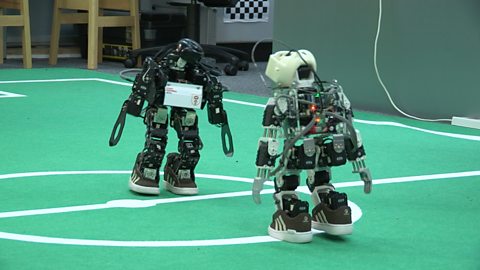
Computing KS1 / KS2: Simulating the experience of F1 racing. video
How realistic, computer-controlled racing simulators are used for training F1 drivers.
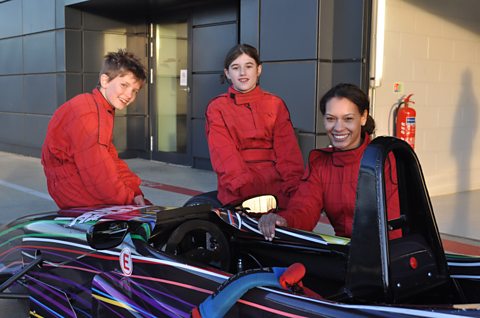
Computing KS1 / KS2: What are bitmap graphics? video
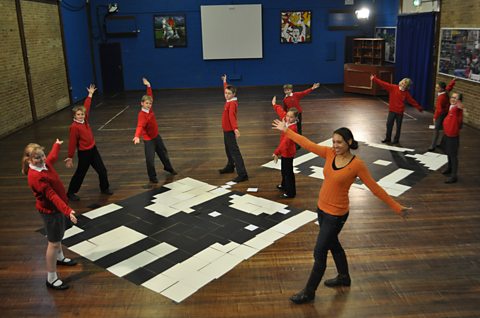
Schoolchildren create large bitmap images using black and white coloured squares.