Professor Robert Bartlett:
Plantagenet kings always looked to expand their territories beyond England.And Edward I was determined to spread his control across the British Isles.
Wales had troubled the Plantagenet kings for generations. Its rugged terrain made it hard to conquer and control. And they regarded its inhabitants as little more than barbarians.
But Edward I was a man who never gave up what he saw as his rights. And these included, in his eyes, overlordship of Wales.
But the Princes of Gwynedd, Llewelyn and his younger brother Dafydd, stood in his way. They had ruled here for centuries.
Edward’s father, Henry III, recognised Llewelyn as Prince of Wales, as long as he paid homage.But when Edward took the throne, Llewelyn refused.
Edward declared Llewelyn a “rebel and disturber of the peace”, and in 1277 set off westwards from Chester at the head of a powerful army of 800 knights, crossbowmen from Gascony and 16,000 infantry.
Edward’s army captured Anglesey, the bread basket of Wales. At a stroke this provided food for his own men and cut off supplies to the Welsh.
Llewelyn had no choice but to surrender and pay homage after all.An uneasy truce followed.
But it was broken when Dafydd ap Gruffudd led a new rebellion against English rule.For over a year, Edward’s army clashed with Welsh defenders. But in 1282, disaster struck for the Welsh dynasty. Llewelyn was killed in battle.
Dafydd ap Gruffudd held out here at Dolbadarn Castle for a few months more. Finally, he was captured and tried by the English.Wales was now a Plantagenet dominion.
Dafydd was executed. And to further stamp his authority, Edward built and repaired a chain of castles across Wales. These fortresses represent the peak of medieval castle-building.
It looked at one point as though Scotland would go the way of Wales, swallowed up by the English kingdom.When King Alexander III of Scotland died in 1286, he left no male heir.
The dead king’s three-year-old granddaughter, Margaret of Norway, was next in line for the throne. Edward decided that Margaret should marry his own infant son.
The situation would be resolved by diplomacy and marriage, not by war. And Britain would be united under the Plantagenets.It remains one of the great “what ifs” of British history. No marriage took place. Little Margaret died in Orkney, on her way to Scotland. And with her died Edward’s plan for a bloodless Plantagenet take-over of Scotland.
After the death of Margaret, Edward agreed to tolerate a subordinate King in Scotland: John Balliol. But as soon as he showed signs of independence…
Edward’s troops attacked Berwick and slaughtered its inhabitants.
After defeating a Scottish army at Dunbar, English garrisons and officials were installed across Scotland.But resistance to English rule grew, led by William Wallace.
Wallace was a proud and charismatic figure who refused to pay homage to Edward.To crush Wallace, the English army had to cross the River Forth at Stirling.
At this time, the bridge here was just wide enough for the English forces to cross two abreast. Once half the army had crossed, the Scots swooped down and cut off the bridge. The English stranded on the northern bank were surrounded.The result was slaughter.
Around 5,000 English infantrymen died at Stirling Bridge.The battle didn’t decide the issue, but Wallace’s defiance shook Edward I.The conquest of Scotland remained an obsession.The king was riding to confront another Scottish leader, Robert Bruce, when he died in 1307.Plantagenet determination to subdue Scotland was undiminished. But Edward II’s defeat by Robert Bruce at Bannockburn seven years later, set the limits to Plantagenet ambitions in Britain; they would never conquer the Scots.
And they provoked a deepening of Scottish national pride, and a sense of independence that survives to this day.
Video summary
Professor Robert Bartlett details Edward I’s expansionist designs on Wales, and his defeat of the two princes of Gwynedd, Llewellyn and Dafydd, in 1282.
Edward’s chain of castles to consolidate control over his new territory are shown on a map.
In Scotland, the failure of Edward’s plan to take control by exploiting the Scottish Succession Crisis is explained. His selection of John Balliol as a subordinate Scottish king, and subsequent invasion of Scotland when John showed independence is discussed.
We hear about strong Scottish resistance to English rule was, and the leadership qualities of William Wallace, with images of many of the Scottish borderlands where battles were fought.
The strategic use of Stirling Bridge by the Scots to defeat the English is shown in detail.
The role of the Plantaganets' failure to subdue the Scots in creating Scottish national identity is considered.
This clip is taken from the original BBC Two series, The Plantagenets.
Teacher Notes
This clip could be used together with a map of the English and Welsh border, to identify the location of castles.
Pupils could consider why they were located in those particular places and in such great quantity (e.g. for defensive reasons).
This could be used to create a 'balance sheet' of Edward’s contrasting fortunes in each country.
Pupils could identify specific reasons for success in Wales and failure in Scotland, then arrange them in priority of significance for the outcome.
This clip will be relevant for teaching history at KS4 / GCSE in England, Wales and Northern Ireland and National 4, National 5 and Higher in Scotland.
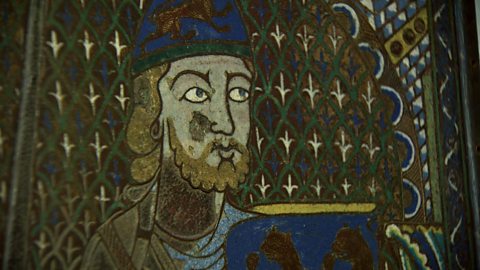
The rise of the Plantagenets. video
This clip explains how the marriage of Princess Matilda to a French duke founded the 331-year-long Plantaganet dynasty. Following a civil war with King Stephen, their son Henry II ruled vast lands in England and France.
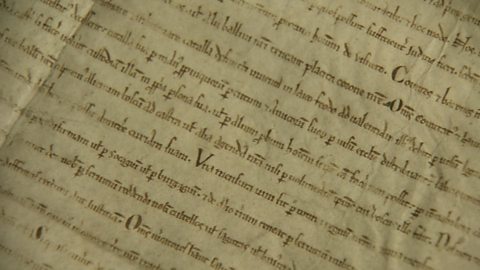
Magna Carta. video
Magna Carta is one of the most famous documents in British history. This clip explains how King John’s conflicts with his barons led to them demanding he sign a document limiting his absolute power.
The birth of parliament. video
This clip explains how De Montfort’s Parliament of 1265 laid the foundations for the two houses of our modern Parliament.
The Peasants' Revolt. video
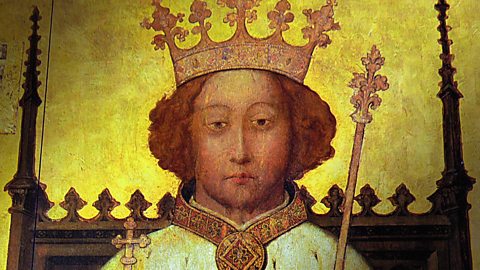
This clip explains how an unpopular new tax led to the greatest uprising in the history of Medieval England, the Peasants' Revolt of 1381, and how young Richard II defused it.
The fall of the Plantagenets. video
This clip explores the battle for supremacy between two branches of the Plantagenet family during the Wars of the Roses, and the events that led up to the death in battle of Richard III, the last Plantagenet king.