Professor Robert Bartlett:
Henry VI was a simple, pious king, and no warrior.
He lost all the territories in France his father, Henry V, had conquered. He also suffered from mental illness, which made him vulnerable.
By 1453 he was incapable of ruling.
Waiting in the wings was a cousin who thought he had a claim to the throne just as good as Henry VI’s and his young son.
Richard Duke of York argued he had a greater right to the crown because Henry VI’s grandfather, Henry of Lancaster, had seized the throne illegally.
But Henry’s wife, Margaret, struggled ferociously to maintain her son’s right to succeed.
The Houses of York and Lancaster were on a collision course.
The nobility was forced to take sides, many members of the leading families were killed and the power-struggle became ever more bitter, bloody and vengeful.
War raged across England, and after 5 years the Yorkists were gaining the upper hand…
But then, disaster….
In 1460, Richard Duke of York himself was killed in battle at Wakefield. His head cut off and displayed on the walls of York, wearing a paper crown - the only crown he ever wore.But the Yorkist torch was taken up by his son, Edward. Aged just 18, tall and handsome, he would prove to be a formidable warrior.After the Battle of Wakefield, he seized control of London, and had himself proclaimed king.
The battle to determine which Plantagenet was the rightful king took place here at Towton in Yorkshire.
In heavy snow, this would be the bloodiest battle ever fought on English soil.
The fighting lasted all day. The turning point coming as dusk fell.
Yorkist reinforcements arrived and attacked the Lancastrian flank.
The Lancastrians were pushed back and began to fall down the hill, panic stricken.
As they tumbled down the slope they found that they had to cross the river that runs at the foot of the hill through the woods.
The dead began to pile up in the river. The retreating Lancastrians were force to clamber over what one chronicler called “bridges of bodies”.
28,000 men were reported dead.
But Edward had won the crown of England
When Edward IV died 22 years later, his twelve-year old son was proclaimed Edward V.
But he was too young to take power… and the new king’s uncle, Richard, saw an opportunity to win the crown for himself.
Richard placed Edward and his younger brother in the Tower of London.
They were never seen again.
Richard III was crowned king, but his suspected murder of the young princes caused outrage.
Lancastrians and some Yorkists now chose to back Henry Tudor, a man with a flimsy claim to the English throne.Henry had been living in exile and had won the support of the French king.
He landed in Wales with thousands of French troops and marched east, gathering support along the way.
Richard and Henry’s armies clashed here near Bosworth in Leicestershire.
Richard’s army was far superior in numbers but the loyalty of his men was in doubt.
At first they seemed to be fighting half-heartedly.
But then Richard saw an opportunity to bring the battle to a swift end.
Richard caught sight of Henry Tudor surrounded by only a small retinue and he charged directly at him with a few loyal knights.
One of Richard’s most powerful nobles, Lord Stanley, was watching the battle unfold.
He commanded up to 5000 men but his allegiance was in doubt.
When he saw Richard isolated and vulnerable, he chose to back the Tudors…
and unleashed his troops upon the Plantagenet king.
The king was abandoned but he chose not to flee. The last Plantagenet monarch was cut down by a lethal blow to the head.
His corpse was stripped naked and paraded along the road to Leicester, where Richard was buried in a hastily dug grave.
The crown Richard wore into battle was discovered in the carnage at Bosworth…it was placed upon the head of the new King: Henry Tudor.
The Plantagenets, who had dominated England for 331 years, fell into oblivion.
Video summary
Professor Robert Bartlett details how the mental illness of Henry VI destabilised the Plantagenet dynasty, causing the House of York to claim a right to throne.
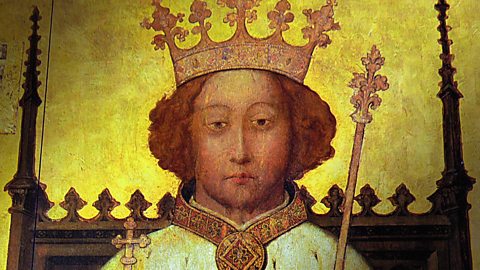
The key figures are shown in contemporary images, and the ensuing civil war and York’s defeat at the Battle of Wakefield in 1460 explored.
The character of Edward IV and his victory at Towton are explained in detail, using images of the modern-day battlefield.
The disappearance of the Princes in the Tower and their effect on Richard III’s reputation is discussed.
The events leading up to Henry Tudor’s unlikely victory at the Battle of Bosworth in 1485, including the key role of Lord Stanley, are explained from the site of the battle.
This clip is taken from the original BBC Two series, The Plantagenets.
Teacher Notes
After watching this clip, your pupils could create a cartoon strip charting the key events in the fall of the Plantagenet dynasty. Which ones do they find most significant?
Pupils could create a timeline of the key events in the Plantagenet dynasty’s fall.
They could then make sort-cards to arrange the key events into how significant they were for the Plantagenets' fall.
This clip will be relevant for teaching history at KS4 / GCSE in England, Wales and Northern Ireland and National 4, National 5 and Higher in Scotland.
The rise of the Plantagenets. video
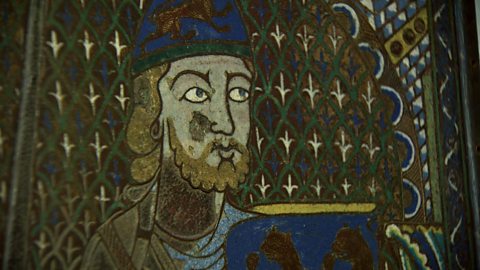
This clip explains how the marriage of Princess Matilda to a French duke founded the 331-year-long Plantaganet dynasty. Following a civil war with King Stephen, their son Henry II ruled vast lands in England and France.
Magna Carta. video
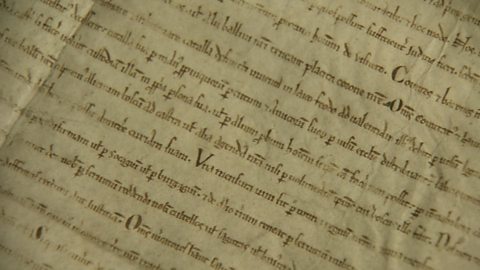
Magna Carta is one of the most famous documents in British history. This clip explains how King John’s conflicts with his barons led to them demanding he sign a document limiting his absolute power.
The birth of parliament. video
This clip explains how De Montfort’s Parliament of 1265 laid the foundations for the two houses of our modern Parliament.
Edward I, the Welsh and the Scots. video
This clip explores Edward I of England’s determination to take control of the whole of Britain, how he achieved this in Wales, but failed to do so in Scotland.
The Peasants' Revolt. video
This clip explains how an unpopular new tax led to the greatest uprising in the history of Medieval England, the Peasants' Revolt of 1381, and how young Richard II defused it.