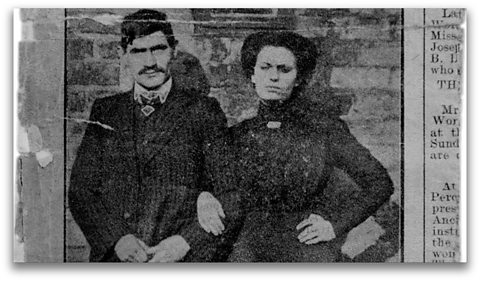
David:Between the 1500s and the 1900s Britain experienced successive waves of migration, both in and out of the country.But why did these mass movements of people take place. What was the experience of the migrants, and how did their comings and their goings affect this country and its people?
David:Half a million people now live in Liverpool, and it’s been estimated that three quarters of them have Irish ancestors. It was their hard manual labour that helped build Britain during the Industrial Revolution, producing most of the vital infrastructure; the very roads, railways and canals that still exist today.
David:During the Industrial Revolution, Ireland was under British rule, with much of the land owned by the British nobility, who, being mainly absentee landlords, rented it out in small, uneconomic plots to Irish tenant farmers.As a result, poverty was widespread, with Irish workers travelling to England for seasonal work on the harvests to supplement their income.
David:But at some point in the mid 1800s the move became permanent.
David: Now what are the factors behind that?One reason is that the potato, which was then the staple food of Ireland, can’t be stored year to year, the way rice or corn can be.
David:Now what that meant was that when, in the 1840s, a blight caused a series of failed potato harvests thousands of starving Irish tenant farmers had to leave and find new ways to feed themselves here in Britain.
David:Between 1846 and 1852, 1.3 million people sailed into Liverpool from Ireland, many of them ill and on the verge of starvation. And it wasn’t just the potato that brought them here… as I found out at Liverpool Central Library.
Sam Caslin:Many of the landlords in Ireland facilitate this emigration, so they buy land from some of the poorer people in order to give those people money to emigrate, or they may reduce rents on the understanding that the people are going to move out and emigrate.
Sam Caslin:Part of this is the landlord wanting to reduce the number of poor people living in the parish because with fewer poor people, the taxes are lower for the landlords.If you’d been in a workhouse for two years then you were eligible to have the parish help you come over to Liverpool. They did restrict it, so you had to be…, it was only for people who’d been in the workhouse for two years.
David:On arrival, most Irish people moved into run down ‘back to backs’ within yards of the docks.
Sam:They were very much, in terms of the Irish Catholics, confined to these working class areas in the north, right near the docks.
David:And what were the conditions like in these parts of the city?
Sam:We have these maps, which tell us about the conditions that people were living in at this time.
David:It’s colour coded…
Sam:Yep – red is the worst, read as pauper street, and then in pink we have semi pauper street, and this is where the Irish live in the city, and as you can see many of these streets are coded in red or pink.There’s a lot of court dwellings in this part of the city. The buildings that had cellars, those cellars would also be occupied – they would be the cheapest form of accommodation. You have many families sharing them and you have problems with damp - there might not be a window into the cellar.
Sam:They don’t have running water inside the houses either. So they’ll have a pump outside in the street. And so you have to go outside, you have to pump the water yourself and bring it back inYou get 12 families sharing a toilet.They would have had possibly an earth pit or something like that in them, so somebody would have had to empty the pit.
David:So you have thousands of people, many of them already weakened by a famine in Ireland living very very close together, in unhygienic conditions. What’s the result?
Sam:There are outbreaks of influenza, cholera. There is a typhus epidemic in 1847.The areas where we have these pink and red streets, these pockets of poverty, are the same areas where we get the deepest concentration of people dying from cholera.
David:How does the city begin to cope with the public health problems that’s going to cause?
SamYou get the Liverpool Sanitary Act, which comes in in 1846. And what this leads to, is in 1847, the city getting its first Municipal Department of Public Health. So the city is making a real effort to investigate conditions.This is a report from 1851, talking about cholera being apparently dependent on atmospheric influences.So they’re starting to think about how cholera is spread.
David:Because it’s a mystery in the middle of the 19th century - what the cause of cholera is?
Sam:Yes. There was a degree of blame that was attributed to the Irish. There was a lot of fear around Irish immigration. We also get a degree of resentment in Liverpool about the pressure that Irish emigration is putting on the city. So there’s a sense at the time that Liverpool is picking up the bill, really, for what is an Irish problem.As you get the spread of disease people start to ask questions about why the Irish are coming over, why the Irish aren’t staying in Ireland and being looked after there by their own, if you like.It means that there is a real tension around Irish immigration into Liverpool at this point.
David:The marriage of English working class culture and Irish culture has produced in Liverpool a city with a unique sensibility, something that was epitomised by the Beatles, Liverpool lads to the core, three of whom had Irish ancestors, so without Irish immigration we don’t get the Beatles.
Video summary
During the 1800s tens of thousands of poor Irish labourers and their families left Ireland to find work in Britain during the Industrial Revolution.
Large numbers came to, and settled in, Liverpool, and faced terrible conditions.
Cholera and other diseases spread and their arrival eventually promoted the beginning of the British public health system.
Historian David Olusoga visits Liverpool Public Record Office and meets local historian Sam Caslin, who is an expert on this period in Liverpool’s history.
This short film looks at the contribution of Irish migrants to Britain’s Industrial Revolution, and how this country owes much of its transport network and housing stock to their work here.
This short film is from the BBC series, Migration.
Teacher Notes
Key Stage 3:
This short film could lead to many different enquiries:
- The relationship between Britain and Ireland.
- The potato famine.
- Housing conditions.
It offers an opportunity to look at the British Industrial Revolution through the lives of people who built its transport networks and worked its machines.
Students could do a photo essay in the area around their home or school, showing every aspect of their built environment that willhave been created by 19th century labourers, many of them probably Irish.
In the film, local historian Sam Caslin shows how much can be learnt from a range of documents: mortality map, register of deaths, public health report, sanitation law, photos, etc.
If there is access to similar documents for the school’s locality then an enquiry into Victorian conditions can be built around them.
Key Stage 4:
This short film covers three key themes:
- The reasons why Irish people migrated.
- Their experiences in Liverpool.
- Their impact on Britain.
Students could create diagrams or posters, make presentations or write using the film’s handling of these themes as a starting point.
In the film some reasons are explained for growing resentment against Irish immigration, these could be compared with other periods:
- Antagonism to medieval Flemings.
- Early or mid 20th century Jews.
- Commonwealth immigrants.
The focus in the film on ancestry could encourage students to find out about their own family histories and stories of migration.
The film is equally useful for a study of public health in industrial Britain: stills of the rich supply of photos of conditions in Liverpool court dwellings could be used for discussion of housing and sanitation conditions.
Sam Caslin shows a ‘poverty map’ of Liverpool and there may be a similar 19th century map of the school’s locality (e.g. Booth’s maps of London), that students can investigate.
This short film is suitable for teaching history at KS3 and KS4/GCSE in England, Wales and Northern Ireland and Fourth Level and National 4 and 5 in Scotland.
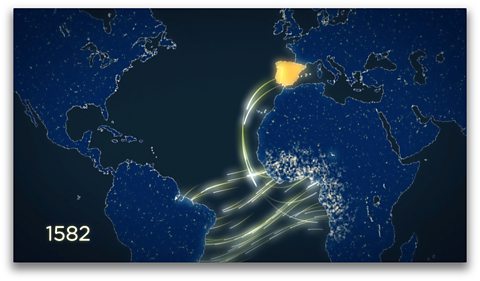
The story of black migrants in Tudor England. video
David Olusoga investigates the lives of the hundreds of black people living in England in the 1500s.
The story of the Palatines who migrated to Britain in the 1700s. video
The story of the Palatine migrants in the 18th century, who were housed in what’s believed to be the world’s first refugee camp.
Black people in Britain during the Atlantic slave trade era. video
An exploration of the lives of Black migrants in Britain during the Atlantic slave trade.
The story of British indentured workers emigrating to America. video
A look at the British indentured labourers sent to work in the new colonies of the United States between 1610 and 1776.
How British migrants made fortunes working for the East India Company. video
The story of wealth accumulated by British migrants working with the East India Company, which they used to climb the social ladder.
Jewish migration to Manchester in the late 1800s. video
A look at the impact of Jewish migration in the late 1800s on Britain and on immigration law.