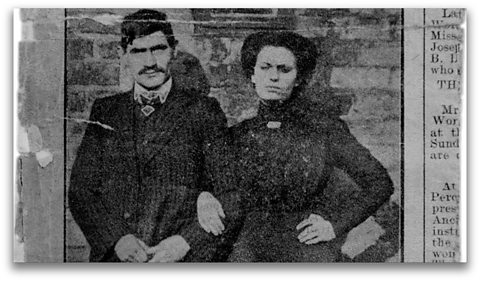
David:Between the 1500s and the 1900s Britain experienced successive waves of migration, both in and out of the country.But why did these mass movements of people take place? What was the experience of the migrants and how did their comings and their goings affect this country and its people?
David:The history of British migration is one of people leaving or being sent from these islands, as well as arriving.
David:Four hundred years ago all manner of children, teenagers, and young men and women, mainly from the poorest families were sent, often against their will, to board ships leaving from here in the Bristol Channel and into the Atlantic Ocean.
David:They were being sent across the oceans to meet the growing demand for cheap labour in Britain’s newly created colonies in north America.
David:From 1610 to American independence in 1776, half a million people left Britain for north America. Some were political and religious dissenters, like the Puritans and the Quakers and the Irish and Scottish Presbyterians. And some were convicts, sent by the British government to clear out its overcrowded prisons. But around half - that’s a quarter of a million - were indentured servants.
David:I went to Bristol Record Office to find out more.
David:The driving force behind this was a commercial company, started in the City of London, called the Virginia Company.
Don Jordan:It as mainly a group of very wealthy merchants in the City of London who had this idea to come together to create a company that would actually create money out of new colonies abroad.There was a huge amount of money to be made if you include control labour costs. They target the poor because they’re the people who can come and work for nothing.
Don:The conditions that they were kept in and worked in were incredibly brutal and some of them were worked to death. And even if you had a very good owner, your life was not your own. They were completely owned by another person.
Don:They had a contract system. You and I would make a contract together we both sign it, we tear it in two, and you keep one half and I keep the other and the jagged line down the middle is the indenture. And so these people became known as indentured servants.
David:The contract specified the amount of time the individual would be expected to work for their keep, and for no wage, in order to repay the cost of their passage to America. Once the period specified in the contract was over, the indentured servant would be free to find work elsewhere.
Don:Take this one here, it’s dates 1618 and what we see is that 15 year old Thomas Harrison of Leeds, in the county of York, he has agreed to be indentured to John Dykes of London, who is a ‘vichiler’*. And he’s made a squiggly circle here, his mark. He obviously can’t read or write.
Don:Here’s George Dixon, he’s only 12.
David:How many years is he going for?
Don:And he’s going for 9 years. From 1618 onwards children were rounded up and they were shipped off to America.
David:Back in Britain, it’s becoming a problem isn’t it?
Don:It does become a problem and we can see this because here we have an act of parliament from 1645 and they’re passing a law that makes it a crime to steal, sell, buy, inveigle, purloin or convey any little children and for the strict and diligent search of all ships and other vessels.
David:Did this act of parliament, to end the abduction, did it work?
Don:Well sadly, it didn’t, people ignored parliament and the people who take them away, the kidnappers, have a wonderful name, they are called ‘Spirits’ because they spirit people away. The spirits hang around at the docksides in major seaports.
And here we have in Bristol, local ordinance mention the cases of boys and maids being spirited away and this is 1654, nine nearly ten years after parliament passed a law saying ‘no more of this. We can’t have any more of it’. Here we have it still going on.
Don:As soon as they got off the ship they would stand in a big row, on the quayside, where they would be sold, literally like cattle. The rich farmers would come down, they’d say “you, you and you” or they would say “we’ll take that batch of ten or that batch of ten” and they would pay either the agent who paid for their transportation across the Atlantic or the ships captain who sometimes was the person to whom they were indented. They would be paid money.
David:How good a deal was it for the people who signed indentured forms?
Don:It was a much better deal for the person who was buying the worker than it was for the worker. It would cost you somewhere between 6-9 pounds to pay for a passage across the Atlantic to Virginia.
Don:It’s been worked out by some historians and people who have looked at the costs of running a plantation in the mid 1600s, that a worker could earn anything from 100 up to 200 – 250 pounds in a short period of time for their master. So you didn’t really have to work for 4 years or 5 yeas or 6 years to pay off your passage, you only really had to work for less than a year. After a few months it was all profit. Was that a fair system?
David:Today Americans like to think of their country as the “land of the free” – but the majority of those early migrants, on board those ships, children and teenagers among them, were certainly not free.
Video summary
Four hundred years ago all manner of children, teenagers, and young men and women, mainly from the poorest families, were sent, often against their will, to board ships leaving from Bristol across the Irish Sea, and into the Atlantic Ocean.
They were sent to meet the growing demand for cheap labour in Britain’s newly created colonies in North America.
From 1610 to American independence in 1776, half a million people left Britain for North America.
Some were political and religious dissenters, like the Puritans, Quakers and the Irish and Scottish Presbyterians.
And some were convicts, sent by the British government to clear out its overcrowded prisons.
But around half - that’s a quarter of a million - were indentured servants.
And most were sent against their will.
In this short film David Olusoga meets writer Don Jordan, who tells the stories of some of these young people.
This short film is from the BBC series, Migration.
Teacher Notes
Key Stage 3:
This story allows students to see that the plantation system exploited poor white as well as Black labour.
Students could look at where the indentured labourers ended up.
Students could look at the similarities and differences between indentured labour and chattel slavery.
Comparisons are possible with the forced emigration of British children to Canada and Australia in the 20th century and child trafficking today.
Key Stage 4:
Students could study various indenture contracts (available by searching online) and use them to build up an idea of the people involved.
Were they religious or political refugees, convicts, those who chose indenture in the hope of a better life when they were later freed, or kidnapped children forced into a form of slavery?
This could lead into a study of plantation life in North America and the Caribbean.
Don Jordan describes the system as being about profit.
The experiences of indentured servants and enslaved Africans, often working on the same plantations, could be compared:
- How were they similar, and how different?
- Or the focus could be back in Britain: what were the conditions forcing many to leave and leaving others vulnerable to kidnap?
This short film is suitable for teaching history at KS3 and KS4/GCSE in England, Wales and Northern Ireland and Fourth Level and National 4 and 5 in Scotland.
The story of black migrants in Tudor England. video
David Olusoga investigates the lives of the hundreds of black people living in England in the 1500s.
The story of the Palatines who migrated to Britain in the 1700s. video
The story of the Palatine migrants in the 18th century, who were housed in what’s believed to be the world’s first refugee camp.
Black people in Britain during the Atlantic slave trade era. video
An exploration of the lives of Black migrants in Britain during the Atlantic slave trade.
How British migrants made fortunes working for the East India Company. video
The story of wealth accumulated by British migrants working with the East India Company, which they used to climb the social ladder.
The Irish migrants who moved to Liverpool during the Industrial Revolution. video
Why thousands of Irish migrants came to Liverpool during the Industrial Revolution.
Jewish migration to Manchester in the late 1800s. video
A look at the impact of Jewish migration in the late 1800s on Britain and on immigration law.