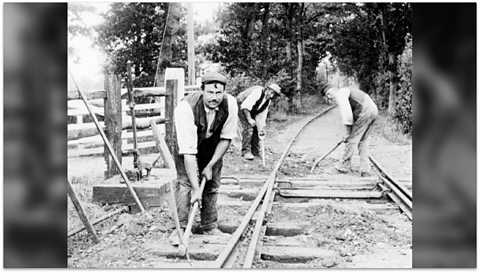
David Olusoga (VO):Between the 1500s and the 1900s, Britain experienced successive waves of migration, both in and out of the country.
But why did these mass movements of people take place? What was the experience of the migrants? And how did their comings and goings affect this country and its people?
David (VO):Manchester and the industrial manufacturing towns surrounding it, acted as a magnet for waves of economic migrants, not just from Ireland and Europe but from all over the world.
David:In the late 1800s and early 1900s, 30,000 Jewish migrants, from Russia and Eastern Europe settled in Manchester, around these streets in the Cheetham Hill area of the city. I’m here to meet two people whose ancestors were part of that migration.
Janice Haber:This is the wedding photograph of my grandparents.
David: What year is this?
Janice Haber: This is 1911.
David: So tell me about their story.
Janice: They were both born in Romania in a little village called Botoshan. They weren’t able to get married in Romania because in those days it was the custom that they couldn’t get married until their older siblings were married as well. And so my grandfather took it on himself to come over to England. He wrote to her to say, I’ll send to you when I am ready, when I am established. And her family let her go but with her elder brothers. She came overland by train, through Romania through Germany to Holland and crossed the North Sea to Grimsby.
David: This was a family moving across continents for love.
Janice: Yes
David: But that is quite unusual for what’s happening to Jewish migrants in Europe in these years Ruth isn’t it?
Dr. Ruth Percy: Very much so. The Jewish migrants, most of them, the push factor is escaping from violence, or escaping from economic hardship and wanting more opportunities. Beginning in 1791, Catherine the Great established this area in the western part of the Russian empire, the Pale of Settlement, present day Ukraine and Poland and the Baltic States. And that was intentionally to remove Jews from other bits of the Russian empire and to put them into this Jewish residential zone because there is a real push to convert them to Christianity which they’re resistant to, so we’ll remove them from that area. And it’s a massive density of Jews living there. About 40% of the world’s Jewish population at the time are living in this area. But they’re also very much restricted while they are in this area. That they are not allowed to move freely throughout. They are limited in the sorts of jobs that they can do. And then there also moments of violence. So 1881 to 1883 and then again in the early 20th century, we see these pogroms. So these are violent attacks, lots of injuries and lots of destruction of property pushing people to leave Eastern Europe and to come to Western Europe and then of course also to cross over to the Americas.
David (VO): At this same time, migrants like the Jews were being drawn by the north of England’s booming economy, at the centre of Britain’s Industrial Revolution.
David: What happens to your grandmother and her brothers?
Janice: At the port of Grimsby they were apprehended because the authorities thought that the two brothers were taking her across to America as part of the white slave trade. There was a Jewish solicitor called Mr. Woolf who was the solicitor for the port of Grimsby. He spoke to the authorities on their behalf. And my grandmother and my grandfather had to be married within the month. But the brothers had to go back.
David: And today we’d call that people trafficking?
Ruth: Yes. The idea of White Slave Trade was well-known – particular concerns about young girls, teenagers, being taken away from their families, being sold, being bought, being stolen and then being forced to become prostitutes. There was an infamous case after a journalist had gone and bought a young girl from a working class neighbourhood in London to prove how easy it was and what a problem this was and to expose problems of slumming and things like this.
David: What were the concerns of people in Britain to the numbers of Jewish immigrants arriving in the country?
Ruth: Because of industrialisation, a number of increasing pressures put on particularly urban areas across the country. Pressures that come with that in terms of poverty, in terms of illiteracy. And the Boer war that runs from 1899 to 1902 really brought this to the public eye because 40% of recruits were turned away because they did not meet the basic medical requirements of the army. They were not fit enough and this is because they are living in slums and not getting enough healthy food. There’s already these pressures on these urban areas which is where migrants tend to come, and that adding more people into the slum areas of cities like Birmingham or Manchester or London is only going to make the situation worse.
David (VO): Politicians and right wing newspapers exploited these economic concerns, stoking up racist xenophobia against migrants like the Jews, which would become familiar throughout the 1900s.
Ruth: I think that what government is concerned about is social stability, that you may have riots, you may have people refusing to pay rent. You may have riots over food. You may have anti-immigration riots. The big thing that we see change in the early 20th century is that we get the introduction of the 1905 Alien Immigration Act. And that is essentially the birthplace of modern immigration regulations. It doesn’t say anything about Jewish immigrants at all in the legislation but the undertones are that it is to restrict these eastern European Jews coming in.
David: So you’re the great, great granddaughter of your ancestors who arrived at Grimsby dock? How do you feel about this?
Tali: Yeah. I find it really interesting how far back my generation goes and how interesting their life was.
David: Do you think if it hadn’t been for the fact that the solicitor at the port of Grimsby happened to be Jewish you maybe not be here?
Janice: Yes its very very likely. Other members of the family such as the sister of my grandmother perished in the Holocaust. This was Shifra. So…
David: So that moment at Grimsby dock…
Janice: …was pivotal
David: The arrival and assimilation of tens of thousands of Jewish migrants has had a real impact on British society – they’ve made significant contributions to politics, economics, science, medicine and the arts. But their arrival here led to changes in the law, to the emergence of modern immigration laws – laws that persist to this day.
Video summary
Contains scenes which some viewers may find upsetting. Discussion of racism, xenophobia and slavery could raise emotive issues around racism and discrimination. Teacher review is recommended prior to use in class.
In this short film for secondary schools historian David Olusoga visits Manchester which, along with the other industrial manufacturing towns surrounding it, acted as a magnet for waves of economic migrants from all over the world.
In the late 1800's and early 1900’s, 30,000 Jewish migrants from Russia and Eastern Europe settled in Manchester.
David Olusoga meets Janice Haber and her family, the descendents of Jewish migrants, and talks to historian Ruth Percy who describes how Conservative politicians and right wing newspapers of the time exploited economic concerns associated with the new migrants, stoking up racist xenophobia against migrants like the Jews, which would become familiar throughout the 1900’s.
The arrival of the Jews and other migrants led to changes in the law, and to the emergence of modern immigration legislation – laws that persist to this day.
This short film is from the BBC series, Migration.
Teacher Notes
Key Stage 3:
This short film has as its heart a strong family story with an element of luck.
Janice’s ancestors made it because of a helpful Jewish solicitor in Grimsby: if they were asylum seekers today, would they be admitted?
The great great granddaughter is asked how she feels about her ancestry - a good starting point for discussion about the value of family history, and for students to investigate their own.
The reference to the Holocaust could be a starting point for an enquiry into the history of Jewish migration and anti-Semitism in England, as a contextual prelude to study of the Holocaust.
Key Stage 4:
This short film illustrates through one family’s story key themes in the 20th and 21st century history of migration:
- Firstly, people coming as refugees seeking safety and finding success and opportunity, often in business, so that they have a marked impact on the country: individual success stories in business, the arts and sciences could be researched.
- Secondly, pressures from poverty and overcrowding led to resentment against immigrants: there are links back, for example, to 19th century Irish immigrants, and forward to the present.
- Thirdly, increasing immigration controls fuelled by xenophobia, often stirred up in the media: students could compare the British Brothers League poster with current anti-immigration headlines.
Students could create a poster with Janice Haber’s family (or another from another period), at the centre and arrows pointing out to all the key themes that the family story links to.
Towards the end Janice reveals that a relative died in the Holocaust, prompting a ‘what if?’ question which could be applied to many migrations - Huguenot, East African, Asian, etc.
This short film is suitable for teaching history at KS3 and KS4/GCSE in England, Wales and Northern Ireland and Fourth Level and National 4 and 5 in Scotland.
The story of black migrants in Tudor England. video
David Olusoga investigates the lives of the hundreds of black people living in England in the 1500s.
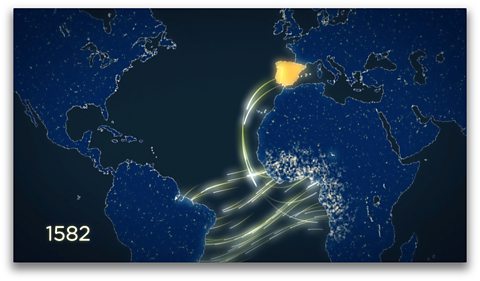
The story of the Palatines who migrated to Britain in the 1700s. video
The story of the Palatine migrants in the 18th century, who were housed in what’s believed to be the world’s first refugee camp.
Black people in Britain during the Atlantic slave trade era. video
An exploration of the lives of Black migrants in Britain during the Atlantic slave trade.
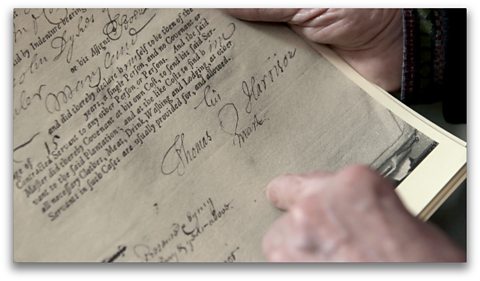
The story of British indentured workers emigrating to America. video
A look at the British indentured labourers sent to work in the new colonies of the United States between 1610 and 1776.
How British migrants made fortunes working for the East India Company. video
The story of wealth accumulated by British migrants working with the East India Company, which they used to climb the social ladder.
The Irish migrants who moved to Liverpool during the Industrial Revolution. video
Why thousands of Irish migrants came to Liverpool during the Industrial Revolution.