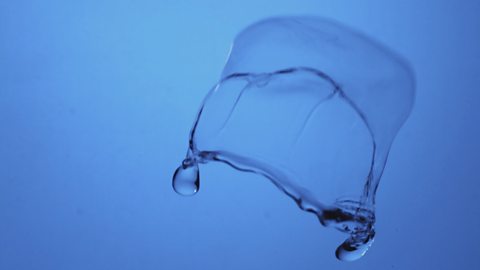
What is wind?
NARRATION: Wherever you live on the planet, weather shapes your world. Yet for most of us, how it works is a mystery. So, I’m going to strip weather back to basics - uncovering it’s secrets in a series of brave, ambitious and sometimes just plain unlikely experiments. To show you weather like you’ve never seen it before.
RICHARD: What is wind? Sounds a simple question doesn’t it? But how does a wind actually start? To find out I’m visiting a place said to have the worst weather in the world. This is Mount Washington in New Hampshire, USA. And it’s perfect for the experiment I’ve got in mind.
TO CAMERA: Well, we are now at the summit. You’re going to have to trust me cos you can’t see much through there, but through the cloud, and the snow, and the howling winds, this is the top of Mount Washington. [INDICATING LONG TUBE] Now, you might have been wondering what this was all about when we set off. I know some of the crew were. Well, what I’ve done in this device, hopefully, is I have caught some wind. There was nothing in it when we set off I just closed the valve - there is now wind in there.
I’m going to release it shortly, and what I’m hoping is that as the wind rushes out that I’ve caught in there it’ll move these little filaments here so that we can actually see it. This all seemed like such a good idea when we came up with it. Got one go at this… Right - here we go. [RELEASES VALVE.] Did you hear that? And I saw it as well. That was wind - and it was, it’s the basis of wind anyway. Because when this was down at the bottom of the mountain the air pressure around and inside this tube was higher than it is up here at the top. So, I shut the valve, captured that higher pressure air in there came up here opened the valve and thehigh-pressure air rushes out to the low pressure. [HISS.]
NARRATION: The height of Mount Washington is enough to create a pressure difference. And pressure differences of various kinds are what create winds.
How to use wind to forecast the weather
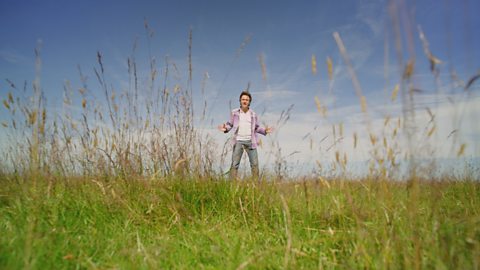
TO CAMERA: Right, here’s how to amaze your friends. First, stand with the wind at your back. Then you’re looking for clouds.If those clouds are moving overhead, directly away from me, or directly towards you, or they’re stationary, then the weather is going to stay broadly the same.
If they’re moving from left to right, it’s going to get worse. If they’re moving from right to left, it’s going to improve.
NARRATION: So… Right to left, better. Left to right, worse. Straight down the middle, stays the same. As long as you have your back to the wind.
TO CAMERA: Unless you’re in the Southern Hemisphere, in which case you reverse that bit. Brilliant, isn’t it?
Download/print a pdf of the video.
Richard Hammond demonstrates how wind is created by differences in air pressure.
He begins by collecting a sample of air inside a sealed tube, transporting it to the top of Mount Washington. Mount Washington is said to have the worst weather in the world, with some of the highest wind speeds ever recorded: 231mph.
At the summit of the mountain – Richard explains that air taken at sea level has a higher pressure than at the top of the mountain. Wind is created when there is a pressure difference.
Teacher Notes
Key Stage 3
This short film could be useful in providing a simple explanation of how wind is formed, and could be used when introducing the concept of air pressure.
You could pause the clip halfway through and ask your students to predict what will happen when Richard releases the air collected. Were their predictions correct? Why did they make that prediction?
Key Stage 4
This short film could be useful when revising the concept of air pressure. Students could be asked to predict what will happen when Richard releases the air collected at sea level.
They could apply their knowledge of pressure changes and discuss what they think would happen in groups.
Curriculum Notes
This short film could be used to teach geography and physics at KS3 and KS4 in England, Wales and Northern Ireland and National 5 in Scotland.
At GCSE it appears in AQA, OCR A, EDEXCEL, EDUQAS, WJEC and CCEA, in SQA at National 5.
More from Richard Hammond's Wild Weather
How can you cool a drink using the sun? video
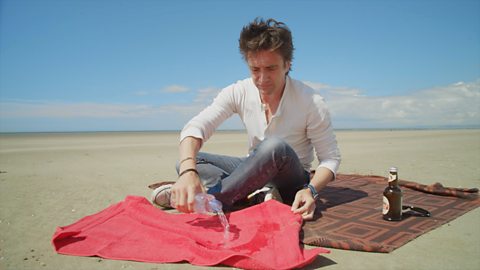
Richard Hammond uses a beach, a towel, water and a drink to demonstrate how evaporation can be used to cool liquid.
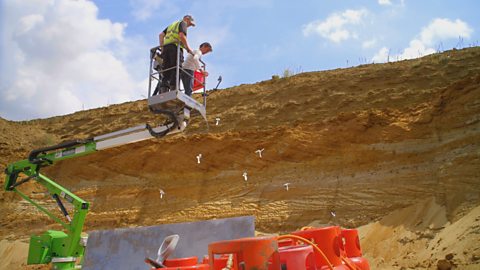
How does a thermal form? video
Richard Hammond demonstrates how thermals are formed through heat from the sun.
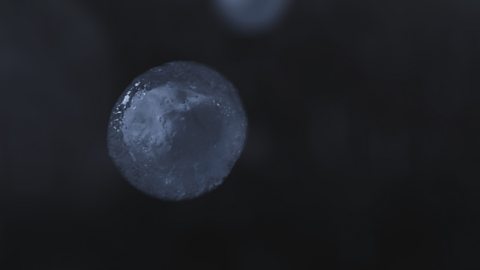
How does hail form? video
Richard Hammond explores the weather conditions that form hail.
How to see thunder. video
Richard Hammond visits Lightning Testing and Consultancy in Oxfordshire to take part in laboratory experiments that demonstrate the effect of thunder within controlled conditions.
How to use wind to forecast the weather. video
Richard Hammond demonstrates how we can forecast the weather simply by watching the way the wind effects the clouds.
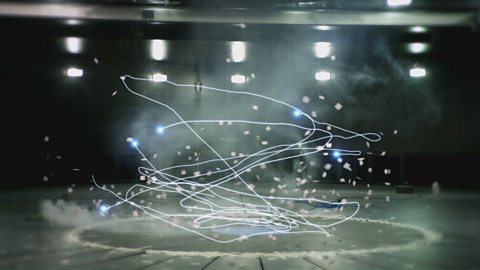
Inside a tornado. video
Richard Hammond explores the properties of a tornado that has been created in laboratory conditions.
What is the difference between rain and drizzle? video
Richard Hammond demonstrates a visual technique to distinguish between drizzle and rain.
Why does water fall as rain? video
Richard Hammond demonstrates the effect of water on other physical objects.