How to see thunder
NARRATION: Wherever you live on the planet weather shapes your world. Yet for most of us how it works is a mystery. So, I’m going to strip weather back to basics, uncovering its secrets in a series of brave ambitious and sometimes just plain unlikely experiments - to show you weather like you’ve never seen it before.
For most of us the only extreme weather we’re likely to encounter is thunder and lightning. We’ve all heard thunder and seen lightning, but believe it or not it’s actually possible to see thunder too.
To find out more I’m visiting one of the few places in the world capable of creating full-blown thunder indoors. They do it by firing 200,000 amps of electrical current down this narrow copper wire. Exactly the same amount as in real lightning.
RICHARD: So this is it, this is where it’s all controlled?
DAN MORGAN: Yep, so you’ll need a pair of these.
RICHARD: Will I?
DAN: As it’s going to be quite loud.
RICHARD: Is it?
DAN: As we’re going to be producing thunder.
RICHARD: OK.
DAN: So don’t look directly at the arc because it’s very bright.
RICHARD: Right, so I’ve come quite a long way to see something that I can’t look at or listen to.
DAN: Pretty much!
RICHARD: Good, OK, brilliant.
DAN: So now we can see the voltage on the capacitors.
RICHARD: Oh, yeah! So essentially this is going to build up a colossal charge and then discharge it?
DAN: Yeah.
RICHARD: Dan?
DAN: Yeah.
RICHARD: I can hear what you’re saying.
DAN: Yeah, when the shot goes through you might want to put your hands over the defenders too as it’s quite loud.
RICHARD: Shall I just cower under the table? I don’t mind.
DAN: Or you could cower under the table.
RICHARD: Right it says 25.
DAN: Yeah we’re nearly there. OK, we’re ready so we can fire.
RICHARD: But I can’t look?
DAN: Yeah, we can’t look.
RICHARD: Or listen. I imagine … BANG! Oh-ho! That, in fact, was quite staggeringly loud.
DAN: Yeah.
RICHARD: I mean really amazingly loud.
DAN: Yeah.
RICHARD: So, was that thunder or was it just, sort of, the discharge of the electricity leaving and arriving?
DAN: No, that was thunder.
NARRATION: But it still doesn’t explain how we might see thunder. Luckily Dan has a way to show us … using slow-motion cameras and a line of lit candles. [ALARM BEEPS, ALARM BLARES, BANG!] The candles are all blown out. And if you watch carefully, you can see that they’re blown out one by one. So what is going on? Well, it’s all to do with temperature.
TO CAMERA: A typical bolt of lightning is somewhere between two and five centimetres wide so something close to that. These by the way are not for style reasons they’re for protection because effectively I’m taking a shaft of sunlight as wide as this screen and focusing it down to something roughly the size of a bolt of lightning. It is hot but it’s nothing compared with lightning. A typical bolt will reach 20 000 degrees Celsius - that’s well over three times the temperature of the surface of the sun itself. Thankfully it only lasts for about one ten-thousandth of a second, but that’s still enough for something quite amazing to happen.
NARRATION: Because lightning is so ferociously hot it explodes the air around it…causing it to rush outwards. What we see with the candles is that air moving away from the lightning bolt in a shock wave. But just how powerful is this wave? Time for another experiment. Can thunder break these glass light bulbs?
DAN: One way to find out.
RICHARD: Zap ‘em!
DAN: Yes.
NARRATION: The thunder blows them apart. And it’s so dramatic that I want to watch it again in slow motion.
RICHARD: I really want to see this one cos I still can’t believe it was strong enough. That’s a heck of a wave!
NARRATION: Notice it’s not the lightning destroying the light bulbs. The arc never even touches them. It’s the shock wave after the flash that does the damage. But I want to see more.
TO CAMERA: What we’ve been looking at impressive though it is is the effect of thunder. I want to look at the thunder itself.
NARRATION: With very specialised cameras we can actually attempt to capture that shock wave on screen. Not the effects, but the actual shock wave itself.
RICHARD: That’s fantastic, that’s absolutely brilliant!
NARRATION: That is the air exploding away from the hot lightning bolt at over 700 mph.
RICHARD: I think we can count that one a definite success.
NARRATION: So it is possible to see thunder. And if you’re unlucky enough to be stood near … you can feel it too.
Download/print a pdf of the video.
Richard Hammond visits Lightning Testing and Consultancy in Oxfordshire to take part in laboratory experiments that demonstrate the effect of thunder within controlled conditions.
There are four stages to the demonstration. The first is a test firing of the experiment, where the volume of the thunder can be heard.
Next, a series of candles and slow motion cameras are used to show how thunder’s shock wave travels, extinguishing the candles. An explanation of how temperature differences cause thunder is given outside using a lens and wood.
A typical bolt of lightning will reach 20,000 degrees Celsius. Because of this heat, the air around it expands into a shock wave.
A third iteration of the demonstration sees thunder breaking light-bulbs, and slow motion allows viewers to distinguish between the shock wave (thunder) and the lighting.
The final demonstration allows the shock wave itself to be seen.
Teacher Notes
This short film provides useful background information for KS3 classes studying storms. For KS4 / GCSE physics, this short film can form an introduction to forces, where students can consider experiment design and the practical application of laboratory science.
Curriculum Notes
This topic appears in geography and physics at KS3 and KS4 in England, Wales and Northern Ireland and National 5 in Scotland. At GCSE it appears in AQA, OCR A, EDEXCEL, EDUQAS, WJEC and CCEA, in SQA at National 5.
More from Richard Hammond's Wild Weather
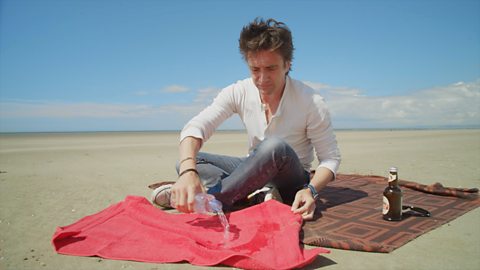
How can you cool a drink using the sun? video
Richard Hammond uses a beach, a towel, water and a drink to demonstrate how evaporation can be used to cool liquid.
How does a thermal form? video
Richard Hammond demonstrates how thermals are formed through heat from the sun.

How does hail form? video
Richard Hammond explores the weather conditions that form hail.

How to use wind to forecast the weather. video
Richard Hammond demonstrates how we can forecast the weather simply by watching the way the wind effects the clouds.

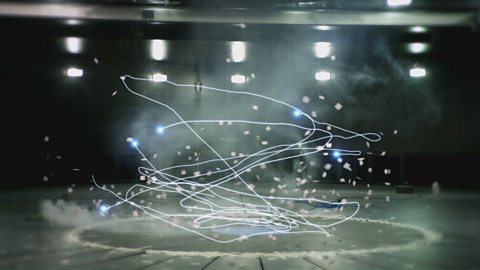
Inside a tornado. video
Richard Hammond explores the properties of a tornado that has been created in laboratory conditions.
What is the difference between rain and drizzle? video
Richard Hammond demonstrates a visual technique to distinguish between drizzle and rain.
What is wind? video
Richard Hammond demonstrates how wind is created due to differences in air pressure.
Why does water fall as rain? video
Richard Hammond demonstrates the effect of water on other physical objects.